 sales@doomshell.com
 +91 8005523567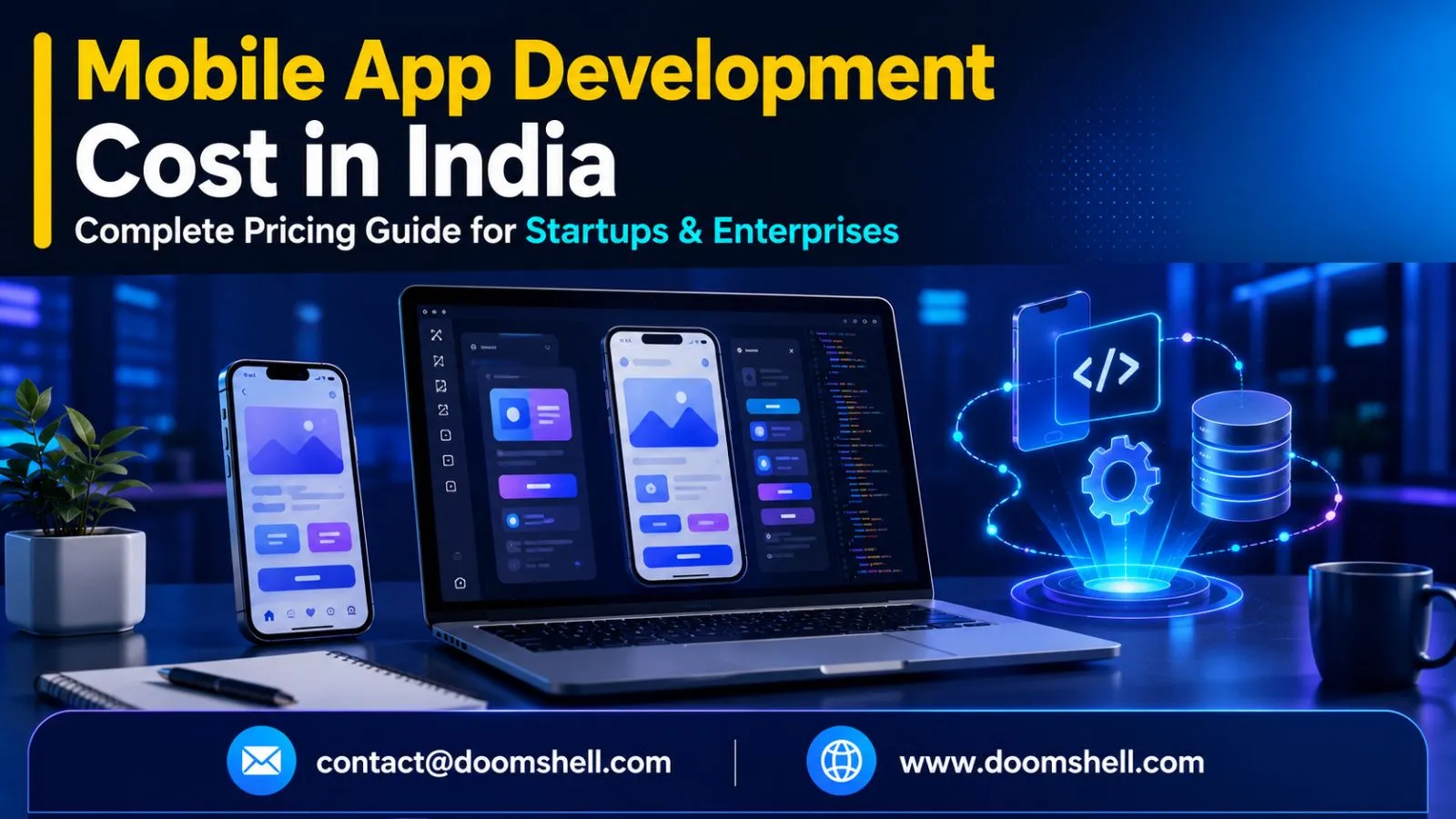
The demand for mobile applications continues to grow as businesses use digital platforms to reach customers, automate operations, and create new revenue channels. From eCommerce and food delivery to healthcare and financial services, mobile apps have become an important part of modern business strategies.
However, one of the first questions businesses ask before starting a project is how much development will cost. The answer depends on several factors, including app complexity, platform selection, features, UI/UX requirements, integrations, security, and development team expertise.
Understanding the mobile app development cost in india can help startups and enterprises prepare realistic budgets and avoid unexpected expenses. This guide explains estimated pricing ranges, major cost factors, category-wise development expenses, hidden costs, and practical ways to control your budget without compromising quality.
How Much Does Mobile App Development Cost in India in 2026?
The mobile app development cost in India can vary significantly depending on the project’s complexity and business requirements. A simple application with limited features requires considerably less development effort than a complex enterprise platform with real-time functionality, multiple integrations, advanced security, and scalable infrastructure.
As a broad planning estimate, businesses may encounter the following ranges:
| App Type | Estimated Development Cost in India |
|---|---|
| Basic app | ₹1.5 lakh – ₹5 lakh |
| Medium-complexity app | ₹5 lakh – ₹15 lakh |
| Advanced app | ₹15 lakh – ₹40 lakh+ |
| Enterprise-grade application | ₹40 lakh – ₹1 crore+ |
These figures are indicative rather than fixed quotations. The final price depends on the technology stack, team composition, project timeline, features, integrations, testing requirements, and post-launch support.
Businesses should request a detailed scope before comparing development quotes.
Average Cost Range for Different App Types
A basic app may include features such as user registration, profile management, static content, simple forms, and basic notifications.
A medium-complexity application may include:
- User authentication
- Payment integration
- Push notifications
- API integrations
- Admin dashboard
- Search and filtering
- Cloud database
- Analytics
Advanced applications often require real-time communication, AI features, location tracking, complex workflows, multiple user roles, and third-party integrations.
For example, a simple appointment-booking app may cost significantly less than a healthcare platform that includes teleconsultation, electronic records, payment processing, doctor dashboards, and compliance requirements.
Therefore, businesses should avoid comparing apps only by category. Two applications in the same industry can have very different technical requirements.
Startup vs Enterprise App Development Costs
Startups often focus on validating an idea quickly. Their first product may therefore contain only the essential features required to test market demand.
An MVP might include:
- User registration
- Core product functionality
- Basic payment processing
- Simple dashboard
- Essential analytics
Enterprises generally require more complex infrastructure. Their applications may need integration with existing CRM, ERP, payment, inventory, authentication, and reporting systems.
Enterprise projects may also require:
- Advanced security
- Multiple user roles
- High availability
- Scalability
- Data migration
- Compliance controls
- Dedicated support
As a result, enterprise development budgets are generally higher.
Cost Comparison with USA, UK, and UAE
India is often considered a cost-effective destination for software development because development teams can offer competitive rates while providing access to a large technology talent pool.
However, international comparisons should be made carefully.
A project developed by a US-based agency may have a different cost structure from one delivered by an Indian development company. The same applies to teams based in the UK or UAE.
The final cost depends on:
- Developer experience
- Project complexity
- Agency reputation
- Team size
- Engagement model
- Technology requirements
Businesses should compare deliverables, technical expertise, communication, project management, and support rather than selecting a provider based solely on the lowest hourly rate.
Factors That Affect Mobile App Development Cost
Several factors influence the final mobile app development cost in india. Understanding these factors can help businesses prepare more accurate budgets.
The most important considerations are the number of features, supported platforms, design complexity, integrations, security requirements, and development timeline.
Features and Functionalities
Features usually have a direct impact on development effort.
A simple application may require only authentication and content management, while a more advanced product may include:
- Real-time chat
- GPS tracking
- Payment gateways
- AI-powered recommendations
- Video streaming
- Social login
- Push notifications
- Multi-language support
- Subscription management
Each feature requires design, development, testing, and sometimes ongoing maintenance.
For example, adding a payment gateway is not simply a matter of connecting an API. The application may also need transaction status handling, refunds, failed payment management, security controls, and reconciliation.
The more complex the functionality, the greater the development effort.
Platform Selection (Android, iOS, or Both)
Businesses need to decide whether to develop for Android, iOS, or both.
Developing separate native applications can increase the total budget because different codebases and development teams may be required.
Cross-platform technologies such as Flutter and React Native can help businesses share significant portions of code across platforms.
However, cross-platform development does not always eliminate platform-specific work. Some applications require native integrations or platform-specific functionality.
The right choice depends on:
- Target audience
- Budget
- Performance requirements
- Device features
- Project timeline
- Long-term maintenance plans
Businesses should select a platform strategy based on product requirements rather than simply choosing the cheapest option.
UI/UX Design Complexity
Design is another important cost factor.
A basic application with standard layouts requires less design effort than a highly customized product with complex user journeys and interactive components.
UI/UX costs may include:
- User research
- Information architecture
- Wireframes
- Prototypes
- Visual design
- Design systems
- Usability testing
- Accessibility
For example, a FinTech application may require extensive attention to information hierarchy and trust because users interact with sensitive financial information.
Investing in UX during the early stages can help identify usability problems before development begins.
Mobile App Development Cost by App Category
The industry and functionality of an application can significantly affect the development budget.
Different categories require different technologies, integrations, security standards, and workflows.
Ecommerce Mobile App Development Cost
The ecommerce mobile app development cost depends on the size and complexity of the shopping platform.
A basic eCommerce app may include:
- Product catalog
- Search
- Product details
- Shopping cart
- User accounts
- Payment integration
- Order tracking
A more advanced platform may require:
- Multiple vendors
- Inventory synchronization
- Personalization
- Loyalty programs
- AI recommendations
- Multiple payment options
- Real-time delivery tracking
A basic eCommerce application might fall within the ₹5 lakh–₹15 lakh range, while a feature-rich marketplace can cost ₹20 lakh or significantly more.
Businesses should also consider integration with existing eCommerce platforms, ERP systems, inventory software, and logistics providers.
Food Delivery App Development Cost
Food delivery applications typically require multiple interfaces.
A complete platform may include:
- Customer application
- Restaurant dashboard
- Delivery partner application
- Admin panel
Important features may include:
- Restaurant discovery
- Menu management
- Online payments
- Order tracking
- GPS location
- Delivery assignment
- Push notifications
- Ratings and reviews
Because of these multiple components, food delivery platforms can become significantly more expensive than basic ordering applications.
A basic food ordering app may require a smaller budget, while a multi-sided platform with real-time logistics and automated delivery management can require substantial investment.
Healthcare and FinTech App Costs
FinTech and Healthcare applications often have higher development requirements because they handle sensitive information and may be subject to regulatory obligations.
Healthcare applications may include:
- Appointment scheduling
- Telemedicine
- Patient profiles
- Digital prescriptions
- Medical records
FinTech applications may require:
- Financial transactions
- Identity verification
- Fraud detection
- Secure authentication
- Transaction monitoring
The exact requirements depend on the market and regulations applicable to the business.
Security and compliance should be considered from the beginning rather than added after development.
Hidden Costs Businesses Should Consider
The initial development quote does not always represent the total cost of owning an application.
Businesses should consider additional expenses that may arise during and after development.
App Maintenance and Updates
Applications require ongoing maintenance after launch.
Maintenance may include:
- Bug fixes
- Security updates
- Operating system compatibility
- Performance optimization
- Feature improvements
- Server management
Mobile operating systems and third-party services change over time. An application may therefore require updates to remain compatible and secure.
Businesses should allocate a recurring maintenance budget instead of treating launch as the end of development.
Third-Party API Integrations
Many applications depend on external services.
Examples include:
- Payment gateways
- Maps
- SMS providers
- Email services
- Analytics platforms
- Cloud storage
- Authentication services
Some APIs have free usage limits, while others charge based on transactions or volume.
For example, an application that uses mapping services extensively may incur recurring usage charges as its user base grows.
These costs should be included in long-term financial planning.
Security and Compliance Requirements
Security requirements can significantly affect development budgets.
Applications handling sensitive information may require:
- Encryption
- Secure authentication
- Multi-factor authentication
- Access controls
- Security testing
- Audit logging
- Data protection measures
Compliance requirements vary by industry and geography.
For example, healthcare and financial applications may require more extensive controls than a basic content application.
Businesses should identify regulatory requirements before development begins to avoid expensive redesigns later.
How to Reduce Mobile App Development Costs Without Compromising Quality
Reducing development costs does not necessarily mean choosing the cheapest developer. The goal should be to reduce unnecessary work while protecting product quality and long-term scalability.
A well-planned development strategy can help businesses manage budgets more effectively.
Build an MVP First
An MVP, or Minimum Viable Product, includes the core functionality required to test a business idea.
Instead of building every planned feature at launch, businesses can prioritize essential functionality.
For example, a food delivery startup might initially launch with:
- Customer registration
- Restaurant listings
- Menu browsing
- Ordering
- Payment
- Basic delivery tracking
Advanced loyalty systems and complex personalization can be added after validating demand.
This approach reduces initial investment and allows businesses to collect real user feedback before making larger investments.
However, an MVP should still have a reliable technical foundation. Cutting essential security or quality testing can create larger costs later.
Choose Cross-Platform Development
Cross-platform development can reduce the need to maintain completely separate codebases.
Technologies such as Flutter and React Native allow developers to build applications for multiple platforms using shared code.
Potential benefits include:
- Faster development
- Reduced duplication
- Easier maintenance
- Faster market launch
However, cross-platform development is not suitable for every project.
Applications requiring highly specialized native functionality may benefit from native development.
Businesses should evaluate performance, integrations, user experience, and long-term requirements before selecting a technology.
Partner with an Experienced Indian Development Company
Choosing the right mobile app development company in india can significantly affect project outcomes.
An experienced partner can help businesses with:
- Technical planning
- UI/UX design
- Architecture
- Development
- Testing
- Deployment
- Maintenance
When evaluating mobile app development services in india, businesses should look beyond pricing.
Consider:
- Relevant portfolio
- Technical expertise
- Industry experience
- Communication process
- Project management
- Security practices
- Post-launch support
A detailed mobile app development quotation should clearly explain the scope, features, technology stack, milestones, payment structure, assumptions, and maintenance terms.
This makes it easier to compare proposals from different providers.
Final Thoughts
The mobile app development cost in india in 2026 depends on much more than the number of screens in an application. Features, platforms, design complexity, integrations, security, compliance, infrastructure, and ongoing maintenance all influence the total investment.
Startups can often manage budgets by launching an MVP and validating their product before expanding functionality. Enterprises may require more comprehensive architecture, integrations, security, and scalability from the beginning.
The most important step is to define requirements clearly before development begins. A detailed scope allows businesses to receive more accurate estimates and avoid unexpected costs.
Whether you are planning an eCommerce application, healthcare platform, FinTech product, or enterprise solution, selecting the right development approach can significantly influence long-term costs.
Instead of choosing a development company based only on the lowest quotation, evaluate technical expertise, communication, project experience, security practices, and post-launch support.
A reliable partner can help you balance development cost, product quality, scalability, and time to market. With proper planning and a clear product strategy, businesses can invest in mobile applications that deliver sustainable value rather than focusing only on the initial development price.
FAQs
1. How much does mobile app development cost in India in 2026?
Mobile app development in India can cost from around ₹1.5 lakh for a basic application to ₹1 crore or more for a complex enterprise platform. The final price depends on features, platforms, UI/UX complexity, integrations, security, and development requirements.
2. How much does eCommerce mobile app development cost?
A basic eCommerce mobile app may cost approximately ₹5 lakh–₹15 lakh, while advanced marketplaces with multi-vendor functionality, inventory systems, personalization, logistics, and multiple integrations can require a significantly higher investment.
3. Is mobile app development cheaper in India than in the USA and UK?
India is generally considered a cost-effective destination for software development compared with many teams in the USA and UK. However, businesses should compare complete project scope, technical expertise, deliverables, quality, and support rather than comparing hourly rates alone.
4. How can startups reduce mobile app development costs?
Startups can reduce initial expenses by developing an MVP, prioritizing essential features, using cross-platform technologies where appropriate, planning requirements carefully, and working with an experienced development team that can create a scalable technical foundation.
5. What should a mobile app development quotation include?
A professional quotation should clearly outline project scope, features, platforms, UI/UX design, technology stack, integrations, estimated timeline, milestones, testing, deployment, maintenance, third-party costs, and payment terms. This helps businesses understand the total expected investment.