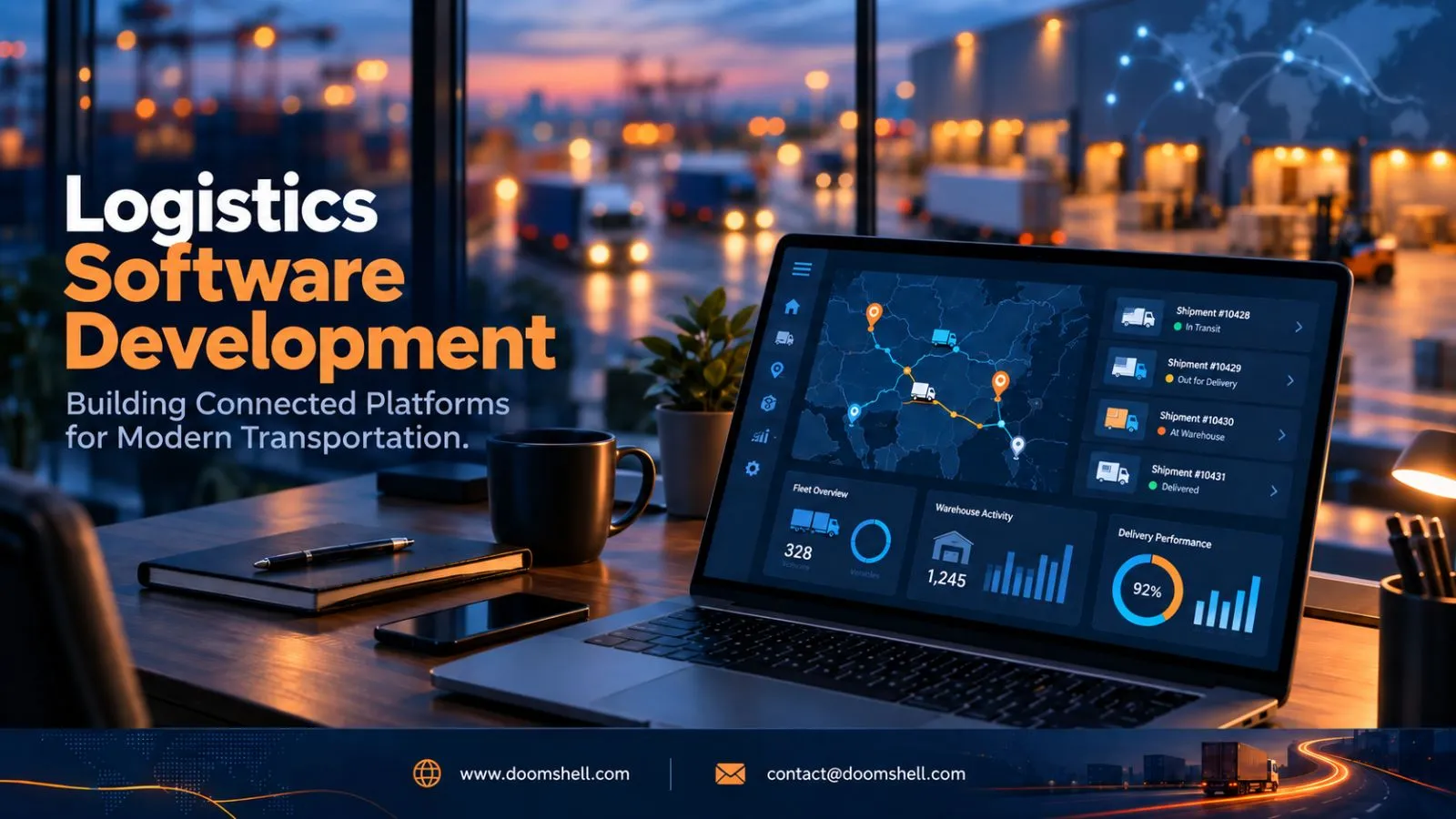
Modern logistics applications need to handle continuously changing delivery information, driver assignments, customer updates, warehouse events, and integration workflows without creating operational bottlenecks.
In 2026, Laravel 13 offers a strong foundation for building connected logistics platforms with API resources, queue improvements, scheduled jobs, event-driven workflows, and scalable application architecture.
Creating Shipment and Delivery Management Systems
Shipment management requires coordination between customers, warehouses, drivers, dispatch teams, and logistics administrators. A centralized application can make shipment information available across these operational touchpoints while keeping status changes synchronized.
Building Shipment Tracking Platforms With Laravel
A shipment tracking platform should provide a clear view of each shipment from creation to final delivery.
A Laravel-based system can manage shipment records, tracking events, delivery milestones, addresses, assigned carriers, estimated delivery information, and exception statuses.
Instead of displaying only a static status such as "in transit," the platform can maintain an event timeline:
Shipment created → Picked up → In transit → Arrived at hub → Out for delivery → Delivered
This event-based approach makes tracking information more useful for both internal teams and customers.
Real-time updates can also be connected to application events so that a shipment status change can trigger notifications, dashboard updates, or downstream workflows.
Developing Delivery Management Workflows
Delivery operations involve many decisions that change throughout the day. A delivery may be delayed, reassigned, cancelled, returned, or redirected.
Custom workflows can manage these operational conditions without requiring staff to update multiple systems manually.
For example, when a driver marks a delivery as unsuccessful, the system can record the reason, update the shipment state, create a follow-up task, and notify the appropriate operations team.
This creates a structured exception-management process rather than treating every delivery problem as a manual case.
Creating Logistics APIs With Laravel
APIs allow logistics applications to exchange shipment and delivery information with mobile applications, customer portals, warehouse systems, fleet platforms, and third-party services.
Laravel 13 includes first-party JSON:API resources, which can help applications return standardized API responses with relationships, links, and resource structures.
A logistics API can expose controlled resources for:
-
Shipments
-
Orders
-
Drivers
-
Vehicles
-
Delivery assignments
-
Tracking events
-
Warehouses
-
Customers
API versioning, authentication, validation, rate limiting, and monitoring should be built into the architecture so integrations remain reliable as the platform grows.
Improving Fleet and Dispatch Operations
Fleet operations depend on accurate information about vehicles, drivers, routes, availability, assignments, and delivery priorities.
A connected logistics platform can bring these operational elements together so dispatch teams can make decisions using current information instead of manually combining data from multiple tools.
Building Fleet Management Dashboards With Laravel
Fleet dashboards can provide a centralized view of vehicles and their operational status.
Depending on the business model, a dashboard may display:
-
Active and available vehicles
-
Current delivery assignments
-
Driver availability
-
Vehicle locations
-
Delayed shipments
-
Upcoming deliveries
-
Completed routes
-
Maintenance-related statuses
The value of the dashboard comes from connecting these data points. A vehicle's availability, for example, becomes more useful when the system can also show which deliveries need assignment.
Developing Driver and Dispatch Portals
Drivers and dispatch teams require different interfaces.
A driver portal may focus on assigned deliveries, route information, pickup instructions, proof of delivery, status updates, and delivery exceptions.
A dispatcher portal can provide a broader operational view, allowing teams to assign deliveries, reassign drivers, monitor exceptions, and coordinate multiple shipments.
Using role-specific interfaces reduces unnecessary complexity and helps each user complete the tasks relevant to their responsibilities.
Managing Delivery Assignments With Laravel
Delivery assignment should be treated as a workflow rather than a simple database update.
A logistics platform can consider factors such as:
-
Driver availability
-
Vehicle capacity
-
Delivery location
-
Delivery priority
-
Time windows
-
Shipment type
-
Current assignments
-
Operational constraints
The application can then support manual dispatch decisions or provide rules that suggest suitable assignments.
As the platform matures, optimization or AI services can be introduced as an additional decision-support layer. The core logistics application should still maintain clear business rules and allow authorized users to review important assignments.
Automating Logistics Workflows
Logistics platforms frequently process tasks that do not need to block a user's request. Notifications, synchronization, data processing, report generation, and external API calls can be moved into background workflows.
This becomes particularly important when a logistics platform handles a large number of shipments or frequent tracking events.
Using Laravel Queues for Background Logistics Jobs
Laravel queues allow time-consuming work to be processed outside the main web request. Supported queue backends include Redis, Amazon SQS, and relational databases.
For logistics applications, queued jobs can handle tasks such as:
-
Importing shipment data
-
Synchronizing tracking events
-
Sending delivery notifications
-
Generating operational reports
-
Processing external API responses
-
Updating warehouse information
-
Recalculating delivery-related data
Laravel 13 also introduces queue routing by job class, allowing specific jobs to be assigned to particular connections or queues. This can help separate high-priority operational workloads from less time-sensitive background processes.
For example, delivery-status updates could use a higher-priority queue while historical report generation runs separately.
Automating Notifications and Delivery Updates
Customers and internal teams often need timely information about shipment progress.
A logistics application can trigger notifications when important events occur, such as:
-
Shipment dispatched
-
Delivery delayed
-
Driver assigned
-
Package out for delivery
-
Delivery completed
-
Delivery attempt failed
-
Shipment returned
Laravel's event and queued-listener architecture can separate the operational event from the notification process. This means recording a shipment update does not necessarily require waiting for every notification or external service to finish.
This architecture can also make notification channels easier to expand as business requirements change.
Scheduling Recurring Logistics Tasks With Laravel
Some logistics operations run on predictable schedules.
Examples include daily reports, periodic synchronization, stale-shipment checks, recurring maintenance reminders, data cleanup, and scheduled customer communications.
Laravel provides scheduling capabilities that allow recurring commands and jobs to be defined within the application.
Scheduling these tasks centrally can reduce dependence on manual operations and make recurring processes easier to monitor and maintain.
Connecting Logistics Platforms With External Systems
Modern logistics companies rarely operate in isolation. Shipment information may need to move between order management, ERP, warehouse, accounting, carrier, customer, and transportation systems.
Integration architecture therefore becomes a core part of logistics software development.
Integrating Shipping APIs With Laravel
External shipping and carrier APIs can provide information about rates, labels, tracking events, shipment creation, and delivery status.
A Laravel integration layer can normalize these external responses into a consistent internal data model.
This is particularly useful when a business works with multiple logistics providers. Instead of building separate workflows throughout the application, provider-specific integrations can be isolated behind a common internal service layer.
This reduces the impact of changes to individual external APIs.
Connecting ERP and Warehouse Systems
ERP and warehouse systems often contain critical information about orders, inventory, purchasing, fulfillment, and financial processes.
A logistics platform can exchange data with these systems through APIs, webhooks, scheduled synchronization, or event-based integrations.
The architecture should clearly define data ownership.
For example, the ERP may remain the source of truth for order information while the logistics application manages shipment execution, driver assignments, and delivery events.
This prevents conflicting versions of the same record from spreading across different systems.
Building Scalable Laravel APIs for Logistics
As logistics platforms grow, APIs may become the central communication layer between web applications, mobile applications, warehouse systems, external carriers, and internal services.
Scalable API architecture should include:
-
Authentication and authorization
-
Request validation
-
Rate limiting
-
Pagination
-
API versioning
-
Error handling
-
Logging and monitoring
-
Idempotent operations for critical updates
Rate limiting is particularly relevant for logistics APIs because integrations may generate large numbers of requests during shipment synchronization or tracking updates. Laravel 13 includes a built-in rate-limiting abstraction that can work with application caching.
For critical shipment operations, idempotency is also important. If an external system retries a request, the logistics platform should avoid accidentally creating duplicate shipments, assignments, or status events.
Designing Logistics Platforms for Real-Time Operations
The next generation of logistics software is increasingly event-driven. Instead of waiting for users to refresh screens or manually synchronize records, applications can respond to operational events as they happen.
For example, a delivery-status event can update a shipment record, publish a dashboard change, trigger a notification, and create a follow-up task.
Laravel's event, queue, broadcasting, and API capabilities can support this type of architecture. Broadcast events can also be placed onto dedicated queues, helping real-time communication remain separate from other application workloads.
This creates a more responsive operational environment where dispatch teams and customers can work with fresher information.
Building Scalable Logistics Software With Laravel
Scalability should be considered from the beginning rather than after a logistics platform starts experiencing performance problems.
A scalable architecture can separate the application's major responsibilities into components such as shipment management, fleet operations, dispatch, notifications, integrations, reporting, and authentication.
Database indexing, caching, queue workers, API optimization, horizontal scaling, and monitoring can then be applied according to the workload of each component.
Laravel 13 was released on March 17, 2026, and its current support policy lists security fixes through March 17, 2028. The release also includes improvements to queues, security, API resources, caching, and AI-oriented application capabilities.
For logistics businesses, the important consideration is not simply adopting the latest framework. It is using a maintainable architecture that can support increasing shipment volumes, more integrations, additional facilities, and new operational workflows.
Conclusion
Logistics software development is becoming the foundation for connected transportation operations, bringing shipment tracking, fleet management, dispatching, automation, APIs, and external integrations into a unified digital environment.
Laravel provides the tools needed to build these systems, from API-driven shipment platforms and role-specific dashboards to queued background processing, scheduled jobs, event-based workflows, and scalable integrations.
A well-designed logistics platform should do more than record where a shipment is. It should connect the events surrounding that shipment and turn them into actionable workflows for dispatchers, drivers, warehouse teams, customers, and management.
By combining modular architecture, reliable APIs, background processing, real-time events, and integration-ready services, businesses can create logistics platforms that remain flexible as shipment volumes, fleets, customers, and operational complexity increase.