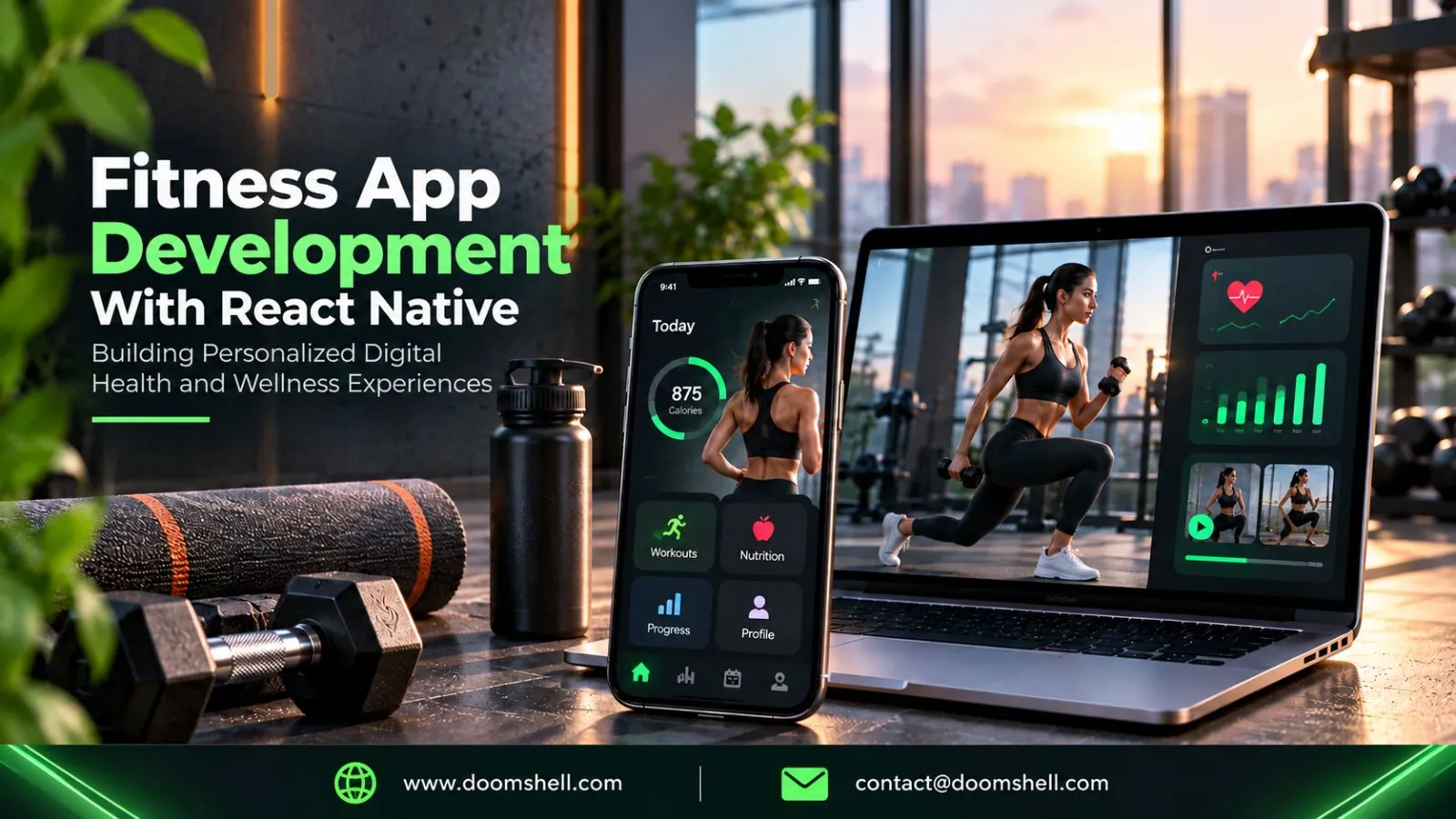
Modern fitness applications are moving beyond basic workout libraries toward adaptive plans, connected health data, intelligent progress tracking, and continuous engagement.
In 2026, React Native's evolving architecture and improved platform integrations make it possible to build fitness products that are more responsive, connected, and scalable.
Creating Personalized Fitness Experiences
Fitness users have different goals, routines, experience levels, and preferences. A beginner may want guided workouts, while an experienced athlete may need detailed performance metrics and training insights.
A successful fitness application therefore needs to move beyond a fixed list of exercises.
Personalisation can combine user goals, workout history, preferred activities, available equipment, schedule, and progress to create a more relevant experience.
React Native provides a cross-platform foundation for building these experiences while allowing applications to use native capabilities when required.
Building Workout Tracking Features With React Native
Workout tracking is one of the core functions of a fitness application.
Users may want to record exercises, repetitions, sets, duration, distance, calories, heart rate, pace, or other activity metrics.
A React Native application can provide an interactive workout interface that allows users to:
-
Start and pause workouts
-
Record exercises
-
Track sets and repetitions
-
Record weights
-
Monitor workout duration
-
Review completed sessions
-
Save personal records
-
Track training frequency
The interface should minimise the amount of interaction required during a workout. Large controls, clear status indicators, and quick actions are especially important when users are moving or exercising.
For advanced fitness products, workout tracking can also incorporate live sensor data and training zones.
Apple's current HealthKit capabilities include workout-zone data for metrics such as heart rate and cycling power, including real-time zone updates during active workouts.
Creating Personalized Fitness Plans With React Native
A personalised fitness plan can adapt according to the user's goals and behaviour.
For example, a strength-training plan could consider:
-
Fitness level
-
Training frequency
-
Available equipment
-
Target muscle groups
-
Previous performance
-
Workout duration
-
Recovery patterns
The plan can then change as the user progresses.
AI can make this experience more dynamic by helping users create routines from natural-language goals.
A user could enter:
“I want a 30-minute home workout three days a week.”
The application can convert that goal into a structured training plan based on available equipment and user preferences.
However, fitness applications should clearly distinguish general wellness guidance from medical advice. When an application deals with medical conditions, injuries, rehabilitation, or high-risk activities, additional professional oversight may be required.
Developing Progress Dashboards With React Native
A progress dashboard should turn raw fitness data into information users can understand.
Instead of showing dozens of numbers, the dashboard can highlight meaningful changes such as:
-
Weekly workout frequency
-
Training volume
-
Running distance
-
Personal records
-
Workout consistency
-
Goal completion
-
Activity trends
-
Training intensity
Visualising progress over time can help users understand whether their behaviour is changing.
A useful dashboard should also avoid creating misleading conclusions from incomplete data. Missing wearable readings, inconsistent tracking, or different measurement methods can affect comparisons.
The application should therefore communicate what the data represents rather than presenting every metric as a definitive health measurement.
Building Connected Fitness Applications
Connected fitness is becoming increasingly important as users rely on smartphones, smartwatches, fitness trackers, and other devices.
Instead of keeping activity information inside one application, modern fitness platforms can use permission-based integrations to build a broader view of the user's activity.
Integrating Health and Fitness Data Into React Native Apps
Fitness applications can connect with platform health-data frameworks to access approved information.
On Apple platforms, HealthKit provides access to health and fitness data with user permission. Workout sessions can collect live information during activities, while workout records can store details for later analysis.
On Android, Health Connect allows applications to read and write approved health and fitness records. Its current release documentation also emphasises explicit access declarations for the data types an application uses.
This means fitness applications can potentially combine information such as:
-
Steps
-
Workouts
-
Distance
-
Heart rate
-
Exercise sessions
-
Calories
-
Activity intensity
-
Sleep-related data where permitted
The key is permission-based access and clear user understanding of what data the application uses.
Connecting Wearable Devices With React Native
Wearables can transform a fitness application from an occasional tracking tool into a continuous activity companion.
A smartwatch or fitness device can provide data during workouts without requiring users to repeatedly interact with their phones.
For example, a running application could receive pace, distance, heart-rate, and location information during an active session.
Apple's current HealthKit documentation supports live workout sessions and workout data collection, while recent updates have expanded workout-zone functionality.
Android's Health Connect ecosystem is also evolving. Recent updates include richer exercise data and improvements around synchronisation and data access.
React Native can act as the shared application layer while native modules handle platform-specific health and wearable functionality.
Creating Real-Time Activity Tracking With React Native
Real-time activity tracking is useful for running, cycling, walking, gym workouts, and other activities.
A fitness application may display:
Duration → Distance → Pace → Heart Rate → Training Zone → Calories
The challenge is keeping the interface responsive while processing continuous data.
Efficient architecture matters because frequent sensor updates can increase battery consumption and affect application performance.
Applications should therefore avoid processing every available data point unnecessarily. Instead, data can be sampled, aggregated, or processed according to the actual requirement of the feature.
Location tracking also needs careful handling. For example, a running application may need continuous GPS during an active workout but should not continue collecting location data without a legitimate purpose.
Developing Engagement and Subscription Features
Fitness products often depend on long-term engagement rather than one-time usage.
A customer may download an application today but generate meaningful business value only if they continue training, renew a membership, or subscribe to premium features.
The product experience should therefore encourage useful habits rather than simply maximise notifications.
Building Fitness Memberships With React Native
Membership features can create recurring revenue while giving users access to additional value.
A fitness membership may include:
-
Premium workout programmes
-
Personalised training plans
-
Advanced analytics
-
Trainer access
-
Exclusive classes
-
Nutrition content
-
Progress reports
-
Wearable insights
Different membership levels can also support different user needs.
For example, a basic plan could provide workout tracking, while a premium tier could include adaptive training programmes and advanced performance analysis.
The application should clearly communicate what each plan includes so users can make informed subscription decisions.
Creating Push Notification Experiences With React Native
Push notifications can remind users about workouts, progress, classes, challenges, or subscription events.
But excessive notifications can quickly become counterproductive.
A better strategy is to make notifications contextual.
Examples include:
-
Workout reminder based on the user's routine
-
Progress milestone
-
Missed training reminder
-
Class starting soon
-
Weekly progress summary
-
Subscription renewal notice
Users should also have meaningful control over notification preferences.
A fitness application should optimise for useful engagement, not simply the number of notifications delivered.
Developing In-App Subscription Workflows
Subscription experiences need to handle more than the purchase button.
The application should support:
Plan Selection → Payment → Activation → Entitlement Check → Renewal → Upgrade/Downgrade → Cancellation
Subscription status should be validated through the appropriate platform and backend systems.
The backend should remain the authoritative source for user entitlements where appropriate, rather than relying solely on the mobile application's local state.
This prevents issues when users switch devices, reinstall the application, or purchase a subscription through another supported platform.
Creating Scalable Fitness Platforms
A fitness application may start with workout tracking but eventually expand into coaching, wearables, nutrition, communities, subscriptions, AI recommendations, and analytics.
The technical architecture needs to accommodate this growth without requiring the entire application to be rebuilt.
Building React Native Apps With Secure Backend APIs
The mobile application should communicate with secure backend APIs for core business operations.
The backend can manage:
-
User accounts
-
Workout history
-
Fitness plans
-
Progress data
-
Subscriptions
-
Recommendations
-
Device synchronisation
-
Notifications
-
Analytics
-
Access permissions
The API layer should include authentication and authorisation so users can access only the data associated with their account.
Health-related information requires additional care. Data should be collected only when necessary, protected during transmission and storage, and handled according to applicable privacy requirements.
The architecture should also support secure token management, input validation, logging, rate limiting, and monitoring.
Managing User Data Across Devices
Users increasingly expect their fitness history to follow them across devices.
Someone might start a workout on a phone, track it through a smartwatch, and review the results later on a tablet.
This requires reliable synchronisation.
Android's Health Connect guidance explicitly describes synchronisation between an application's datastore and Health Connect, including handling new, updated, and deleted records.
A fitness platform should therefore define a clear source of truth and synchronisation strategy.
Important considerations include:
-
Conflict resolution
-
Duplicate prevention
-
Offline data
-
Timestamp handling
-
Deleted records
-
Device identification
-
Incremental synchronisation
-
Retry mechanisms
Offline support can be particularly useful for workouts because users may exercise in locations with limited connectivity.
The application can record activity locally and synchronise it with the backend when connectivity returns.
Optimizing React Native Applications for Different Devices and Screen Sizes
Fitness users can access an application on phones with different screen sizes, operating-system versions, hardware capabilities, and performance levels.
The interface should therefore be responsive and adaptive.
React Native 0.87, released in August 2026, made the Strict TypeScript API the default JavaScript API and introduced a faster, leaner Metro update, while also adding experimental Swift Package Manager support and Android Gradle Plugin 9 support.
For a fitness application, the benefits of keeping the technology stack current go beyond development convenience.
Performance can directly affect the workout experience.
Applications should optimise:
-
Rendering performance
-
Image and video loading
-
Animation smoothness
-
Battery usage
-
Background processing
-
API requests
-
Local storage
-
Large workout histories
-
Accessibility
-
Different display sizes
Fitness apps that include video workouts require additional attention to streaming, caching, adaptive quality, and network conditions.
AI and the Next Generation of Fitness Applications
AI is creating new possibilities for personalised fitness experiences.
Instead of offering the same programme to every user, an application can use approved activity data and user preferences to provide more adaptive experiences.
Potential features include:
-
AI-assisted workout planning
-
Natural-language fitness search
-
Adaptive exercise recommendations
-
Training summaries
-
Progress explanations
-
Exercise discovery
-
Conversational coaching interfaces
For example, a user might ask:
“I trained legs yesterday. What type of workout should I do today?”
An AI layer could use the user's available training information to provide a general recommendation within the application's defined safety boundaries.
The important distinction is between fitness guidance and medical decision-making.
AI systems should not present uncertain outputs as medical facts, and health-sensitive recommendations should include appropriate safeguards and professional review where necessary.
Fitness platforms should also make it clear which information is generated by AI and which comes directly from recorded activity data.
Conclusion
Fitness App Development With React Native is evolving from simple workout trackers into connected digital wellness platforms.
Modern applications can combine personalised training plans, workout tracking, progress dashboards, wearable data, real-time activity monitoring, subscriptions, secure APIs, and cross-device synchronisation within one ecosystem.
The technology underneath these experiences is also advancing. React Native 0.87 is currently an active stable release, while Apple HealthKit and Android Health Connect continue expanding the types and quality of fitness data applications can access with appropriate permissions.
The next generation of fitness products will increasingly focus on context rather than raw data: understanding what a user is trying to achieve, recognising changes in activity, and turning multiple data sources into useful experiences.
For businesses planning a fitness platform in 2026, the priority should be to build a scalable and privacy-conscious foundation that can support today's workout features while remaining ready for AI-assisted coaching, richer wearable integrations, and increasingly personalised wellness experiences.