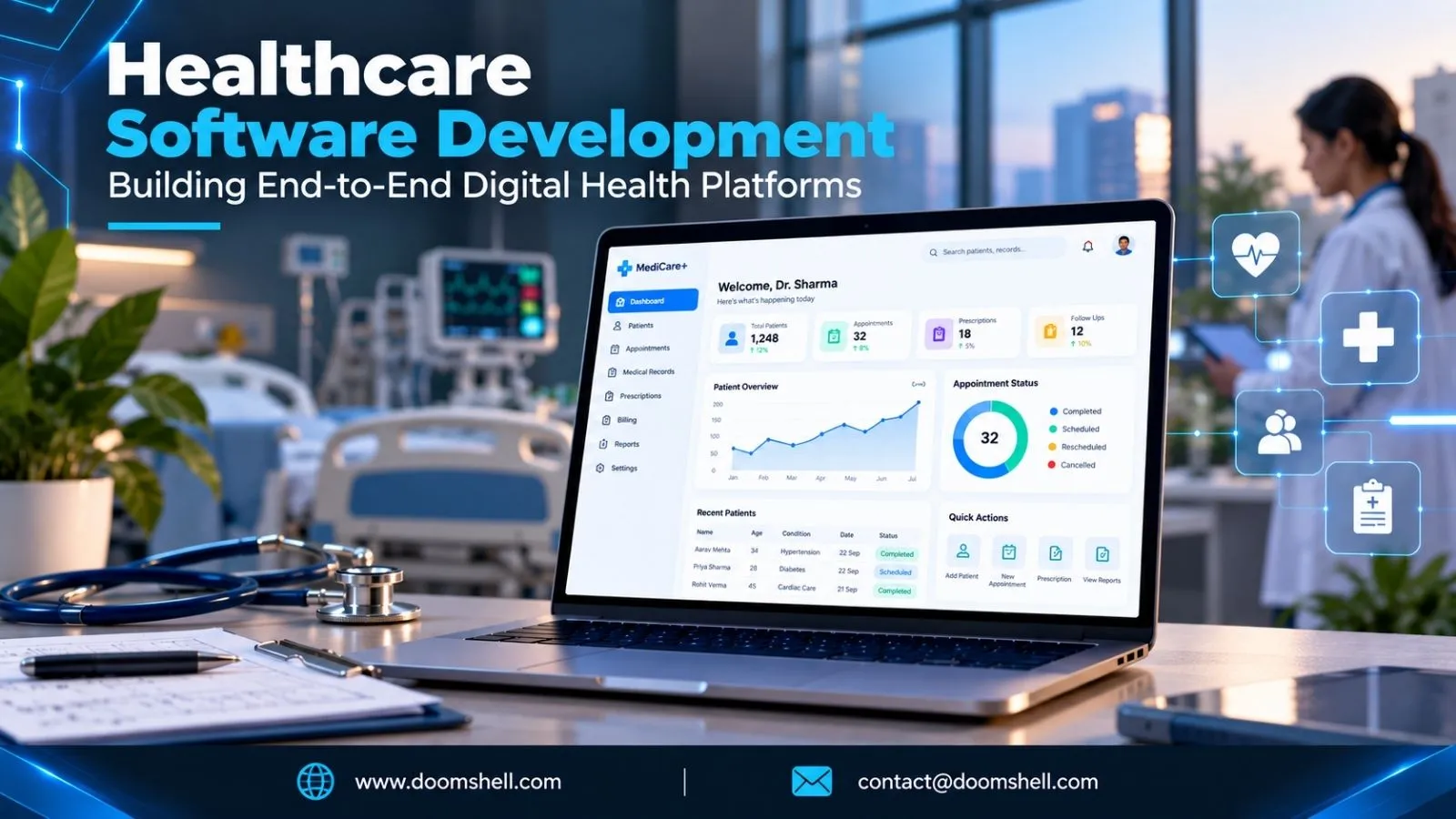
Modern healthcare applications are moving beyond isolated portals toward interoperable systems that support personalized experiences, secure data exchange, real-time workflows, and scalable cloud infrastructure.
In 2026, standards-based interoperability, API security, cloud-ready architecture, and AI-enabled workflows are becoming important considerations when designing end-to-end digital health platforms.
Developing Patient-Facing Healthcare Applications
Patient-facing applications are often the primary digital touchpoint between healthcare organizations and the people they serve. A well-designed platform can bring appointments, health information, communication, documents, and personalized services into one accessible experience.
Healthcare software development should focus on making these applications simple for patients while maintaining the security, privacy, and reliability expected from healthcare systems.
Building Patient Portals With Full-Stack Development
A patient portal can provide a centralized environment for accessing appointments, medical information, prescriptions, invoices, test results, care instructions, and secure communications.
Full-stack development allows the frontend experience and backend services to be designed as one connected system. The application can use secure authentication, API-based services, structured databases, and permission controls to ensure patients only access information associated with their accounts.
A modern portal can also be designed around mobile responsiveness and accessibility so that patients can use essential services across smartphones, tablets, and desktops.
Creating Appointment and Healthcare Management Features
Appointment management is one of the most common functions in digital healthcare platforms. However, an enterprise-grade system needs to handle more than a basic booking calendar.
Healthcare applications can support:
-
Provider availability
-
Appointment scheduling and rescheduling
-
Cancellation workflows
-
Appointment reminders
-
Virtual consultation links
-
Department-based scheduling
-
Patient check-in
-
Follow-up appointments
The backend can connect scheduling rules with provider calendars and organizational workflows. This reduces manual coordination and creates a consistent scheduling experience for both patients and healthcare staff.
Developing Personalized Patient Dashboards
A personalized dashboard can bring relevant information into one view instead of requiring patients to navigate multiple sections.
Depending on the healthcare platform, a dashboard might display upcoming appointments, care tasks, medication reminders, recent results, secure messages, health documents, and recommended next steps.
Personalization should be based on authorized patient data and clearly defined business rules. Healthcare applications should avoid exposing unnecessary information simply because it exists in the backend.
This principle of minimum necessary access is especially important when building systems that process protected health information.
Building Healthcare Administration Systems
Healthcare organizations also require powerful internal applications. Administrative systems coordinate providers, staff, departments, facilities, schedules, workflows, and operational data.
A full-stack healthcare platform can connect these processes instead of forcing teams to switch between disconnected applications.
Creating Doctor and Staff Management Platforms
Provider and staff management systems can centralize information about doctors, nurses, specialists, administrators, departments, shifts, availability, and responsibilities.
A custom platform can include scheduling, credential information, department assignments, leave management, notifications, and workflow approvals.
For larger organizations, the system can also separate data and permissions by facility, department, or role. This creates a structured foundation for managing distributed healthcare teams.
Developing Hospital Workflow Applications
Hospital workflows often involve multiple teams and handoffs. A patient's journey may involve registration, triage, consultation, diagnostics, treatment, pharmacy, billing, discharge, and follow-up.
Software can connect these stages through workflow-driven applications.
For example, completing one workflow step can automatically create a task for the next department. A diagnostic result can become available to an authorized clinician, while a discharge workflow can trigger follow-up instructions and administrative processes.
The objective is not simply to digitize paperwork. It is to create a connected operational workflow where information moves to the right person at the right stage.
Building Role-Based Healthcare Dashboards
Healthcare employees need different information depending on their responsibilities.
A physician dashboard may focus on patient records and appointments. A nurse may need task lists and care-related information. An administrator may require operational and financial metrics.
Role-based dashboards can provide each user with an appropriate view while limiting access to information that is not required for their role.
Healthcare software development should combine role-based access with authentication, session controls, audit logging, and authorization checks throughout the application.
Security cannot depend only on hiding interface elements. Backend services must independently verify whether a user is authorized to perform each sensitive action.
Connecting Healthcare Data and Services
Healthcare organizations frequently use multiple systems for electronic records, laboratories, imaging, billing, pharmacy, scheduling, insurance, and patient engagement.
Connecting these systems is therefore one of the most important architectural challenges in digital health.
Developing Healthcare APIs With Full-Stack Technologies
Healthcare APIs can provide controlled communication between patient applications, administrative platforms, clinical systems, and third-party services.
A well-designed API architecture should define:
-
Authentication and authorization
-
Data validation
-
Resource permissions
-
Rate limits
-
Error handling
-
Audit logging
-
Version management
-
Monitoring
FHIR is a major healthcare interoperability standard designed for exchanging structured health information electronically. The current FHIR development landscape is also moving toward greater support for scalable, standardized exchange, including device-generated data and AI-enabled healthcare workflows.
Full-stack applications can use FHIR-compatible APIs where appropriate while maintaining application-specific services for workflows that do not map directly to standardized resources.
Integrating Third-Party Healthcare Systems
Healthcare platforms may need to communicate with external systems such as laboratories, pharmacies, payment services, identity providers, telehealth services, insurance platforms, and clinical data systems.
Integration should be designed around clear data ownership.
For example, a healthcare application might manage patient-facing scheduling while an existing clinical system remains the authoritative source for certain medical records.
This prevents the same information from being independently modified in multiple systems and reduces synchronization problems.
Building Secure Data Exchange Workflows
Healthcare data exchange requires security at every stage.
API authentication alone is not sufficient. Developers also need to consider authorization at the object and field levels, sensitive workflow protection, input validation, secure configuration, logging, and third-party API risks. OWASP's API Security guidance specifically highlights risks such as broken object-level authorization, broken authentication, excessive resource consumption, and unsafe API consumption.
For organizations subject to HIPAA, the regulatory environment also requires appropriate safeguards for electronic protected health information. HHS notes that healthcare applications and cloud providers handling protected health information may fall within business-associate requirements depending on the relationship and services involved.
This makes security architecture part of the initial product design rather than something added after development.
Scaling Digital Healthcare Applications
Healthcare platforms may begin with one clinic or service and later expand across multiple facilities, providers, regions, or healthcare programs.
The architecture should therefore support growth without creating unnecessary complexity.
Designing Scalable Full-Stack Architectures
A scalable healthcare platform can separate frontend applications, backend services, databases, APIs, background jobs, authentication, and integrations into clearly defined layers.
This makes it easier to scale high-demand components independently.
For example, appointment APIs may experience very different traffic patterns from reporting services or document-processing workflows. Separating these workloads can improve reliability and make infrastructure resources easier to manage.
Modern frameworks can also support background processing for notifications, synchronization, report generation, data imports, and other operations that do not need to block a user's request.
Laravel 13, released in March 2026, includes improvements across queues, caching, security, APIs, and AI-oriented application capabilities, making current full-stack architectures more flexible for applications that need both conventional business workflows and newer intelligent features.
Optimizing Database-Driven Healthcare Applications
Healthcare platforms can generate substantial volumes of structured data. Patient records, appointments, transactions, audit events, messages, documents, and integration logs all require careful database design.
Performance can be improved through:
-
Appropriate database indexing
-
Efficient query design
-
Pagination
-
Caching
-
Read/write workload separation
-
Background processing
-
Data archiving
-
Monitoring and performance testing
Healthcare databases should also be designed around data integrity. A faster system is not useful if records become inconsistent or important changes cannot be audited.
Building Cloud-Ready Healthcare Platforms
Cloud architecture can provide healthcare applications with flexible infrastructure, managed services, automated deployments, monitoring, backup capabilities, and scalable compute resources.
However, moving healthcare data to the cloud requires more than selecting a hosting provider.
Organizations need to evaluate data residency, access controls, encryption, backup policies, incident response, vendor agreements, logging, and applicable regulatory requirements.
For HIPAA-regulated environments, HHS states that covered entities and business associates can use cloud services to create, receive, maintain, or transmit ePHI when the applicable requirements are met, including an appropriate business associate agreement with the cloud service provider.
A cloud-ready architecture should therefore combine scalability with privacy, security, observability, and controlled data management.
Making Healthcare Platforms Ready for AI and Automation
AI is becoming an additional application layer for healthcare platforms rather than a replacement for their core systems.
A well-architected platform can provide AI services with controlled access to approved data for use cases such as document summarization, administrative assistance, patient communication, workflow prioritization, and information retrieval.
The underlying data architecture becomes especially important here. AI systems need reliable, structured, permission-aware information to produce useful results without exposing data outside its intended context.
Healthcare organizations should also maintain human oversight for clinical or high-impact decisions. AI-enabled features should clearly define what the system can automate, what requires review, and how important actions are recorded.
Conclusion
Healthcare software development is increasingly about building connected digital ecosystems rather than isolated healthcare applications.
Patient portals, appointment systems, staff management, hospital workflows, APIs, third-party integrations, dashboards, and cloud infrastructure can work together through a carefully designed full-stack architecture.
Interoperability standards such as FHIR can support structured healthcare data exchange, while secure API design and role-based access help protect sensitive information. At the infrastructure level, scalable databases, background processing, monitoring, and cloud-ready architecture create a foundation for long-term growth.
For healthcare organizations planning a new digital platform, the strongest approach is to design around the complete healthcare journey: patient experience, operational workflows, data interoperability, security, scalability, and future intelligent services.