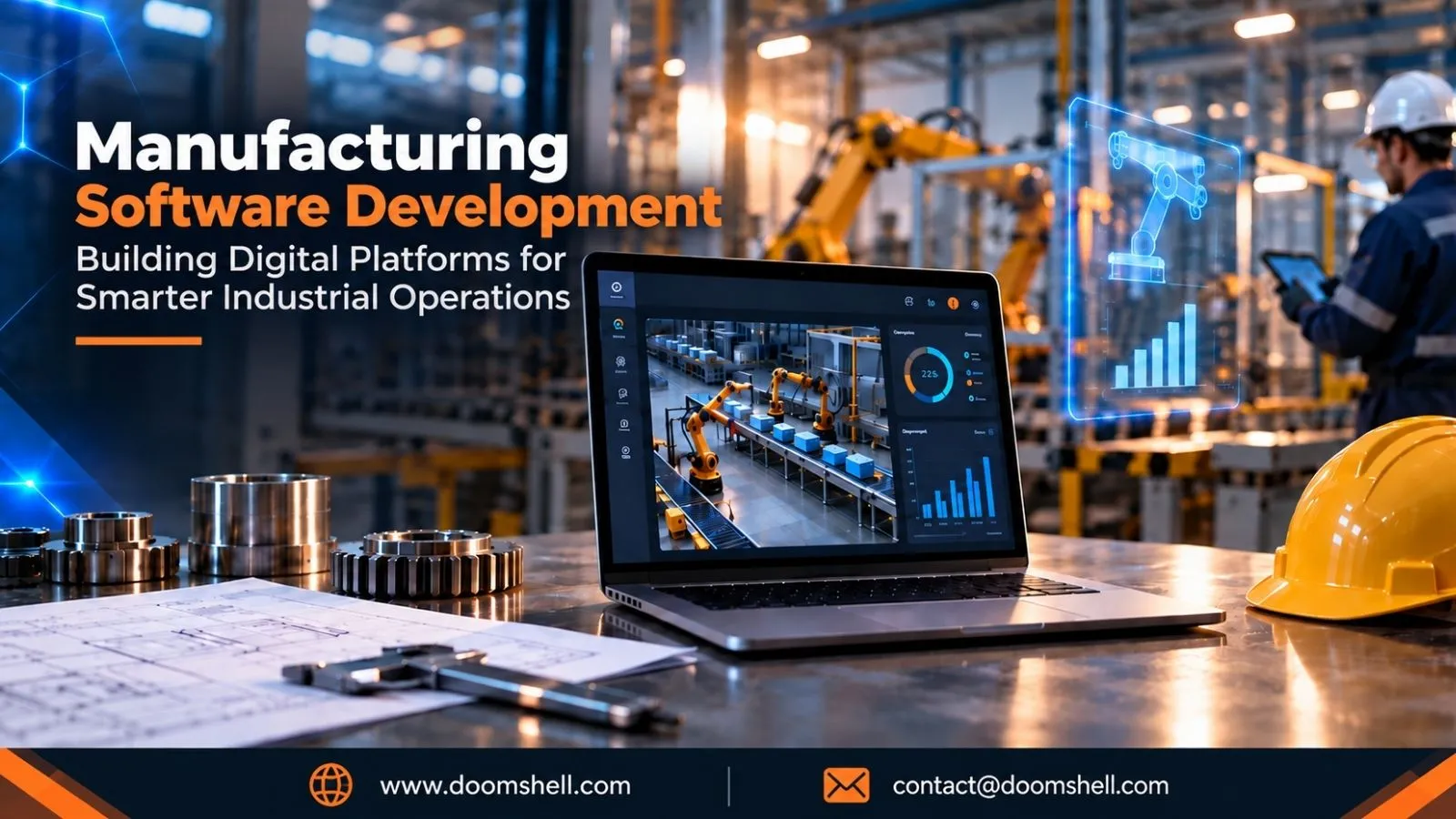
Modern manufacturing applications are moving beyond basic record keeping toward real-time visibility, workflow automation, scalable APIs, and data-driven decision-making.
In 2026, Laravel 13 provides a modern foundation for building modular manufacturing platforms that can process operational workloads, integrate business systems, and scale across multiple facilities.
Digitizing Production and Plant Operations
Manufacturing environments depend on coordinated production schedules, machine activity, work orders, quality checks, maintenance tasks, and operator workflows. Manufacturing software development can bring these processes into one connected platform instead of relying on disconnected spreadsheets, legacy tools, or manual updates.
A centralized application can give production managers a consistent view of what is happening across lines, shifts, and plants while allowing operators to interact with the information relevant to their roles.
Building Production Management Systems With Laravel
Laravel can provide the application layer for production management systems that coordinate work orders, production batches, material requirements, machine assignments, quality checkpoints, and completion records.
A production module can be designed around the actual workflow of a factory. For example, a work order may move through stages such as scheduled, materials allocated, production started, quality inspection, completed, and dispatched.
Laravel's structured application architecture makes it possible to separate these workflows into maintainable modules. This helps manufacturers introduce new production processes without rebuilding the entire platform.
Creating Real-Time Manufacturing Dashboards
Manufacturing dashboards should provide more than static reports. They should help users understand the current operational state of a facility.
A Laravel-based dashboard can bring together information such as:
-
Production targets and actual output
-
Machine or line status
-
Open and completed work orders
-
Inventory availability
-
Quality inspection results
-
Downtime events
-
Pending maintenance activities
The goal is to turn operational data into an accessible decision layer. Managers can monitor exceptions, while supervisors can focus on production bottlenecks that require attention.
Managing Production Workflows With Laravel
Production workflows often contain dependencies. A material shortage can delay a work order, a failed quality check can stop a batch, and an equipment issue can require production schedules to be adjusted.
Manufacturing software development can model these dependencies directly inside the application.
Laravel can support workflow rules, approvals, notifications, validation, and event-driven actions. This allows the platform to automatically trigger the next step when a production event occurs instead of requiring employees to manually update multiple systems.
Automating Inventory and Procurement Processes
Production efficiency depends heavily on material availability. If inventory data is inaccurate or procurement workflows are slow, production planning becomes difficult.
A manufacturing platform can connect inventory levels with purchasing rules, supplier information, warehouse movements, and production requirements. This creates a more connected flow from material demand to procurement and stock management.
Developing Inventory Management Modules With Laravel
A custom inventory module can manage raw materials, components, finished goods, batches, locations, stock movements, and reorder thresholds.
Instead of treating inventory as a simple quantity field, the application can maintain an auditable history of how stock moves through the organization.
For example, a transaction may record:
Purchase received → warehouse location → production issue → work-in-progress → finished goods → dispatch
This structure gives businesses better visibility into stock movement and makes it easier to investigate discrepancies.
Automating Purchase and Stock Workflows
Procurement can also be automated around business rules.
When inventory falls below a defined threshold, the system can identify the affected item, check supplier information, create a purchase request, route it for approval, and update the relevant procurement status.
More advanced workflows can incorporate production forecasts and planned work orders so that procurement decisions are connected to upcoming manufacturing requirements rather than relying only on current stock levels.
Connecting Laravel With ERP and Inventory Systems
Manufacturing businesses rarely operate with a single application. Existing ERP, accounting, warehouse, procurement, and inventory systems may already contain important operational data.
Laravel can act as an integration layer between these systems through APIs, webhooks, scheduled synchronization, and controlled data exchange.
A well-designed integration architecture should define which system owns each type of data. For example, an ERP may remain the source of truth for financial records while the manufacturing application manages production workflows and operational events.
This approach reduces duplicated records and helps create a more reliable digital manufacturing environment.
Building Data-Driven Manufacturing Applications
Manufacturing software becomes more valuable when operational data can be transformed into useful information.
Production events, inventory transactions, procurement activity, quality records, and machine-related information can create large volumes of data. The application needs an architecture capable of processing that information without slowing down the user experience.
Processing Operational Data With Laravel
Laravel can be used to collect, validate, transform, and store operational data from multiple application modules and external systems.
A manufacturing platform might process events such as:
-
Work order updates
-
Inventory transactions
-
Production completions
-
Quality inspection results
-
Procurement changes
-
Equipment alerts
-
User actions
A structured event-driven approach can help separate data collection from downstream processing, making the platform easier to maintain as operational requirements grow.
Creating Custom Reporting Dashboards
Different manufacturing roles need different information.
Plant managers may need production performance and exception summaries. Procurement teams may need supplier and purchasing information. Warehouse teams may focus on stock movements and shortages.
Custom Laravel dashboards can provide role-specific reporting instead of forcing every employee to work with the same interface.
Manufacturing reporting can also move from historical summaries toward operational intelligence by highlighting trends, exceptions, delayed workflows, and recurring issues.
Using Laravel Queues for Background Processing
Not every manufacturing task should run during a user's web request. Large data imports, report generation, notifications, synchronization jobs, and integration processes can be moved into background queues.
Laravel provides a unified queue system supporting backends such as Redis, Amazon SQS, and relational databases. Its queue capabilities include delayed jobs, job chaining, batching, failure handling, and monitoring.
For high-volume manufacturing platforms, Laravel Horizon can provide visibility into Redis-powered queues, including throughput, runtime, failures, and worker configuration. Laravel 13's Horizon documentation also supports automatic worker balancing based on queue workload.
This architecture helps keep operational dashboards responsive while intensive background processes continue independently.
Scaling Enterprise Manufacturing Platforms
Manufacturing software development becomes more complex when one application needs to support multiple plants, warehouses, production lines, business units, or regions.
The architecture should therefore be designed for expansion from the beginning.
Building Modular Laravel Enterprise Applications
A modular Laravel platform can separate major business capabilities such as production, inventory, procurement, quality, maintenance, reporting, and administration.
This makes it easier to introduce new features without tightly coupling every part of the system.
Laravel 13, released in March 2026, continues Laravel's annual release cycle and includes improvements around application APIs, queues, caching, security, and AI-oriented workflows. The framework's current support policy provides security fixes for Laravel 13 through March 2028.
For manufacturers, the practical advantage is not simply using the newest framework version. It is building an application architecture that can evolve alongside changing production requirements.
Developing Role-Based Access With Laravel
Manufacturing applications often contain sensitive operational and business information. Operators, supervisors, procurement teams, plant managers, administrators, and executives should not necessarily have identical permissions.
Role-based access can control which users can view, create, approve, modify, or export specific information.
For example, an operator may update production quantities, while a plant manager can approve workflow changes and an administrator can configure system-level settings.
Access controls should also be combined with audit trails so organizations can understand who performed important actions and when.
Scaling Laravel Applications for Multiple Plants
A multi-plant manufacturing platform needs to handle differences between facilities while maintaining centralized governance.
The application can use plant-level structures for:
-
Production lines
-
Warehouses
-
Users and roles
-
Inventory locations
-
Work orders
-
Procurement workflows
-
Reporting
-
Operational configurations
A shared platform can provide centralized visibility while allowing each facility to maintain its own operational rules.
Scalability should also be considered at the infrastructure level. Caching, database optimization, queue workers, API architecture, monitoring, and horizontal scaling can help the application support increasing transaction volumes.
Making Manufacturing Software More Intelligent
The next stage of manufacturing software development is not simply digitizing existing paperwork. It is creating platforms that can connect operational data with intelligent workflows.
For example, production data can feed forecasting models, inventory events can trigger automated procurement workflows, and operational exceptions can generate alerts for the appropriate teams.
AI can also become an application layer rather than a separate feature. A manufacturing platform could provide natural-language access to approved operational information, summarize production exceptions, or help users investigate recurring workflow issues. These capabilities should be implemented with clear permissions, controlled data access, and human oversight.
The underlying architecture still matters. AI features are only useful when the application has reliable operational data, well-defined business rules, secure APIs, and consistent data ownership.
Conclusion
Manufacturing software development is becoming an important part of modern industrial operations because production, inventory, procurement, reporting, and enterprise systems increasingly need to work as one connected environment.
Laravel provides a flexible foundation for building these platforms, from production management dashboards and inventory modules to background processing, enterprise APIs, role-based access, and multi-plant applications.
The strongest manufacturing platforms are not simply collections of digital forms. They create a connected operational layer where teams can access accurate information, automate repetitive workflows, respond to exceptions, and scale processes across facilities.
For businesses planning a new manufacturing platform or modernizing an existing industrial application, a modular Laravel architecture can provide a practical foundation for building secure, data-driven, and scalable digital operations.