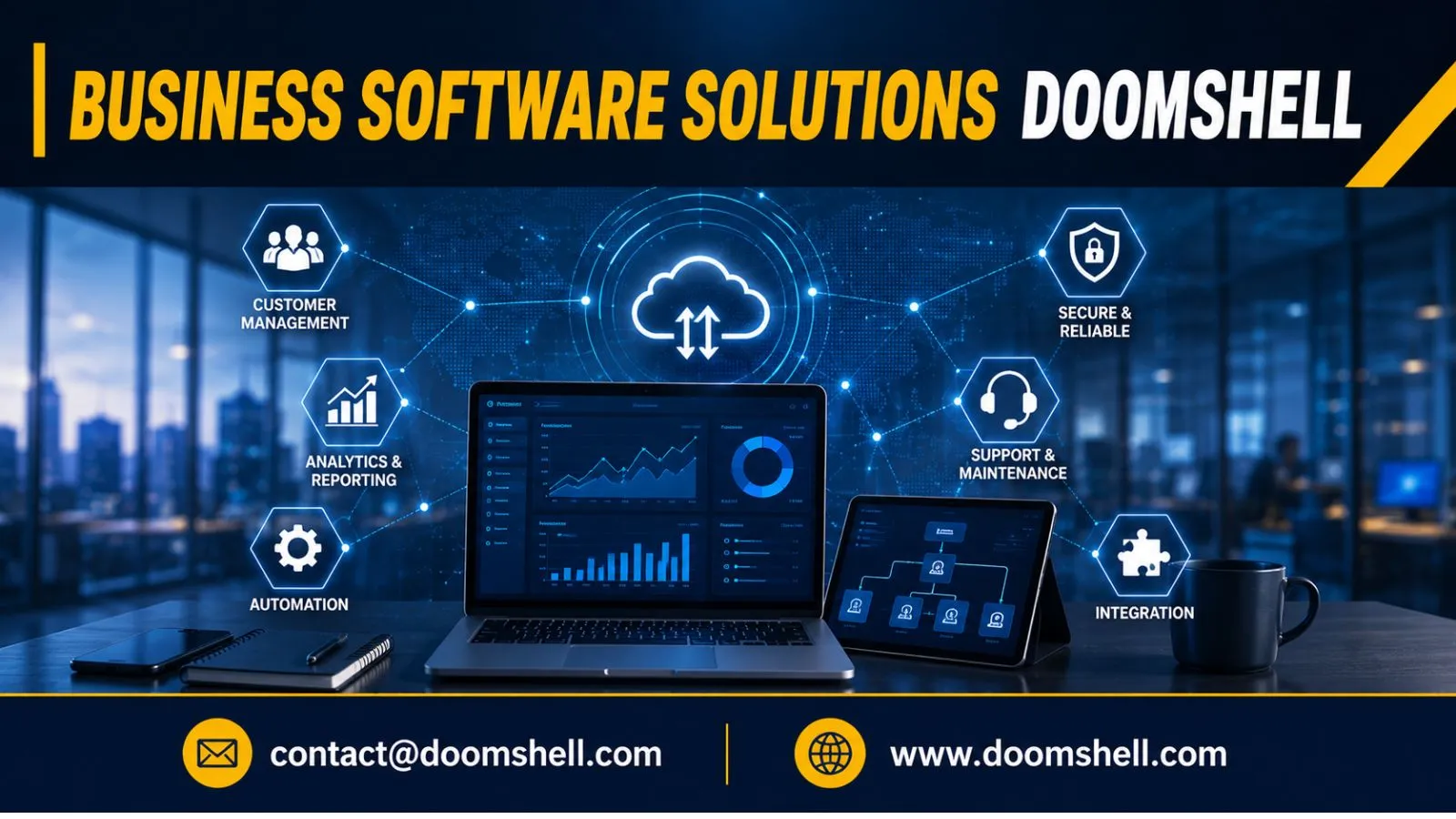
In today's competitive digital landscape, businesses need more than traditional methods to stay ahead. Manual processes, disconnected systems, and outdated workflows can reduce productivity, increase operational costs, and slow business growth. Whether an organization is a startup, a small business, or a large enterprise, the right technology can make everyday operations more efficient.
Business software solutions help organizations automate routine tasks, centralize information, improve collaboration, and make informed decisions. From payroll processing and customer communication to inventory control and eCommerce management, the right software can simplify complex workflows and support sustainable growth.
Doomshell Softwares Pvt Limited provides business-focused software products designed to address operational challenges across different industries. By selecting tools that match their needs, businesses can improve efficiency today while preparing for future expansion.
What Are Business Software Solutions and Why Do Businesses Need Them?
Business software solutions are digital applications that help organizations manage, automate, and improve essential operations. Instead of relying on spreadsheets, paperwork, and disconnected applications, businesses can use integrated systems to organize information and coordinate activities.
Common Types of Business Management Software
Different departments require different tools, but their overall goal is to make work more organized and measurable.
Common categories include:
-
Customer relationship management (CRM)
-
Human resource and payroll management
-
Inventory and retail management
-
Sales and marketing automation
-
Procurement and vendor management
-
eCommerce and order management
-
Customer support and communication
-
Reporting and business analytics
An organization may need only a few of these tools initially. As its operations expand, additional modules can help connect departments and reduce information gaps.
For example, inventory software can help retailers monitor stock levels, while payroll software can simplify salary calculations and employee records. A centralized CRM can help sales teams track leads, manage customer interactions, and follow up on opportunities more consistently.
Key Benefits of Business Process Automation
Business process automation reduces the repetitive work employees perform every day. Tasks such as generating invoices, sending notifications, recording transactions, and preparing reports can become faster and more consistent when supported by appropriate software.
Automation also improves data accuracy by reducing duplicate entries and manual calculations. Centralized information helps teams access the records they need without repeatedly requesting updates from other departments.
Other benefits include better customer service, clearer accountability, faster reporting, and improved resource allocation. However, software delivers the greatest value when businesses first identify their actual problems and then choose tools that solve them.
An effective implementation should also include employee training, clear workflows, access controls, and regular performance reviews. Technology alone cannot fix an inefficient process, but well-planned automation can make an improved process easier to maintain.
Exploring Doomshell's Business Software Products
Doomshell offers software products for specific operational requirements, helping organizations select digital tools according to their industry and business model. The most suitable product depends on the processes a company needs to improve.
Software for Education, Payroll, and Customer Communication
School ERP Software: Educational institutions can organize student records, admissions, attendance, examinations, fee collection, and parent communication through a centralized system. Digitizing these activities can reduce administrative workload and improve access to essential information.
Payroll Software: Payroll automation helps businesses manage salary calculations, payslips, employee records, leave information, and payroll reports. Configuring the system around applicable tax rules and statutory requirements can also support more consistent payroll administration.
WhatsApp Business API Platform: Businesses can streamline customer communication through approved messaging workflows. Potential uses include appointment reminders, order updates, customer support, lead follow-ups, and service notifications. Organizations should configure messaging practices in line with applicable platform policies and customer consent requirements.
These tools address different challenges, but each can help reduce repetitive tasks and improve the consistency of daily operations.
Solutions for Retail, Events, Procurement, and eCommerce
Event Ticket Booking Software: Event organizers can manage online bookings, ticket information, attendee records, payment workflows, and event-related communication. These capabilities can support conferences, seminars, exhibitions, and other organized events.
Grocery Store Management Software: Retailers can manage product records, stock levels, billing, supplier information, and sales reports. Better inventory visibility can help businesses identify fast-moving products and reduce avoidable stock discrepancies.
eTendering and Procurement Software: Digital procurement tools help organizations coordinate vendor records, quotations, bidding activities, and approval workflows. Centralized documentation can improve transparency and make purchasing activities easier to track.
eCommerce Store Platform: Businesses can organize product catalogs, customer information, online orders, payment integrations, and order tracking through a digital storefront. A well-planned platform can help companies expand their sales channels and manage online operations more efficiently.
Vehicle Service Management Software: Automotive workshops can use dedicated software to coordinate appointments, job cards, service histories, billing, and spare-parts inventory. These features can make workshop operations more organized and help staff provide timely customer updates.
Before choosing a product, businesses should confirm its current features, customization options, integrations, implementation requirements, and pricing.
How to Choose the Right Software and Measure Business Growth
Selecting business software requires a clear understanding of existing workflows, business priorities, and future requirements. A tool that works well for one organization may not suit another with different processes or operational complexity.
Evaluate Cost, Integration, Security, and Scalability
Start by identifying the processes that consume the most time or create recurring problems. Then prepare a list of essential features and compare potential solutions against those requirements.
Consider these factors before making a decision:
-
Total cost: Include implementation, subscriptions, hosting, training, maintenance, and upgrades.
-
Ease of use: Choose an interface that employees can learn without unnecessary complexity.
-
Integration: Check whether the software can exchange information with existing accounting, CRM, payment, or communication tools.
-
Data security: Review access permissions, authentication, backups, data retention, and recovery procedures.
-
Scalability: Confirm that the solution can support additional users, departments, transactions, and locations.
-
Technical support: Understand the provider's response times, maintenance arrangements, and upgrade process.
Businesses should also test important workflows through a demonstration or pilot implementation. This helps employees identify usability issues before the software becomes central to daily operations.
After implementation, measure results using practical indicators such as processing time, error rates, inventory accuracy, customer response times, and administrative costs. These measurements help determine whether the software is delivering meaningful value.
Customization, Digital Transformation, and Long-Term Growth
Standard software can be sufficient when business processes are straightforward. However, organizations with specialized workflows may need custom modules, additional integrations, or tailored reporting.
A custom solution can be designed around specific approval processes, industry requirements, user roles, and operational priorities. Businesses should still avoid unnecessary features and begin with the capabilities that deliver the greatest practical benefit.
Working with an experienced technology partner can help organizations plan development, connect existing systems, and support future improvements. Doomshell Softwares Pvt Limited helps businesses explore digital tools that align with their operational goals, from industry-specific products to customized software requirements.
For organizations evaluating a business software development company in India, relevant considerations include technical expertise, project planning, communication, maintenance support, data protection, and the ability to understand business requirements.
A successful digital transformation does not always require replacing every existing system at once. A phased approach allows businesses to prioritize high-impact processes, train employees, review outcomes, and expand gradually.
Conclusion: Build a Smarter Business with the Right Digital Tools
Business software solutions can help organizations reduce manual work, improve operational visibility, strengthen customer relationships, and support sustainable growth. The right combination of automation, reporting, and integrated workflows can make everyday tasks more manageable while giving employees more time for higher-value activities.
Doomshell provides digital software options for areas such as education, payroll, retail, procurement, events, eCommerce, and customer communication. Businesses can evaluate these products according to their current challenges, available budgets, and future plans.
For any IT Company looking to improve operational efficiency, the best starting point is to identify recurring problems, define measurable objectives, and select software that addresses those needs without introducing unnecessary complexity.
Ultimately, effective software is not simply about adopting more technology. It is about creating smoother workflows, making better-informed decisions, and building a flexible digital foundation that supports business growth over time.