
 sales@doomshell.com
 +91 8005523567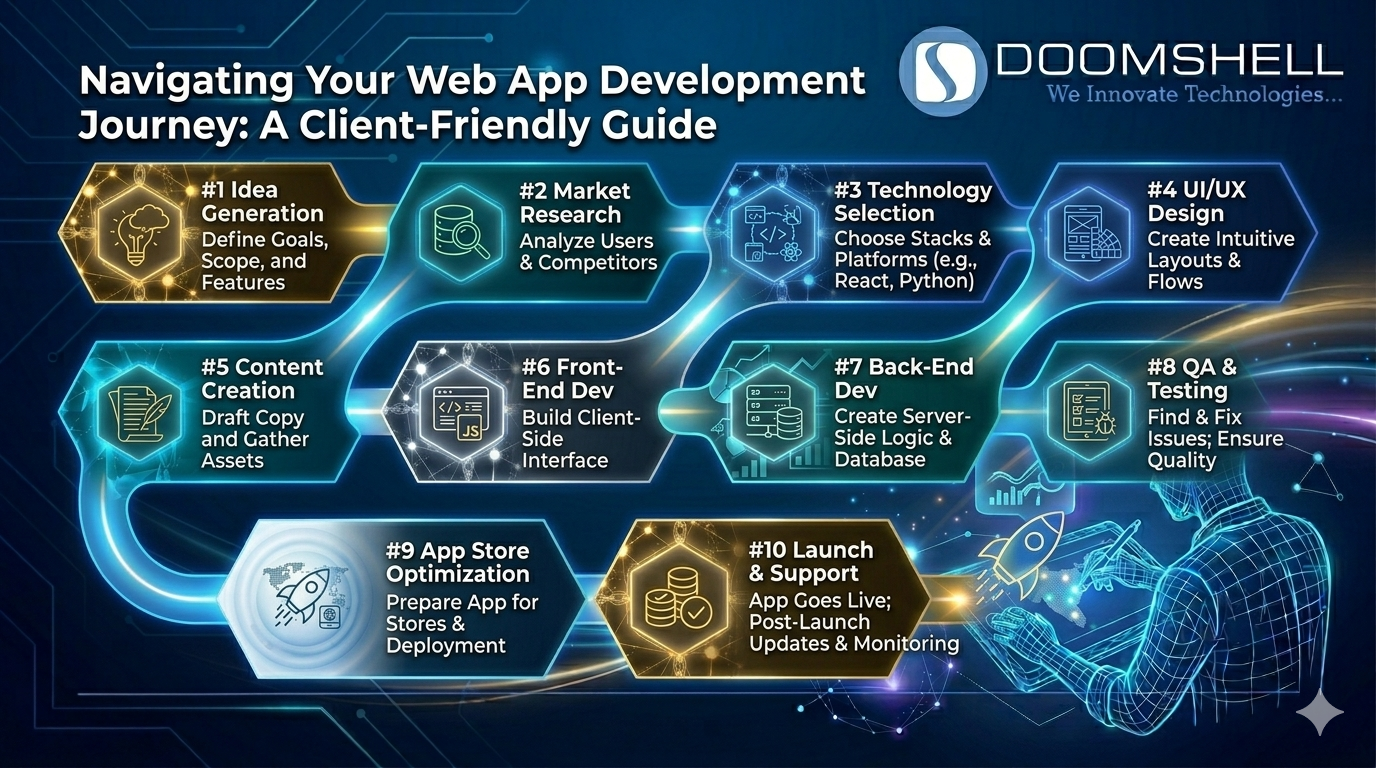
In today’s digital-first world, web applications have become the backbone of modern businesses. Whether you’re launching an eCommerce store, SaaS platform, healthcare portal, educational website, CRM system, or enterprise application, a well-planned web application can significantly improve business operations and customer experiences.
However, building a successful web application involves much more than writing code. It requires strategic planning, user-focused design, robust development, rigorous testing, secure deployment, and continuous maintenance.
Understanding the complete web application development process helps businesses make informed decisions, reduce development risks, and ensure their project is delivered on time and within budget.
In this comprehensive guide, we’ll walk you through every stage of web application development—from the initial idea to post-launch support—so you can better understand how modern web applications are built in 2026.
What is Web Application Development?
Web application development is the process of designing, building, testing, deploying, and maintaining software applications that run in web browsers. Unlike traditional desktop applications, web apps are accessible from anywhere through an internet connection without requiring installation on users’ devices.
Examples of web applications include:
- Customer Relationship Management (CRM) systems
- Learning Management Systems (LMS)
- Online Banking Platforms
- eCommerce Websites
- Healthcare Portals
- Project Management Tools
- Booking Platforms
- Inventory Management Systems
- HR Management Software
- SaaS Applications
Modern web applications focus on performance, security, scalability, and exceptional user experience.
Step 1: Understanding Business Requirements
Every successful web application begins with understanding business objectives and user requirements.
During this discovery phase, development teams work closely with stakeholders to identify:
- Business goals
- Target audience
- Required features
- User workflows
- Technical requirements
- Budget
- Timeline
- Future scalability needs
A clear understanding of project requirements reduces misunderstandings and ensures the final product aligns with business expectations.
Step 2: Planning and System Architecture
Once the requirements are finalized, developers create a detailed roadmap for the project.
This planning stage includes:
- Technology stack selection
- Project architecture
- Database planning
- Security strategy
- API planning
- Development milestones
- Resource allocation
Proper planning minimizes development challenges and establishes a strong foundation for the entire project.
Step 3: UI/UX Design
User experience plays a critical role in the success of any web application.
Designers create wireframes, prototypes, and visual layouts that focus on:
- Clean navigation
- Responsive layouts
- User-friendly interfaces
- Brand consistency
- Accessibility
- Interactive user journeys
A well-designed interface helps users complete tasks quickly while improving engagement and customer satisfaction.
Step 4: Front-End Development
Front-end development transforms design concepts into interactive web pages that users can see and interact with.
Developers use modern technologies such as:
- HTML5
- CSS3
- JavaScript
- React
- Angular
- Vue.js
- Bootstrap
- Tailwind CSS
Front-end development ensures the application is:
- Responsive across devices
- Fast-loading
- Interactive
- Mobile-friendly
- Browser compatible
An optimized front end creates a seamless user experience across desktops, tablets, and smartphones.
Step 5: Back-End Development
The back end is the core engine that powers the application.
Back-end developers build features such as:
- User authentication
- Business logic
- Payment processing
- API integrations
- Data processing
- Security controls
- Notifications
- Reporting systems
Popular back-end technologies include:
- Node.js
- PHP
- Laravel
- Python
- Django
- ASP.NET
- Java
- Spring Boot
A robust back end ensures smooth application performance and secure data management.
Step 6: Database Development
Every web application relies on a database to store and manage information efficiently.
Depending on project requirements, developers may use:
- MySQL
- PostgreSQL
- MongoDB
- Microsoft SQL Server
- Firebase
- Oracle Database
Database optimization improves:
- Performance
- Security
- Data retrieval
- Backup and recovery
- Scalability
Proper database architecture ensures long-term reliability as the application grows.
Step 7: API Integration
Modern web applications often communicate with external services through APIs (Application Programming Interfaces).
Common API integrations include:
- Payment gateways
- SMS services
- Email platforms
- Social media login
- Maps and location services
- CRM software
- ERP systems
- AI-powered services
API integration allows businesses to expand application functionality without developing every feature from scratch.
Step 8: Testing and Quality Assurance
Before launching the application, every feature undergoes extensive testing.
Quality assurance includes:
- Functional testing
- UI testing
- Performance testing
- Security testing
- Compatibility testing
- Load testing
- Mobile responsiveness testing
- Bug fixing
Comprehensive testing ensures the application delivers a reliable and secure user experience.
Step 9: Deployment and Launch
After successful testing, the web application is deployed to a production server where users can access it.
Deployment activities include:
- Server configuration
- Domain setup
- SSL certificate installation
- Database migration
- Performance optimization
- Security implementation
- Monitoring tools
A carefully planned deployment minimizes downtime and ensures a smooth launch.
Step 10: Maintenance and Continuous Improvement
Launching the application is only the beginning.
Regular maintenance helps keep the application secure, efficient, and competitive.
Ongoing maintenance includes:
- Security updates
- Bug fixes
- Performance optimization
- Feature enhancements
- Software upgrades
- Database optimization
- User feedback implementation
- Backup management
Continuous improvement ensures your web application evolves with changing business requirements and technology trends.
Essential Technologies Used in Web Application Development
Modern web applications combine multiple technologies for maximum performance.
Popular technologies include:
- HTML5
- CSS3
- JavaScript
- React
- Angular
- Vue.js
- Node.js
- PHP
- Laravel
- Python
- Django
- MySQL
- PostgreSQL
- MongoDB
- AWS
- Microsoft Azure
- Docker
- Kubernetes
- Git
- REST APIs
Selecting the right technology stack depends on your project’s complexity, scalability, and business goals.
Benefits of Professional Web Application Development
A professionally developed web application provides several business advantages:
- Improved customer experience
- Increased operational efficiency
- Better data management
- Enhanced security
- Higher scalability
- Faster business processes
- Cross-platform accessibility
- Reduced operational costs
- Improved customer engagement
- Long-term business growth
Investing in professional web development creates a strong digital foundation for future expansion.
Future Trends in Web Application Development
Web application development continues to evolve with emerging technologies.
Major trends in 2026 include:
- Artificial Intelligence integration
- Progressive Web Apps (PWAs)
- Low-code development
- Cloud-native architecture
- Serverless computing
- Headless CMS
- Voice-enabled applications
- Blockchain integration
- Real-time collaboration features
- Advanced cybersecurity solutions
Businesses adopting these innovations can build faster, smarter, and more scalable applications.
Conclusion
Developing a successful web application requires careful planning, modern technology, skilled developers, and a user-focused approach. From understanding business requirements and designing intuitive user interfaces to coding, testing, deployment, and ongoing maintenance, every stage contributes to the application’s overall success.
By following a structured web application development process, businesses can reduce risks, improve project efficiency, and create secure, scalable, and high-performing digital solutions. As technology continues to advance in 2026, investing in professional web application development will help organizations stay competitive, improve customer experiences, and drive long-term digital growth.
Frequently Asked Questions
What is the web application development process?
The web application development process includes requirement analysis, planning, UI/UX design, front-end development, back-end development, database creation, API integration, testing, deployment, and ongoing maintenance.
How long does it take to develop a web application?
Development time depends on the complexity of the project. A basic web application may take 2–4 months, while enterprise-level applications can require 6–12 months or longer.
Which technologies are commonly used in web application development?
Popular technologies include HTML5, CSS3, JavaScript, React, Angular, Vue.js, Node.js, PHP, Laravel, Python, Django, MySQL, PostgreSQL, MongoDB, AWS, and REST APIs.
Why is testing important in web application development?
Testing helps identify bugs, improve security, ensure performance, verify compatibility across devices and browsers, and provide users with a reliable and seamless experience.
Why is ongoing maintenance necessary after launching a web application?
Regular maintenance keeps the application secure, improves performance, fixes bugs, updates software dependencies, adds new features, and ensures compatibility with evolving technologies and user requirements.