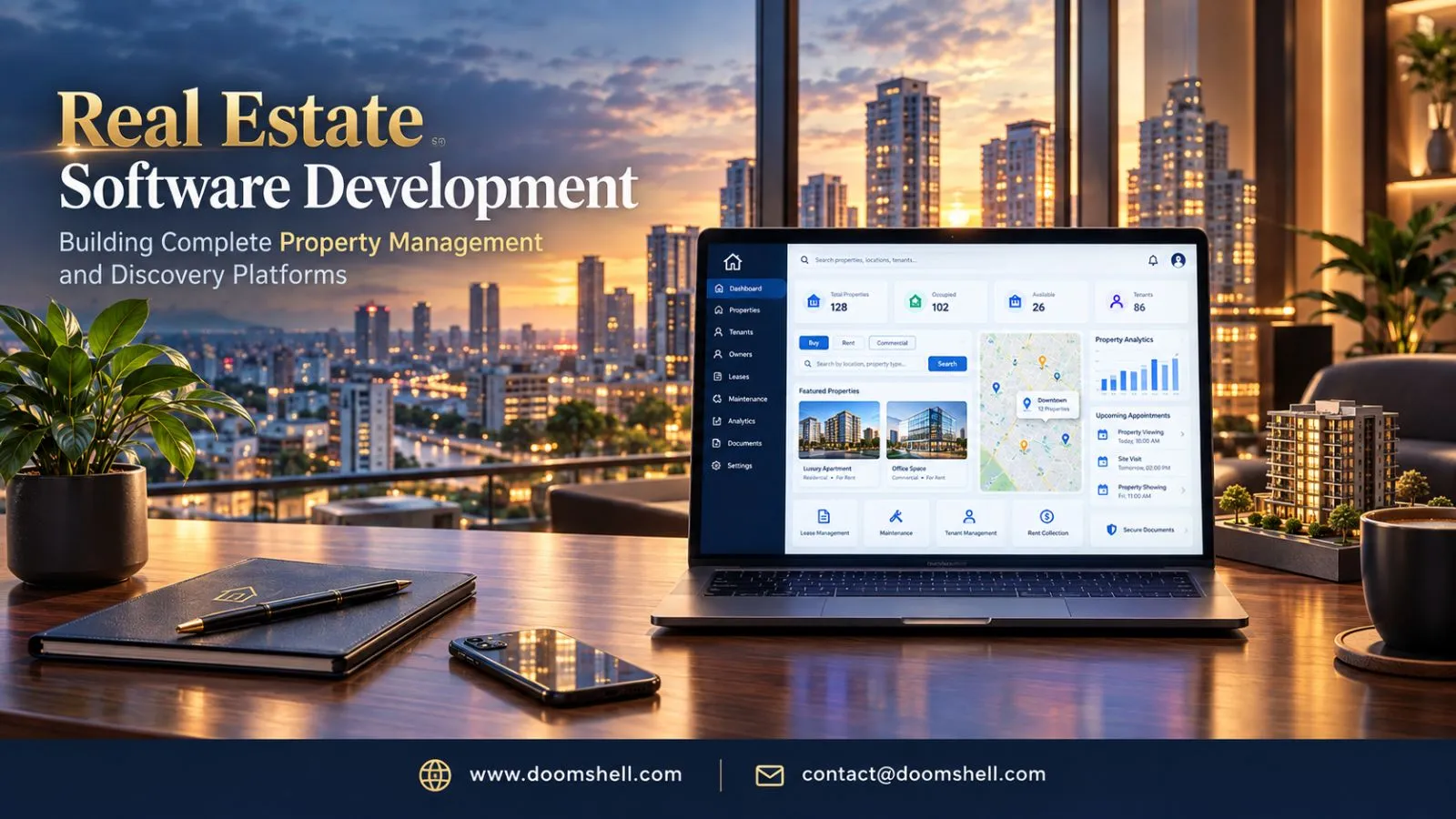
Real Estate Software Development is no longer limited to creating property listing websites. Buyers, renters, agents, brokers, developers, and property managers increasingly expect a complete digital experience where they can discover properties, compare listings, submit inquiries, manage leads, complete documentation, and track transactions from connected platforms.
A modern real estate application needs both an engaging frontend and a reliable backend. The frontend handles search, maps, listings, dashboards, and customer interactions, while backend services manage property data, authentication, workflows, integrations, and transactions.
The architecture should also prioritize web performance. Modern web development increasingly emphasizes responsive interaction and user-centric performance metrics such as Core Web Vitals, while browser capabilities continue to evolve through the 2026 Baseline.
Creating Property Search and Discovery Experiences
Property discovery is often the first major interaction between a customer and a real estate platform. A useful search experience should make it easy to find relevant properties without forcing users through complicated navigation.
Building Property Search With Full-Stack Development
Full-stack development allows property search to connect the user interface with structured property databases and backend services.
A real estate search platform can support criteria such as:
-
Location
-
Property type
-
Price range
-
Number of bedrooms
-
Number of bathrooms
-
Area
-
Furnishing
-
Amenities
-
Availability
-
Property status
The backend can process these parameters and return relevant properties, while the frontend presents results through cards, lists, maps, or other interactive layouts.
For larger property databases, search architecture should also consider indexing, pagination, caching, and efficient database queries. This becomes particularly important when thousands of listings need to be searched without making the interface feel slow.
Creating Advanced Filters and Location-Based Search
Location is one of the defining elements of real estate discovery.
A platform can combine addresses, geographic coordinates, neighborhoods, postal areas, landmarks, and map boundaries to create more useful search experiences.
For example, a customer could search for:
Apartments → Within a selected area → Under a specific budget → Near a chosen location
Advanced filtering can then narrow the results without requiring users to restart the search.
Location-based services can also support map markers, distance calculations, geocoding, nearby amenities, and neighborhood exploration.
When integrating mapping services, developers should also consider API security, data handling, request controls, and client-side protection. Modern mapping platforms provide security guidance for API-based applications, including controls around authentication and data in transit.
Developing Interactive Property Listing Pages
A property listing page should bring important information together in a format that supports decision-making.
A detailed property page can include:
-
Property images
-
Videos or virtual tours
-
Price
-
Property specifications
-
Floor plans
-
Amenities
-
Location information
-
Nearby facilities
-
Agent details
-
Availability
-
Inquiry options
Interactive components can allow visitors to switch between images, compare specifications, view maps, or request additional information without navigating away from the property.
Structured property information is also important for search visibility and AI-assisted discovery. Pages should use clear headings, descriptive content, structured data where appropriate, and consistent property attributes so that both users and automated systems can understand the listing.
Building Agent and Customer Portals
A real estate platform serves multiple types of users. Customers need property discovery and communication tools, while agents and property managers need operational dashboards.
Creating Real Estate Dashboards With Full-Stack Technologies
A real estate dashboard can provide agents with a centralized workspace for managing properties, inquiries, leads, appointments, and customer interactions.
An agent dashboard might include:
-
Active listings
-
New inquiries
-
Scheduled property visits
-
Lead status
-
Follow-up tasks
-
Property performance
-
Customer conversations
-
Documents
-
Recent activity
Administrators can receive broader controls for managing users, properties, agents, locations, permissions, and platform settings.
Role-based dashboards help ensure that users see the information relevant to their responsibilities instead of exposing every system function to every account.
Developing Lead and Customer Management Features
Real estate businesses generate leads through property searches, inquiry forms, calls, advertisements, property visits, and other channels.
A lead management system can capture these interactions and move prospects through defined stages.
For example:
New Lead → Contacted → Qualified → Property Visit → Negotiation → Converted
Each stage can trigger specific actions or reminders.
Customer profiles can store relevant interactions, preferred property types, budgets, locations, and communication history.
Automation can then help agents identify which leads require follow-up while reducing the amount of manual administrative work.
Building Property Management Workflows
Property management requires more than listing properties online.
A management workflow can include:
-
Property onboarding
-
Owner information
-
Tenant information
-
Availability
-
Maintenance requests
-
Lease documentation
-
Payment records
-
Property inspections
-
Notifications
The same platform can connect property information with operational workflows so that managers have a consistent view of each asset.
Workflow states should be explicit. For example, a maintenance request can move from submitted to assigned, in progress, and completed, with relevant users receiving updates at each stage.
Developing Real Estate Transaction Features
Once a customer identifies a property, the platform needs to support the next steps of the transaction.
Building Property Inquiry and Booking Workflows
A property inquiry should become a structured workflow rather than simply an email notification.
The system can capture the property, customer information, inquiry type, preferred contact time, and requested action.
For rental or short-term property platforms, booking workflows can include:
-
Property selection
-
Availability verification
-
Customer information
-
Price calculation
-
Booking request
-
Payment or authorization
-
Confirmation
-
Notification
The backend should verify availability and transaction status before confirming the final result.
This prevents outdated frontend information from becoming the source of truth for a transaction.
Integrating Payment and Verification Services
Real estate platforms may need payments for deposits, bookings, application fees, property services, or other transactions.
Payment integrations should be handled through secure backend services rather than exposing sensitive credentials in frontend code.
A reliable payment workflow should account for:
-
Successful transactions
-
Failed payments
-
Pending payments
-
Duplicate requests
-
Refunds
-
Webhook events
-
Transaction reconciliation
Verification services can also be integrated when businesses need identity, document, or customer verification.
The important principle is to treat payment and verification responses as externally generated events that must be validated before changing the internal transaction state.
Creating Document Management Features
Real estate processes can generate significant amounts of documentation.
A digital document management module can organize:
-
Property documents
-
Agreements
-
Lease contracts
-
Identity documents
-
Inspection reports
-
Payment records
-
Verification documents
-
Supporting attachments
Documents should be associated with the appropriate property, customer, agent, or transaction.
Access should be controlled through permissions rather than simply hiding document links from unauthorized users.
Audit records can also help track important actions such as document uploads, replacements, approvals, and downloads.
Integrating Real Estate Business Systems
Real estate companies often already use multiple systems for customer management, property operations, marketing, accounting, payments, and communication.
A modern platform should therefore be designed for integration from the beginning.
Developing APIs for Property Platforms
APIs allow property applications to exchange information between frontend interfaces, backend services, mobile applications, CRM systems, and external providers.
A real estate API can expose controlled resources such as:
-
Properties
-
Locations
-
Agents
-
Customers
-
Leads
-
Appointments
-
Bookings
-
Documents
-
Transactions
API design should include authentication, authorization, input validation, rate controls, logging, and consistent error handling.
The API should also avoid exposing unnecessary database fields. Returning only the information required by a specific application reduces complexity and limits unnecessary data exposure.
Connecting CRM and Property Management Systems
CRM integration can connect customer interactions with property information.
For example:
Website Inquiry → CRM Lead → Property Match → Agent Assignment → Follow-Up → Conversion
Property management integration can provide additional operational information such as availability, tenant records, maintenance status, or lease information.
Instead of allowing each application to directly modify every other system, an integration layer can coordinate data exchange.
This makes the overall architecture easier to maintain when a business adds new services or changes an existing platform.
Building Scalable Full-Stack Real Estate Applications
Real estate applications need to scale across both data volume and user activity.
A growing platform may eventually handle:
-
Large property catalogs
-
Multiple locations
-
Thousands of agents
-
High search traffic
-
Customer accounts
-
Images and documents
-
Payment transactions
-
External API requests
-
Analytics workloads
A modular architecture can separate major capabilities such as search, listings, authentication, CRM, transactions, documents, and integrations.
Caching can reduce repeated database queries, while asynchronous processing can handle tasks such as notifications, document processing, image optimization, and data synchronization without blocking the main user request.
Frontend performance should receive equal attention. Large property images, maps, galleries, and interactive components can affect page loading and responsiveness. Core Web Vitals and real-user performance measurements provide useful signals for identifying these problems.
Using AI in Real Estate Platforms
AI can extend a real estate platform beyond traditional keyword search.
A conversational property search interface could allow users to describe requirements naturally:
“Find a three-bedroom apartment near a business district with parking and a moderate budget.”
An AI service can convert the request into structured search parameters before the platform queries its property database.
AI can also support:
-
Property recommendations
-
Lead classification
-
Automated inquiry responses
-
Listing content assistance
-
Document classification
-
Customer support
-
Property matching
-
Market-data summarization
However, AI-generated information should not replace authoritative property records.
Price, availability, ownership information, transaction status, and other critical data should come from validated system records.
Designing Real Estate Platforms for Long-Term Growth
A real estate application should be designed around business processes rather than individual screens.
A property listing may eventually connect to:
Property → Agent → Customer → Inquiry → Visit → Document → Transaction → CRM
Designing these relationships clearly allows the platform to support new workflows without rebuilding its core architecture.
It also makes future expansion easier. A business may start with residential listings and later add commercial properties, rentals, property management, or developer inventory.
A modular full-stack foundation can accommodate these changes while keeping individual components manageable.
Conclusion
Real Estate Software Development enables property businesses to build connected platforms that combine discovery, customer management, transactions, documentation, and property operations.
Full-stack development can support advanced property search, location-based discovery, interactive listings, agent dashboards, customer portals, lead management, booking workflows, payments, verification, and document management.
The strongest platforms are not simply digital property catalogs. They connect the entire property journey—from the first search and inquiry to agent engagement, verification, documentation, and transaction management.
By combining scalable APIs, optimized databases, secure integrations, responsive interfaces, and carefully governed AI capabilities, real estate businesses can build digital platforms that are easier to extend as property inventory, users, locations, and operational requirements grow.