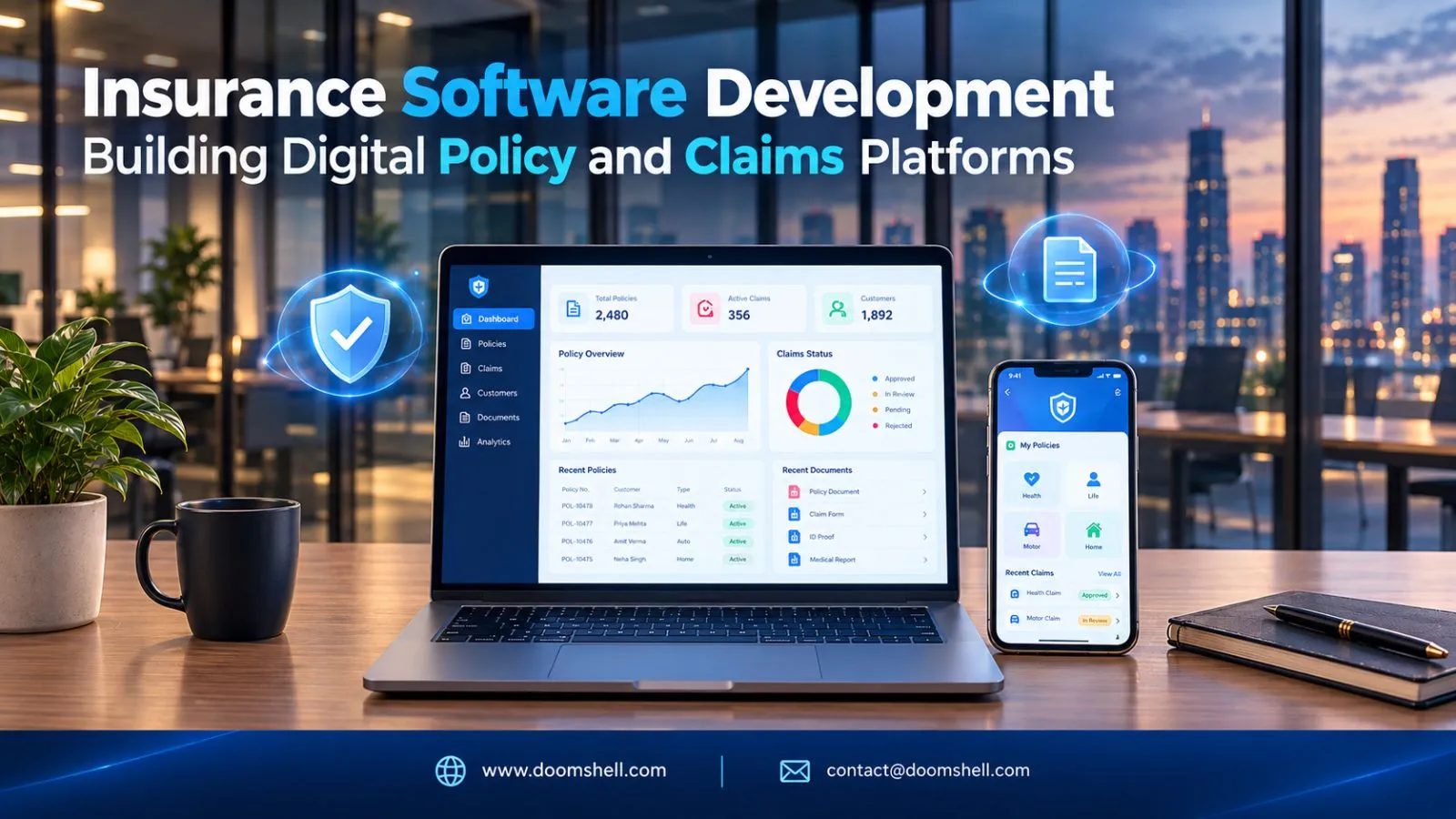
Modern insurance applications are moving from fragmented administrative tools toward digital workflows that provide faster customer service, automated claims processing, structured data, and real-time operational visibility.
In 2026, Yii remains a practical foundation for building data-intensive insurance platforms, with Yii 2.0.55 released in May 2026 and continued improvements around security, PHP compatibility, static analysis, and application tooling.
Creating Digital Insurance Portals
Digital insurance portals give customers, agents, and brokers a centralized way to manage policies and insurance-related activities. Instead of depending on phone calls, emails, or manual paperwork for every interaction, users can access relevant information and complete eligible tasks through self-service interfaces.
Building Customer Policy Portals With Yii
A customer policy portal can provide access to policy details, coverage information, renewal dates, premium status, documents, claims, and communication history.
Yii can provide the backend architecture for managing these workflows while a responsive frontend delivers the customer experience.
A typical portal can support:
-
Policy viewing and document downloads
-
Premium and payment information
-
Renewal reminders
-
Claim submission
-
Claim status tracking
-
Personal information updates
-
Secure customer communication
The application should expose only information associated with the authenticated customer and enforce authorization at the server level.
For insurance businesses, this creates a single digital entry point for routine policy management while reducing repetitive administrative interactions.
Developing Agent and Broker Dashboards
Agents and brokers need a different view from policyholders. Their dashboards may involve multiple customers, policies, applications, renewals, claims, commissions, and follow-up activities.
A Yii-based dashboard can organize these workflows around role-specific responsibilities.
For example, an agent could see:
New leads → Pending applications → Policies requiring action → Upcoming renewals → Open claims
This turns the application into an operational workspace rather than simply a database interface.
Dashboards can also provide filtering by customer, policy type, region, status, or renewal period, allowing agents to prioritize their work more efficiently.
Creating Personalized Insurance Interfaces
Personalization can make insurance portals easier to navigate by displaying the information most relevant to a specific customer or user role.
A policyholder with multiple products might see health, property, vehicle, or business policies grouped separately. An agent could instead see customer portfolios, renewal opportunities, or unresolved claims.
Personalization should remain controlled by business rules and access permissions. Sensitive insurance information should not be surfaced merely because it exists in the underlying database.
Automating Claims Management
Claims processing can involve multiple stages, including submission, document collection, verification, assessment, approval, payment, and closure.
Insurance software development can convert these stages into structured workflows so that each claim has a clear state, responsible team, required information, and audit history.
Building Claims Processing Workflows With Yii
A claims platform can model a claim through clearly defined states such as:
Submitted → Under Review → Documents Required → Assessment → Approved/Rejected → Payment → Closed
Each transition can trigger the appropriate business workflow.
For example, submitting a claim could automatically create a review task, validate required information, request missing documents, and notify the customer.
This approach reduces manual coordination and gives claims teams a consistent process for handling cases.
Yii's structured MVC architecture and database capabilities can support these workflow-driven applications while keeping business logic separated from presentation and data-access layers.
Creating Document and Verification Modules
Insurance claims often depend on documents such as invoices, identification records, repair estimates, medical documents, photographs, or proof of ownership.
A digital claims platform can provide secure document upload and verification workflows.
The application can track:
-
Document type
-
Upload status
-
Verification status
-
Submission date
-
Reviewer
-
Claim association
-
Required or optional status
Document-processing services can also be integrated to extract structured information from uploaded files. For example, an invoice-processing workflow could identify amounts, dates, and supplier information before sending the extracted data for validation.
AI can assist with classification and extraction, but sensitive claim decisions should remain subject to defined business rules and appropriate human review.
Automating Claim Status Updates With Yii
Customers frequently want to know what is happening with their claim.
Instead of requiring customers to contact an insurer for every update, the platform can automatically communicate important workflow changes.
A claim-status event can trigger:
-
Customer notifications
-
Agent alerts
-
Internal tasks
-
Dashboard updates
-
Document requests
-
Follow-up reminders
The application can maintain a complete event history so that both customers and authorized employees have a consistent view of the claim's progress.
This also creates a foundation for operational reporting, allowing insurers to identify claims that remain in a particular stage longer than expected.
Managing Policy and Customer Data
Insurance platforms depend on structured information. Customer profiles, policy records, coverage details, beneficiaries, premiums, claims, payments, and documents need to remain connected without creating unnecessary duplication.
Using Yii ActiveRecord for Insurance Data
Yii ActiveRecord provides an object-oriented interface for accessing and manipulating database records. An ActiveRecord model maps application objects to database tables and supports querying, validation, relationships, saving, and transactions.
This can be useful for insurance applications where business entities naturally map to structured records.
For example, an insurance platform might define relationships between:
Customer → Policy → Coverage → Claim → Documents → Payment
These relationships allow developers to create application services around real insurance entities while keeping database interactions organized.
Transactions can also help protect data consistency when several related records need to be updated as part of one business operation.
Building Policy Management Systems With Yii
A policy management system can centralize the lifecycle of insurance products.
The platform may manage:
-
New policy applications
-
Policy issuance
-
Coverage changes
-
Endorsements
-
Renewals
-
Cancellations
-
Expiration
-
Premium information
-
Policy documents
A policy should also have a clear history of important changes. Rather than simply replacing an existing value, the system can preserve relevant versions and effective dates.
This becomes especially useful when employees need to understand what coverage or policy information applied at a specific point in time.
Creating Advanced Search and Reporting Features
Insurance teams often need to search across large datasets.
Search and reporting can help users identify policies by customer, product, status, renewal date, geographic area, claim status, or other business attributes.
Yii's data-access and grid capabilities can support filterable administrative interfaces, while reporting services can transform operational data into management dashboards.
Reports might include:
-
Claims by status
-
Claims processing time
-
Renewal pipelines
-
Policy growth
-
Premium activity
-
Open documentation requests
-
Customer service workloads
The key is to distinguish operational reporting from analytical workloads. Large reports should not unnecessarily slow down customer-facing transactions.
Integrating Insurance Applications
Insurance businesses commonly depend on multiple external systems. Payment processors, identity services, CRM platforms, document services, communication providers, and third-party insurance systems may all need to exchange information with the core application.
Building REST APIs With Yii Framework
Yii provides REST controller capabilities for exposing application resources through APIs. Its REST framework includes features such as HTTP method validation, data formatting, authentication, rate limiting, and authorization support.
This makes REST APIs suitable for connecting insurance applications with web portals, mobile applications, partner systems, and internal services.
For example, an API layer could expose controlled resources for:
-
Customers
-
Policies
-
Claims
-
Payments
-
Documents
-
Agents
-
Notifications
API design should include authentication, authorization, validation, versioning, monitoring, and clear ownership of sensitive data.
Connecting Payment and Verification Services
Insurance platforms may need external services for premium payments, identity verification, bank-account verification, fraud checks, document verification, or communication.
An integration layer can isolate third-party dependencies from the core policy and claims logic.
For example:
Insurance Platform → Integration Service → External Provider → Normalized Response
The application can then convert different provider responses into a consistent internal format.
This makes it easier to replace or add providers without rewriting core insurance workflows.
Payment workflows should also be designed around explicit transaction states such as initiated, authorized, processing, completed, failed, or reversed.
Integrating CRM and Third-Party Insurance Systems
CRM systems can contain valuable customer and sales information, while existing insurance systems may remain responsible for policy administration or claims processing.
A modern platform can connect these systems through APIs, webhooks, scheduled synchronization, or event-driven workflows.
The most important architectural decision is defining which system owns each piece of information.
For example, the CRM may own customer engagement information, while the policy platform owns coverage and policy status.
Clear data ownership reduces synchronization conflicts and prevents teams from working with outdated records.
Building AI-Assisted Insurance Workflows
AI is increasingly becoming an application layer for insurance operations rather than a standalone technology experiment.
Claims platforms can use AI-assisted document classification, information extraction, summarization, anomaly detection, and customer-service workflows.
For example, an incoming claim could be classified automatically, required documents could be identified, and extracted information could be presented to a claims professional for verification.
A responsible architecture keeps AI outputs distinguishable from verified insurance records. High-impact decisions should have appropriate review controls, auditability, and clearly defined escalation paths.
This creates a practical balance between automation and human oversight.
Making Insurance Platforms Secure and Scalable
Insurance applications contain sensitive customer, financial, policy, and claims information. Security should therefore be integrated into the architecture rather than added after development.
Important controls include:
-
Strong authentication
-
Role-based authorization
-
Encryption
-
Secure document storage
-
API security
-
Audit logging
-
Rate limiting
-
Input validation
-
Backup and recovery
-
Security monitoring
Yii's 2.0.55 release in May 2026 included a security fix related to isolated variables in view and error-handler rendering, along with improved compatibility and static-analysis annotations.
Keeping the framework and dependencies maintained is therefore an important part of operating production insurance applications.
Scalability should also be considered across application servers, databases, background workers, document processing, APIs, and reporting workloads. Heavy operations such as large report generation or document processing can be moved into background jobs rather than blocking customer-facing requests.
Designing Insurance Platforms for Long-Term Growth
Insurance applications often evolve gradually. A company may begin with policy management and later add claims, payments, customer portals, agent workflows, analytics, AI-assisted processing, or new insurance products.
A modular architecture allows these capabilities to develop without turning the entire platform into a tightly coupled system.
Yii's MVC structure, ActiveRecord data layer, REST capabilities, validation mechanisms, and extensible architecture can support this approach. The framework also continues to receive 2026 ecosystem updates, including Yii 2.0.55 and newer supporting packages.
The objective should be to build a platform that can accommodate new workflows while keeping core policy and claims data consistent.
Conclusion
Insurance software development is transforming policy and claims operations by connecting customer portals, agent dashboards, claims workflows, policy data, payments, verification services, and third-party systems into unified digital platforms.
Yii provides a structured foundation for these applications, with ActiveRecord for data-driven systems and REST capabilities for connecting insurance platforms with other applications and services.
The most effective insurance platforms do more than digitize existing forms. They create connected workflows where policy changes, claims, documents, payments, notifications, and customer interactions can move through clearly defined processes.
For insurers and insurance technology businesses planning a new platform, the combination of modular architecture, secure APIs, structured data management, workflow automation, and carefully governed AI capabilities can provide a foundation for scalable digital insurance operations.