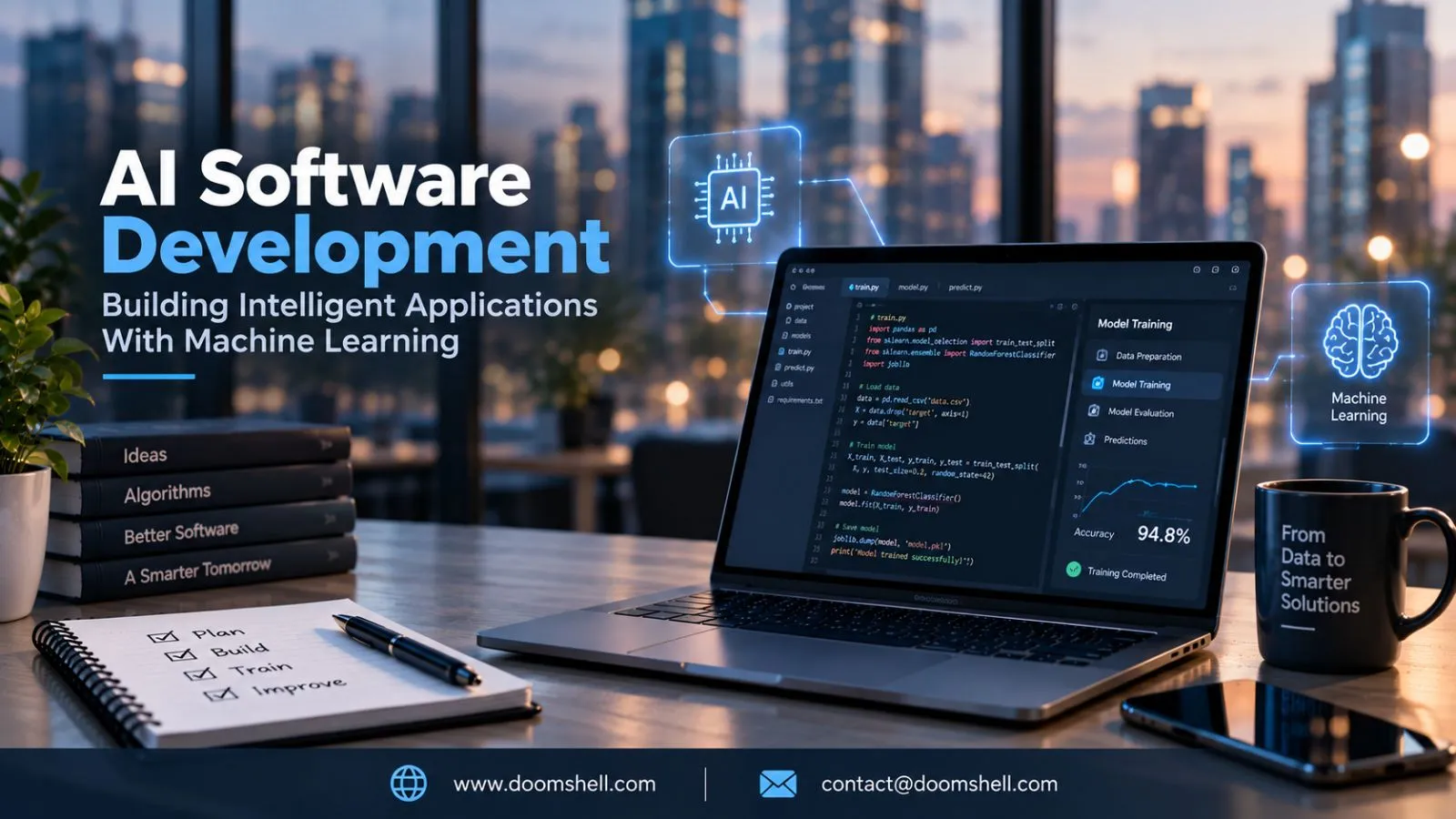
Modern AI applications are moving beyond standalone models toward production systems that connect business data, AI APIs, retrieval systems, human workflows, and secure application infrastructure.
In 2026, Python remains a major foundation for AI development, while FastAPI, LLM APIs, vector search, structured outputs, and cloud-native deployment patterns are helping teams turn AI models into usable business applications.
Developing AI-Powered Business Applications
AI becomes valuable when it is connected to a specific business workflow. Instead of building an AI model in isolation, organizations can integrate intelligence into customer applications, internal tools, analytics platforms, and operational systems.
AI software development can support use cases such as document processing, forecasting, recommendation engines, intelligent search, customer assistance, fraud detection, and workflow automation.
Building AI Features With Python
Python provides a flexible development environment for creating AI features because it can connect application logic, data-processing pipelines, machine learning models, and AI services within the same technology ecosystem.
A business application can use Python to perform tasks such as:
-
Classifying incoming documents
-
Extracting information from text
-
Detecting patterns in operational data
-
Predicting demand
-
Ranking recommendations
-
Summarizing business information
-
Generating structured responses
The important architectural consideration is separating the AI component from the application's core business rules where appropriate. This allows models to be updated, evaluated, or replaced without rebuilding the entire application.
Integrating Machine Learning Models Into Web Applications
A trained machine learning model becomes useful when users and business systems can access its predictions.
A web application might send customer or operational data to a model service, receive a prediction, and use that result to trigger a business workflow.
For example:
User request → Application validation → AI model → Prediction → Business rules → User response
The model should not automatically become the final decision-maker for every workflow. Applications can introduce confidence thresholds, human review, validation rules, and fallback paths for uncertain predictions.
This approach is especially useful when AI output affects customer interactions, financial operations, healthcare workflows, or other sensitive processes.
Developing Intelligent Recommendation and Prediction Systems
Recommendation systems can help businesses personalize products, content, services, or actions based on relevant user and contextual data.
Prediction systems can estimate outcomes such as demand, customer churn, delivery delays, inventory requirements, or operational anomalies.
Effective systems combine model predictions with application context. A recommendation engine, for example, can consider model-generated rankings alongside availability, business rules, customer preferences, and real-time constraints.
This creates a more useful decision layer than relying on a model's output alone.
Creating Data-Driven Machine Learning Solutions
Machine learning performance depends heavily on the quality and structure of the data used to train and operate the system.
AI software development should therefore treat data engineering, model evaluation, monitoring, and lifecycle management as core components of the solution.
Data Processing and Model Development With Python
Python can be used to build data pipelines that clean, transform, validate, and prepare information for machine learning.
A typical workflow can include:
Data collection → Validation → Cleaning → Feature preparation → Model training → Evaluation → Deployment
Data validation is particularly important because changes in upstream systems can affect model behavior without any change to the model itself.
Production systems should also track model versions, training data versions, evaluation results, and deployment history so teams can understand how a prediction system has changed over time.
Building Predictive Analytics Applications
Predictive analytics applications turn historical and real-time information into forecasts or probability estimates.
Businesses can apply these systems to areas such as:
-
Demand forecasting
-
Customer behavior analysis
-
Equipment maintenance
-
Risk detection
-
Sales forecasting
-
Inventory planning
-
Operational anomaly detection
A predictive application should communicate uncertainty appropriately. A forecast is not a guaranteed outcome, so dashboards can include confidence ranges, historical comparisons, and relevant factors rather than presenting predictions as absolute facts.
This makes AI output easier for business users to interpret.
Automating Machine Learning Workflows With Python
Machine learning projects can become difficult to maintain when model training and deployment depend on manual steps.
Automation can connect data validation, training, testing, evaluation, deployment, and monitoring into repeatable workflows.
A mature machine learning lifecycle can include:
-
Collecting new data
-
Validating data quality
-
Training or retraining models
-
Running evaluation tests
-
Comparing model performance
-
Registering approved versions
-
Deploying the selected model
-
Monitoring production behavior
This approach makes it easier to manage model updates while maintaining traceability.
Developing Generative AI and NLP Applications
Generative AI has expanded the scope of AI software development from prediction and classification toward systems that can understand instructions, retrieve information, generate content, and interact with users through natural language.
For businesses, the challenge is connecting these capabilities to reliable data and controlled workflows.
Building AI Assistants With Python
Python can provide the orchestration layer for AI assistants that interact with business systems.
An enterprise assistant might help employees search internal information, summarize documents, answer operational questions, or initiate approved workflows.
A useful architecture can look like:
User → Python application → Authentication → Retrieval/tools → LLM → Validation → Response
The assistant should only access information the authenticated user is authorized to retrieve.
For knowledge-intensive applications, retrieval-augmented generation can connect the model with current organizational information rather than relying only on information encoded in the model during training.
Developing NLP-Based Business Applications
Natural language processing can turn unstructured text into structured business information.
Applications can process:
-
Customer messages
-
Support tickets
-
Contracts
-
Reports
-
Reviews
-
Emails
-
Product descriptions
-
Internal documents
An NLP workflow might classify a support request, extract key information, determine its category, and route it to the appropriate team.
Structured extraction is particularly useful because it allows unstructured language to become machine-readable application data.
Integrating LLM APIs Into Python Applications
LLM APIs can add text generation, classification, summarization, extraction, reasoning, and conversational capabilities to existing applications.
However, production integration requires more than sending a prompt and displaying the response.
Applications should consider:
-
Input validation
-
Output validation
-
Structured responses
-
Authentication
-
Rate limits
-
Token and usage monitoring
-
Prompt versioning
-
Error handling
-
Sensitive-data controls
-
Model fallback strategies
Structured outputs are particularly valuable for business applications because they allow generated responses to conform to predefined schemas before they are passed to downstream systems.
This reduces the risk of treating free-form model output as trusted application data.
Deploying Scalable AI Applications
AI applications have different infrastructure requirements from conventional web applications. Model inference, data processing, vector search, API traffic, background jobs, and user requests can create different workload patterns.
A production architecture should separate these responsibilities where appropriate.
Building AI APIs With FastAPI
FastAPI is a Python web framework designed for building APIs and provides features such as automatic OpenAPI documentation, type-based validation, asynchronous support, and dependency injection.
It can be used to expose machine learning models and AI services through controlled endpoints.
For example:
Web/Mobile Application → FastAPI → AI Service → Model/LLM → Response
FastAPI can handle request validation and API-level controls while the underlying AI service manages model inference or external AI integrations.
Separating the AI API from the frontend also allows multiple applications to consume the same intelligence layer.
Connecting Python Models With Cloud Infrastructure
Cloud infrastructure can provide scalable compute, storage, networking, monitoring, and deployment capabilities for AI systems.
Different AI workloads may require different infrastructure strategies.
A lightweight prediction model may run efficiently on CPU infrastructure, while larger model inference or training workloads may require specialized accelerators.
A cloud architecture can also separate:
-
Application APIs
-
Model inference services
-
Data storage
-
Feature pipelines
-
Vector databases
-
Background workers
-
Monitoring services
This makes it possible to scale the most demanding component without unnecessarily scaling the entire application.
Creating Production-Ready Python AI Systems
Moving an AI prototype into production requires operational controls around the model as well as the application.
A production-ready system should address:
-
Model and prompt versioning
-
API authentication
-
Data encryption
-
Observability
-
Latency monitoring
-
Cost tracking
-
Error handling
-
Evaluation pipelines
-
Access controls
-
Human review
-
Model performance monitoring
For generative AI, monitoring should extend beyond infrastructure metrics. Teams may also need to evaluate response quality, hallucination rates, retrieval accuracy, instruction-following, and safety behavior.
AI applications should have clear fallback behavior when the model is unavailable or produces an uncertain result.
Building AI Applications With RAG and Intelligent Search
Retrieval-augmented generation is becoming an important architecture for enterprise AI because it can connect language models with an organization's changing information.
Instead of asking an LLM to answer solely from its pretrained knowledge, a RAG system can retrieve relevant information from approved sources and provide that context to the model.
A typical workflow is:
User question → Query processing → Retrieval → Relevant context → LLM → Grounded response
Python can orchestrate the retrieval and generation layers while vector search, metadata filtering, and access-control systems determine which information is eligible for retrieval.
This is especially useful for internal knowledge assistants, technical documentation, customer support, and enterprise search.
The retrieval layer should also enforce permissions. A document that exists in a company's knowledge base should not automatically be available to every employee simply because an AI system can retrieve it.
Making AI Software Development More Reliable in 2026
AI engineering is increasingly shifting from experimentation toward measurable production systems.
The focus is no longer only on whether a model can generate an impressive response. Businesses also need to understand whether the output is accurate enough for the intended task, whether the system can be monitored, how much each request costs, and what happens when the model fails.
For this reason, AI applications benefit from evaluation datasets, automated testing, observability, version control, and human feedback loops.
AI agents can also interact with tools and business systems, but tool permissions should be narrowly scoped. An AI assistant that can retrieve information may require different permissions from one that can create records, send communications, or initiate transactions.
This makes AI governance an application architecture concern, not simply a model-selection decision.
Conclusion
AI software development is evolving from standalone machine learning experiments into complete application ecosystems that combine models, business data, APIs, cloud infrastructure, retrieval systems, and human workflows.
Python provides a flexible foundation for developing machine learning pipelines, NLP applications, AI assistants, predictive systems, and generative AI services. FastAPI can then expose these capabilities through scalable API layers, while cloud infrastructure can support production workloads and independent scaling.
The most valuable AI applications are not necessarily the ones with the largest models. They are systems that connect the right intelligence to the right business workflow, use reliable data, enforce appropriate permissions, measure output quality, and provide clear fallback paths.
For businesses investing in AI in 2026, building production-ready architecture around the model can be just as important as choosing the model itself.