 sales@doomshell.com
 +91 8005523567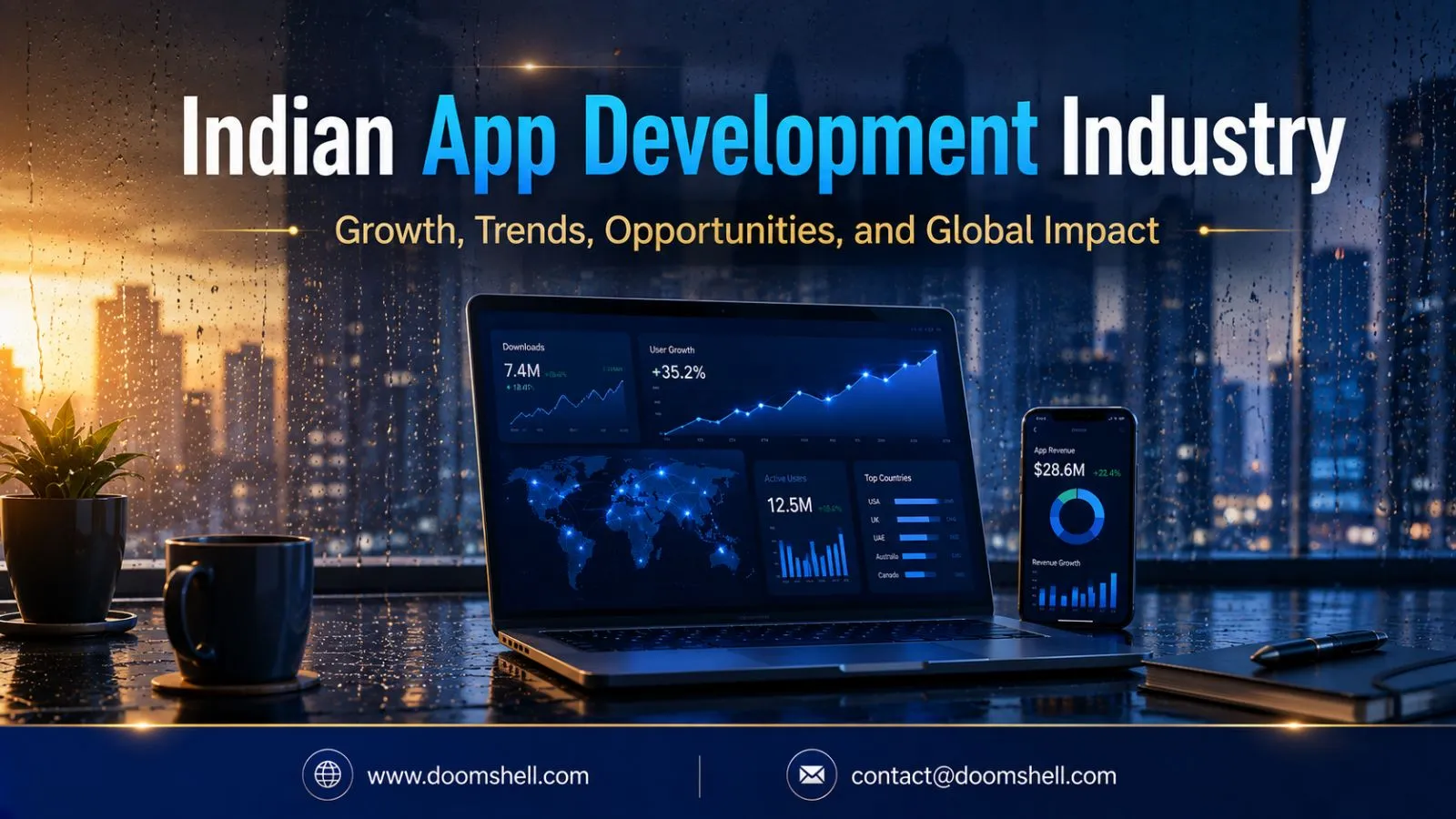
The global mobile application market continues to grow at an impressive pace, driven by increasing smartphone adoption, faster internet connectivity, artificial intelligence, and digital transformation across industries. Businesses of every size now rely on mobile applications to improve customer engagement, streamline operations, and generate new revenue streams. As a result, the Indian App Development Industry has become one of the most influential technology sectors, attracting startups, enterprises, and global brands looking for reliable software development partners.
India has evolved from being a cost-effective outsourcing destination to becoming a global innovation hub for mobile application development. Today, Indian developers build applications for healthcare, fintech, education, retail, logistics, entertainment, and artificial intelligence. This guide explores the industry’s growth, user behavior, emerging technologies, outsourcing advantages, and future opportunities using current market trends and real-world examples.
Why India Has Become a Global App Development Leader
India has established itself as one of the world’s largest software development ecosystems. The country produces thousands of engineering graduates every year while supporting millions of experienced IT professionals working with international companies and technology startups.
Several factors contribute to India’s leadership position:
-
Large pool of skilled developers
-
Competitive development costs
-
Strong English communication
-
Experience with global clients
-
Expertise across multiple technologies
-
Rapid adoption of emerging technologies
Global companies such as Microsoft, Google, Amazon, Adobe, IBM, Oracle, and Salesforce have major engineering centers in India. These organizations provide developers with experience building scalable applications that serve millions of users worldwide.
This combination of technical expertise and practical experience has positioned India as one of the preferred destinations for mobile application development.
Indian App Development Industry: Current Market Growth
The Indian App Development Industry continues expanding as businesses increase investments in mobile-first digital solutions. Organizations across healthcare, banking, education, travel, retail, and logistics are launching mobile applications to improve customer experiences and business efficiency.
Several factors are accelerating this growth.
-
Rising smartphone penetration
-
Affordable mobile internet
-
Digital payment adoption
-
Growth of online businesses
-
Government digital initiatives
-
Increasing startup investments
India also has one of the largest consumer markets for mobile applications. Millions of users download new apps every month, encouraging businesses to invest in user-friendly and feature-rich digital products.
As artificial intelligence and cloud technologies continue evolving, application development companies are integrating advanced features such as chatbots, voice search, predictive analytics, and personalized recommendations into modern mobile applications.
Popular Mobile App Categories Driving Growth
Consumer behavior has changed significantly over the past few years. Mobile applications now support nearly every aspect of daily life, creating opportunities for businesses across multiple industries.
Popular application categories include:
-
Social networking
-
eCommerce
-
Online education
-
Healthcare
-
Digital banking
-
Food delivery
-
Travel booking
-
Gaming
-
Video streaming
-
Productivity tools
For example, digital payment applications have experienced exceptional growth due to widespread adoption of cashless transactions. Similarly, healthcare applications now allow patients to schedule appointments, consult doctors remotely, and access digital prescriptions.
Educational technology has also expanded rapidly, with learning platforms offering interactive courses, skill development programs, and certification opportunities directly through mobile devices.
This diversity creates opportunities for developers specializing in different industries and technology stacks.
Understanding Indian Mobile User Behavior
India has one of the world’s largest smartphone user populations. Mobile devices have become essential for communication, shopping, entertainment, banking, education, and professional work.
Today’s smartphone users expect applications to provide:
-
Fast loading speed
-
Secure payments
-
Personalized experiences
-
Offline functionality
-
Simple navigation
-
Regular feature updates
Businesses that focus on user experience generally achieve better customer retention and higher application ratings.
For example, eCommerce platforms use artificial intelligence to recommend products based on previous purchases, while streaming applications personalize content according to viewing habits.
Developers who understand user behavior can create applications that improve engagement while increasing customer satisfaction and long-term business growth.
The Rise of Enterprise Mobile Applications
Consumer applications dominate app stores, but enterprise software has become one of the fastest-growing segments in mobile development. Organizations increasingly rely on custom mobile applications to improve internal operations and employee productivity.
Many companies now invest in Mobile App Development Services for solutions such as:
-
Customer relationship management
-
Inventory tracking
-
Employee attendance
-
Field service management
-
Business analytics
-
Internal communication
For instance, logistics companies use mobile applications to monitor deliveries in real time, while manufacturing businesses track production processes through custom dashboards.
Enterprise applications reduce manual work, improve operational efficiency, and support data-driven decision-making. As digital transformation continues across industries, demand for customized enterprise applications is expected to increase significantly.
Emerging Technologies Transforming App Development
Modern mobile applications are becoming more intelligent through the adoption of advanced technologies. Businesses expect applications not only to perform tasks but also to provide predictive insights and personalized experiences.
Leading technologies shaping the industry include:
-
Artificial Intelligence
-
Machine Learning
-
Internet of Things (IoT)
-
Blockchain
-
Augmented Reality
-
Cloud Computing
For example, retail applications now use AI-powered recommendation engines, while healthcare platforms integrate wearable devices to monitor patient health in real time.
Developers who stay updated with these technologies can create innovative applications that improve customer engagement while helping businesses remain competitive in rapidly changing digital markets.
App Monetization Models That Drive Business Growth
Building a successful mobile application is only the first step. Businesses also need a sustainable revenue strategy to maximize their return on investment. Choosing the right monetization model depends on the target audience, app category, and long-term business goals.
Popular monetization methods include:
-
In-app purchases
-
Subscription plans
-
Freemium models
-
In-app advertising
-
Affiliate partnerships
-
Premium downloads
For example, streaming platforms generate recurring revenue through monthly subscriptions, while gaming applications often rely on in-app purchases and virtual rewards. E-commerce applications increase revenue by offering personalized recommendations and loyalty programs that encourage repeat purchases.
Selecting the right monetization strategy helps businesses improve profitability while maintaining a positive user experience and long-term customer retention.
Cost of Mobile App Development in India
Development cost remains one of the biggest reasons companies choose India for software projects. While pricing depends on project complexity, technology stack, features, and development timeline, India continues to offer excellent value compared to many Western countries.
Development costs are influenced by:
-
Application complexity
-
Platform selection
-
Third-party integrations
-
Security requirements
-
Maintenance and updates
For instance, a basic business application generally requires fewer resources than an AI-powered healthcare platform with real-time analytics and cloud integration.
The lower operational costs in India allow businesses to allocate more budget toward marketing, customer acquisition, and future product improvements without compromising development quality.
This combination of affordability and technical expertise makes India a preferred destination for startups and enterprises alike.
Why Global Businesses Outsource App Development to India
Outsourcing has become a strategic decision rather than simply a cost-saving measure. Organizations worldwide choose India because they gain access to experienced development teams capable of delivering high-quality mobile applications within competitive timelines.
Major outsourcing advantages include:
-
Experienced software engineers
-
Flexible hiring models
-
Faster project delivery
-
Strong technical expertise
-
Excellent communication
-
Long-term support services
Many international startups begin with a dedicated development team in India before expanding globally. This approach enables rapid product development while reducing recruitment challenges.
Indian development companies also provide expertise across Android, iOS, Flutter, React Native, cloud technologies, artificial intelligence, blockchain, and enterprise software, making them suitable for projects across different industries.
Challenges and Opportunities in the Indian App Market
Despite rapid growth, the mobile application industry also faces challenges that businesses and developers must address. Understanding these issues allows organizations to build stronger digital products and improve long-term success.
Common challenges include:
-
High market competition
-
User retention
-
Data privacy regulations
-
Cybersecurity risks
-
Changing customer expectations
-
Continuous technology updates
At the same time, these challenges create significant opportunities.
Businesses investing in innovative technologies, personalized user experiences, and strong cybersecurity practices can differentiate themselves in increasingly competitive app stores.
Growing adoption of artificial intelligence, wearable devices, digital payments, and connected technologies continues creating new opportunities for developers and entrepreneurs entering the Indian market.
Future Trends Shaping the Mobile App Industry
The next generation of mobile applications will be powered by intelligent automation, cloud-native infrastructure, and immersive user experiences. Businesses are increasingly investing in technologies that improve customer engagement while simplifying business operations.
Emerging trends include:
-
AI-powered mobile applications
-
Voice-enabled interfaces
-
Super apps
-
5G-powered experiences
-
Cloud-native development
-
Low-code application platforms
Demand for Mobile App Development Services is expected to increase as organizations modernize legacy systems and launch mobile-first digital products.
Industries such as healthcare, fintech, logistics, education, retail, and manufacturing will continue driving mobile application adoption. Companies that embrace these technologies early will be better positioned to meet changing customer expectations and remain competitive.
Conclusion
The Indian App Development Industry has transformed into one of the world’s leading technology ecosystems by combining skilled professionals, competitive pricing, innovation, and global project experience. Businesses across every industry now rely on Indian developers to build secure, scalable, and feature-rich applications that support digital transformation.
Although competition continues increasing, India’s strong engineering talent, modern technology expertise, and growing startup ecosystem ensure continued expansion in the coming years. Organizations seeking reliable development partners benefit from India’s technical capabilities, flexible engagement models, and proven ability to deliver high-quality software solutions.
As mobile technology continues evolving through artificial intelligence, cloud computing, and next-generation connectivity, India is expected to remain a driving force behind global mobile application innovation.
Frequently Asked Questions
1. Why is the Indian app development industry growing so quickly?
The industry is expanding because of increasing smartphone adoption, digital transformation, affordable internet, skilled software engineers, government technology initiatives, and growing demand for mobile-first business solutions.
2. Why do global companies outsource app development to India?
Businesses choose India because of its experienced developers, competitive pricing, excellent communication, flexible hiring models, and expertise across Android, iOS, Flutter, React Native, AI, and cloud technologies.
3. Which industries benefit most from mobile app development?
Healthcare, fintech, education, retail, logistics, travel, entertainment, manufacturing, and eCommerce are among the industries investing heavily in custom mobile applications to improve customer experiences and operational efficiency.
4. What technologies are shaping the future of mobile applications?
Artificial intelligence, machine learning, cloud computing, blockchain, Internet of Things (IoT), augmented reality, voice assistants, and 5G connectivity are driving innovation across the mobile application industry.
5. How can businesses choose the right app development company in India?
Evaluate technical expertise, project portfolio, client reviews, communication processes, technology stack, post-launch support, security practices, and experience within your industry before selecting a development partner.