As businesses invest in digital transformation, choosing the right development team has become essential for controlling costs and achieving sustainable growth. When you hire full-stack developers from India, you can access professionals who work across frontend interfaces, backend systems, databases, and application integrations. An experienced IT Company can help businesses evaluate their technical requirements, select an appropriate hiring model, and build software that supports long-term objectives.
However, lower development costs alone do not guarantee better results. Businesses must also consider developer expertise, communication, project management, security, maintenance, and the total cost of delivering a successful product. A detailed cost-benefit analysis helps decision-makers understand where outsourcing creates value and how to minimise potential risks.
Why Hire Full-Stack Developers from India?
India has an established software development industry serving startups, small and medium-sized businesses, and global enterprises. Businesses can choose independent professionals, dedicated developers, or complete development teams according to their project requirements.
Access to Diverse Technical Expertise
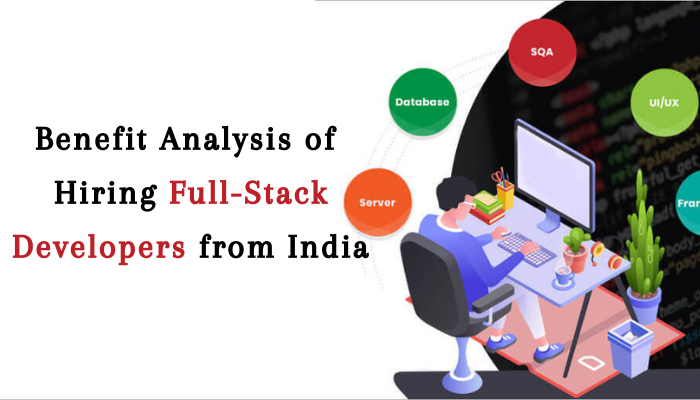
Full-stack developers work across the major layers of a web application. Their responsibilities may include building user interfaces, implementing server-side logic, managing databases, integrating APIs, and preparing applications for deployment.
Depending on the project, developers may work with React, Angular, Vue.js, Node.js, Python, PHP, Laravel, MySQL, PostgreSQL, or MongoDB. Cloud platforms, version control, automated testing, and deployment pipelines may also form part of their responsibilities.
This breadth of knowledge can be particularly valuable for startups developing a minimum viable product (MVP). A capable full-stack developer can coordinate frontend and backend functionality, reduce unnecessary handoffs, and help validate an idea before the business invests in a larger team.
However, full-stack expertise does not eliminate the need for specialists. Complex cybersecurity, infrastructure, data engineering, or large-scale system architecture may require dedicated expertise.
Flexible Hiring Models for Different Business Needs
Businesses can select a hiring arrangement based on the project's duration, complexity, and available internal resources.
-
Dedicated developers: Suitable for ongoing product development and continuous feature improvements.
-
Fixed-price projects: Useful when requirements and deliverables are clearly defined.
-
Hourly engagement: Appropriate for smaller tasks, debugging, and changing requirements.
-
Team augmentation: Helps internal teams add specific skills without expanding permanent headcount.
-
Complete development teams: Suitable for projects requiring coordinated design, development, testing, and project management.
The right model depends on how much control, continuity, and flexibility your business needs. Clearly defined responsibilities and deliverables help prevent confusion and keep the project aligned with its objectives.
Cost-Benefit Analysis of Full-Stack Developer Hiring
The financial advantage of outsourcing becomes clearer when businesses compare the complete cost of hiring with the value delivered. Salaries are only one part of the equation; recruitment, onboarding, management, infrastructure, and ongoing maintenance also affect the final investment.
Compare Total Hiring Costs, Not Just Salaries
Hiring locally may involve recruitment fees, employee benefits, equipment, training, and other operational expenses. Outsourcing can reduce some of these costs, although the actual savings depend on the engagement model and contract terms.
The full-stack developer hiring cost in India varies according to experience, technology stack, project complexity, location, and whether you hire directly or through a development company. For this reason, businesses should request detailed quotations rather than rely on a single average rate.
Consider these cost components before making a decision:
-
Developer compensation or contracted service fees
-
Recruitment, onboarding, and knowledge transfer
-
Project management and communication
-
Software licences and development infrastructure
-
Quality assurance and security testing
-
Maintenance, updates, and technical support
A lower initial quotation may not represent the best value if it excludes testing, documentation, deployment, or post-launch assistance. Comparing equivalent deliverables provides a more realistic picture of cost efficiency.
Measure Return on Investment Beyond Cost Savings
Return on investment (ROI) measures the financial benefit generated relative to the investment required. In software development, that benefit may include reduced operating expenses, faster product launches, improved customer retention, increased sales, or less manual work.
A practical approach is to define measurable outcomes before development begins. For example, an internal business application might aim to reduce repetitive administrative work, while an e-commerce platform may focus on improving checkout completion and order processing.
A simplified formula is:
ROI = (Financial Benefits − Total Investment) ÷ Total Investment × 100
Suppose a business invests ₹10 lakh in a software project and estimates ₹15 lakh in attributable financial benefits over a defined period. Its illustrative ROI would be 50%.
These figures are hypothetical, not a typical project outcome. Businesses should use realistic forecasts and account for operating expenses, ongoing maintenance, and the time required to generate returns.
Technical Quality, Productivity, and Potential Risks
Cost savings become meaningful when the development team delivers dependable software that meets business requirements. Evaluating technical capability and establishing clear working processes helps businesses protect their investment.
Evaluate Technical Skills and Modern Development Practices
A qualified full-stack developer should demonstrate practical understanding of frontend development, backend programming, databases, APIs, testing, and deployment. The required stack should match the project's architecture rather than simply reflect popular technologies.
AI-assisted coding tools are also changing development workflows. Developers may use AI tools to generate initial code, explain unfamiliar codebases, create tests, or assist with debugging. However, generated code still requires human review, validation, and security checks.
During recruitment, review relevant projects, ask candidates to explain their technical decisions, and use practical assessments that resemble real work. Evaluate their ability to debug problems, structure maintainable code, and communicate trade-offs.
For production applications, also assess automated testing, code reviews, dependency management, access controls, and deployment practices. These measures help reduce avoidable defects and future maintenance costs.
Manage Communication, Security, and Time-Zone Differences
Remote development can introduce challenges when requirements are unclear or project responsibilities are poorly defined. Businesses can reduce these risks through written specifications, regular progress reviews, shared project boards, and documented decisions.
Agree on overlapping working hours, response expectations, escalation procedures, and delivery milestones. Time-zone differences may provide scheduling flexibility, but they do not automatically guarantee faster delivery.
Security requires equal attention. Establish appropriate confidentiality agreements, source-code ownership, repository access, data-handling requirements, and procedures for managing sensitive information. Grant access according to each team member's responsibilities and avoid sharing production credentials unnecessarily.
Before signing an agreement, clarify who owns the deliverables, how changes are approved, what happens if deadlines shift, and which services are included after launch.
These safeguards help businesses maintain accountability without creating unnecessary administrative overhead.
How to Maximise the Value of Full-Stack Development Services
Successful outsourcing requires more than selecting a developer at an attractive rate. Businesses should establish clear priorities, choose the right partner, and measure progress throughout the project lifecycle.
Choose a Partner That Matches Your Requirements
Hiring a full-stack development company in India, review its portfolio, relevant industry experience, technical capabilities, communication process, and approach to quality assurance.
Ask prospective partners how they handle requirement changes, testing, documentation, deployment, and maintenance. Discuss the expected deliverables and confirm that the proposed team has experience with the technologies your application requires.
A reliable partner should explain technical recommendations clearly, identify potential risks, and provide realistic estimates. Avoid choosing a provider solely on the basis of low pricing or ambitious delivery promises.
Doomshell Softwares Pvt Limited works with businesses seeking software development solutions aligned with their project requirements. A detailed discussion of your objectives, expected functionality, budget, and support needs can help establish a suitable development approach.
Plan for Scalability and Long-Term Maintenance
A successful application must remain useful as business requirements evolve. Plan for ongoing maintenance, security updates, performance monitoring, backups, and compatibility improvements from the beginning.
Use milestones to review functionality, test important workflows, and verify that the application meets agreed acceptance criteria. Monitor delivery progress alongside quality indicators such as defect rates, application performance, and the stability of releases.
Start with the features that deliver the greatest business value, then expand based on customer feedback and measurable results. This approach helps avoid unnecessary development expenditure while preserving flexibility for future growth.
Ultimately, hiring full-stack developers from India can provide a practical balance of technical capability, cost efficiency, and team flexibility. The strongest results come from matching developer expertise to project complexity, measuring business outcomes, and maintaining clear standards for quality, security, and accountability.
With careful planning and a focus on total value rather than initial price alone, businesses can make more informed development decisions and build digital products that support sustainable growth.