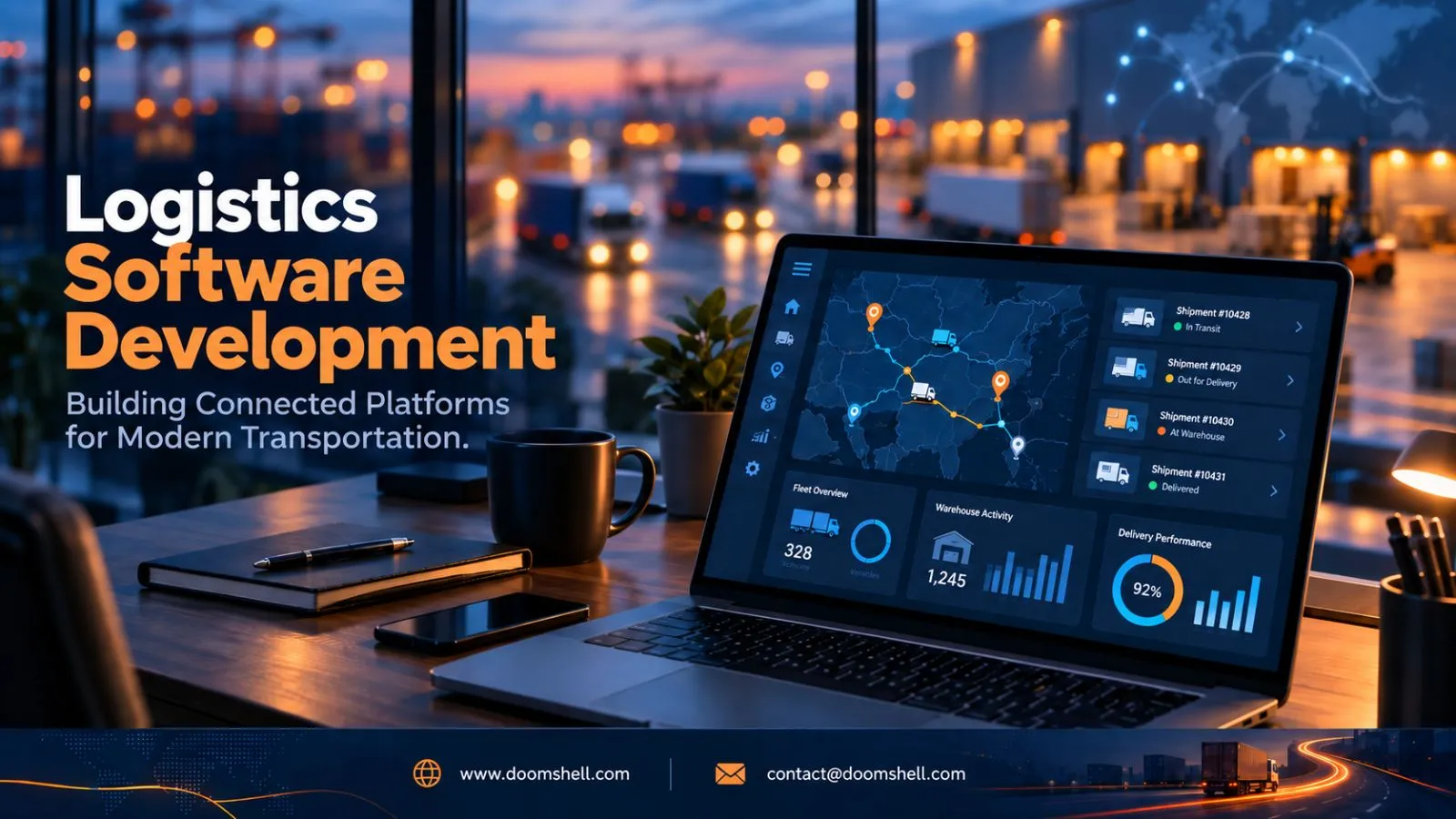
Logistics software development is becoming increasingly data-driven as businesses manage complex transportation networks, changing demand, multiple warehouses, and time-sensitive deliveries. A modern logistics platform needs to do more than record shipments. It should collect operational data, process events, connect different systems, and provide actionable information to teams.
Python is particularly useful for logistics applications because it offers a broad ecosystem for APIs, data processing, automation, analytics, and machine learning. When combined with an appropriate database and cloud architecture, it can support everything from shipment tracking services to predictive supply chain applications.
Building Shipment Tracking Backends With Python
Shipment tracking depends on a continuous flow of events.
A logistics system may receive information when an order is packed, dispatched, scanned at a warehouse, loaded onto a vehicle, reaches a distribution center, or arrives at its destination.
A Python-based backend can process these events and maintain the latest shipment status. Instead of storing tracking information as isolated records, the platform can create a chronological event history for each shipment.
This approach makes it easier to identify delays, calculate estimated delivery times, and provide customers or operations teams with updated information.
For large-scale systems, event queues and asynchronous processing can help absorb bursts of tracking updates without slowing down the primary application.
Creating Real-Time Logistics APIs
APIs allow logistics applications to exchange information with mobile apps, customer portals, warehouse systems, carriers, and internal tools.
A real-time logistics API may expose shipment status, warehouse inventory, delivery events, route information, or order updates.
A well-designed API should provide consistent responses, authentication, validation, rate limiting, error handling, and clear versioning.
Real-time updates can also be delivered through event-driven mechanisms rather than forcing clients to repeatedly request the same information. This can reduce unnecessary traffic and improve visibility across the logistics ecosystem.
Managing Delivery Data With Python
Logistics platforms generate large volumes of operational data.
This can include:
-
Shipment events
-
Delivery timestamps
-
Vehicle information
-
Warehouse scans
-
Order details
-
Route information
-
Failed delivery attempts
-
Geographic data
Python can help process and transform these datasets for operational applications and analytics.
Data pipelines can validate incoming information, standardize formats, remove duplicates, and prepare records for reporting or machine learning.
The quality of these pipelines matters because inaccurate or delayed data can affect forecasting, delivery planning, inventory decisions, and customer communication.
Automating Inventory and Order Operations
Manual inventory and order processes can create delays and increase the possibility of errors. Automation can connect warehouse activity with orders, stock levels, replenishment rules, and reporting systems.
The objective is to create workflows that react to operational events instead of relying entirely on manual updates.
Automating Inventory Workflows With Python
Inventory automation can monitor stock levels and trigger predefined actions.
For example, when inventory reaches a specified threshold, the system can generate an alert or initiate a replenishment workflow.
Python applications can also process inventory updates from warehouses and external systems, helping maintain a consistent view of stock availability.
More advanced workflows can consider multiple warehouses, reserved inventory, incoming shipments, safety stock, and expected demand.
This allows businesses to move from simple stock counting toward more responsive inventory management.
Building Order Processing Systems
Order processing connects several stages of the supply chain.
An order may need to be validated, allocated to a warehouse, reserved against available stock, picked, packed, shipped, and finally marked as delivered.
A centralized order processing system can coordinate these steps and maintain the state of each order.
Automation rules can determine where an order should be fulfilled, what happens when stock is unavailable, and when another system needs to receive an update.
This reduces repetitive manual work and gives operations teams greater visibility into order status.
Developing Automated Supply Chain Reports
Supply chain teams often need regular reports covering inventory, shipments, delivery performance, order volume, and exceptions.
Instead of manually collecting information from multiple systems, automated reporting pipelines can gather and process the required data.
Reports can highlight metrics such as:
-
On-time delivery rate
-
Order processing time
-
Inventory turnover
-
Stockout frequency
-
Average delivery time
-
Delayed shipments
-
Warehouse performance
Automated reporting also creates a consistent source of operational information for management teams.
Using Data Analytics for Logistics Optimization
The next stage of logistics technology is not simply collecting data but using it to identify patterns and support decisions.
Historical orders, transportation information, inventory movement, and delivery events can provide valuable signals for forecasting and optimization.
Building Demand Forecasting Models With Python
Demand forecasting can help businesses estimate future product requirements.
Python provides a strong ecosystem for building statistical and machine learning models that can analyze historical demand alongside relevant variables.
Depending on the business, models can consider seasonality, historical sales, promotions, product lifecycle, regional demand, and other operational factors.
Forecasting should not be treated as a guaranteed prediction. Models need regular evaluation against actual demand and should be updated when customer behavior or market conditions change.
A practical forecasting system can also provide confidence ranges or scenarios rather than presenting one number as absolute certainty.
Analyzing Delivery and Transportation Data
Transportation data can reveal where logistics operations are losing time or resources.
Businesses can analyze delivery duration, route performance, failed deliveries, carrier performance, vehicle utilization, and regional patterns.
For example, repeated delays within a particular delivery region may indicate a scheduling or routing issue. Similarly, unusual delivery times for a specific route can trigger further investigation.
Python-based data processing can automate these analyses and transform raw transportation records into actionable operational insights.
Creating Predictive Supply Chain Dashboards
A predictive dashboard combines current operational visibility with forward-looking information.
Instead of showing only the number of delayed shipments, it can highlight shipments at higher risk of delay. Instead of displaying current inventory alone, it can show potential future stock shortages based on demand and replenishment information.
Useful dashboards can combine:
Current state → Historical trends → Predictions → Recommended operational actions
This makes analytics more useful for decision-making.
Dashboards should also allow users to filter information by warehouse, region, product, carrier, or time period so that teams can investigate specific operational issues.
Integrating Logistics Platforms
Supply chains depend on many interconnected systems. A logistics platform may need to communicate with shipping providers, ERP platforms, warehouse management systems, inventory applications, marketplaces, and customer-facing applications.
Strong integration architecture keeps these systems connected without creating unnecessary dependencies.
Connecting Python Applications With Shipping APIs
Shipping APIs can provide information about rates, labels, tracking, delivery events, and shipment services.
A Python integration layer can normalize information from different providers so that the main logistics application does not need to handle every external format separately.
Integration services should also account for API failures, authentication changes, request limits, retries, and delayed responses.
This makes the system more resilient when an external service becomes temporarily unavailable.
Integrating ERP and Inventory Systems
ERP and inventory platforms often contain critical business information.
A logistics application may need product records, purchase orders, customer information, stock levels, invoices, and fulfillment data from these systems.
Instead of manually transferring this information, APIs or event-driven integrations can synchronize relevant data between applications.
Data ownership should be clearly defined. Each system should have a known source of truth for important records to reduce conflicts and inconsistent information.
Building Scalable Python Microservices for Logistics
As logistics platforms become larger, separating specific capabilities into services can help teams scale and maintain them independently.
Potential services might include:
-
Shipment tracking
-
Order processing
-
Inventory synchronization
-
Notifications
-
Forecasting
-
Reporting
-
Carrier integrations
Python microservices can be useful where individual services have specialized processing or analytics requirements.
However, microservices also introduce operational complexity. Service communication, monitoring, deployment, authentication, data consistency, and failure recovery all need to be considered.
For smaller platforms, a modular architecture may be simpler. Microservices become more useful when there is a clear operational or scaling reason to introduce them.
Building Smarter Logistics Platforms With Data and Automation
Logistics software development is moving toward connected systems that combine real-time visibility, automation, analytics, forecasting, and integrations.
Python can support many of these capabilities, from processing shipment events and building APIs to developing forecasting models and data pipelines.
The strongest logistics platforms are not defined by technology alone. They are designed around the movement of products, information, and decisions across the supply chain.
By connecting operational systems, automating repetitive workflows, and turning supply chain data into actionable insights, businesses can build logistics software that is more responsive, measurable, and prepared for changing demand.