 sales@doomshell.com
 +91 8005523567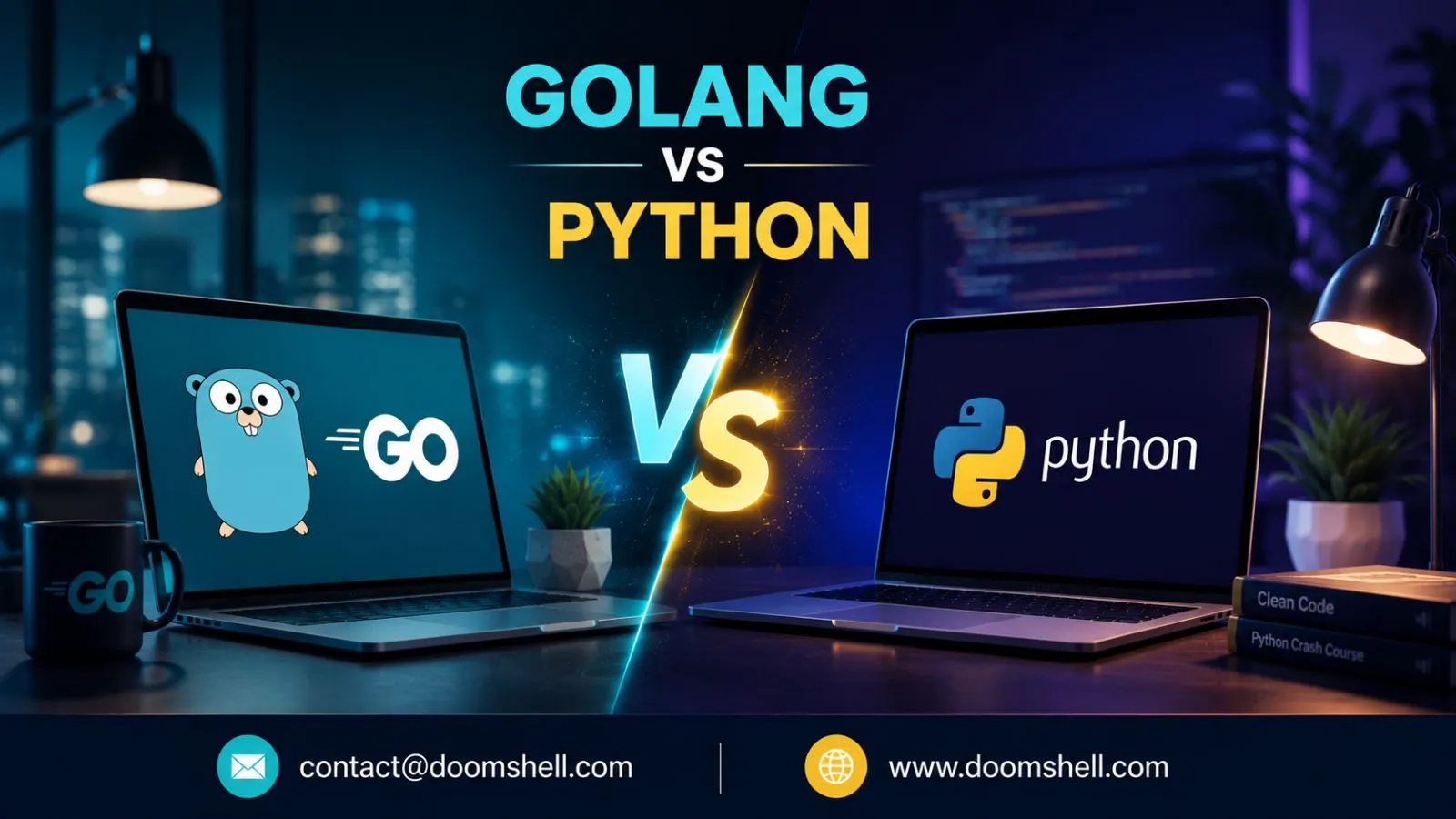
Choosing the right programming language is one of the most important architectural decisions for modern software development. In 2026, Golang (Go) and Python continue to dominate different areas of the technology landscape. While Golang excels in building scalable backend systems, cloud-native applications, and microservices, Python remains the preferred language for AI, machine learning, automation, and rapid application development.
In this comprehensive Golang vs Python comparison, we’ll explore their performance, scalability, syntax, concurrency, ecosystem, and real-world use cases to help you determine which language best fits your business goals.
Market Analysis of Golang vs Python 2026
Python continues to dominate the global developer ecosystem, with more than 75% developer adoption across AI, machine learning, automation, scripting, and analytics.
Meanwhile, Golang maintains an annual growth rate of approximately 20–25%, driven by the rapid adoption of cloud computing, Kubernetes, microservices, and containerized applications.
Enterprise adoption of Golang continues to rise, particularly in fintech, SaaS, DevOps, and cloud-native environments, where nearly 60% of backend teams use Go for performance-critical services.
North America and Europe account for most enterprise Golang adoption, while the Asia-Pacific region is experiencing the fastest growth due to digital transformation and startup expansion.
Today, more than 70% of technology organizations use both Python and Golang together—leveraging Python for intelligence-driven workloads and Golang for high-performance backend systems.
What is Golang?
Golang, commonly known as Go, is an open-source, statically typed, compiled programming language developed by Google.
It was specifically designed to solve challenges related to:
- High concurrency
- Scalability
- Performance
- Distributed computing
- Cloud-native infrastructure
- Backend development
Go produces lightweight, fast, and reliable applications, making it one of the preferred languages for modern enterprise systems.
Common Golang applications include:
- REST APIs
- Backend services
- Kubernetes
- Docker
- Cloud platforms
- Microservices
- Networking software
What is Python?
Python is a high-level, interpreted programming language known for its readability, simplicity, and massive ecosystem.
Its flexibility has made it one of the most widely used programming languages across industries.
Python powers applications such as:
- Artificial Intelligence
- Machine Learning
- Data Science
- Automation
- Web Development
- Cybersecurity
- Scripting
- Business Intelligence
Its extensive libraries significantly reduce development time, making Python an excellent choice for rapid innovation.
Syntax & Ease of Use: Golang vs Python
Python is widely recognized for its clean and beginner-friendly syntax.
Its readable code allows developers to:
- Learn quickly
- Prototype rapidly
- Write less boilerplate code
- Build applications faster
These qualities make Python especially attractive for startups, researchers, and data scientists.
Golang follows a stricter programming model with static typing and explicit syntax.
Although Go requires more structured coding, this discipline leads to:
- Better code consistency
- Easier maintenance
- Fewer runtime errors
- Higher reliability
For enterprise software, Go’s structured approach often proves beneficial over the long term.
Performance: Golang vs Python
Performance is one of the biggest differentiators between Go and Python.
Python Performance
Python uses an interpreted execution model, making it slower for CPU-intensive workloads.
However, its extensive ecosystem—including optimized libraries such as NumPy, TensorFlow, and Pandas—allows Python to perform exceptionally well in:
- Machine Learning
- Artificial Intelligence
- Data Processing
- Scientific Computing
- Analytics
For applications where developer productivity is more important than raw execution speed, Python remains highly effective.
Golang Performance
Go compiles directly into machine code, resulting in:
- Faster execution
- Lower memory consumption
- Reduced latency
- Higher throughput
- Predictable performance
This makes Golang particularly suitable for:
- Backend APIs
- Real-time applications
- High-traffic web services
- Cloud infrastructure
- Networking applications
When raw performance matters, Golang consistently outperforms Python.
Concurrency & Parallelism
Concurrency is one of Golang’s strongest advantages.
Python
Python’s Global Interpreter Lock (GIL) limits true multithreading within a single process.
Although developers can use:
- Multiprocessing
- AsyncIO
- Celery
- Distributed task queues
these approaches increase application complexity.
Python remains excellent for I/O-bound applications but is less efficient for CPU-bound concurrent workloads.
Golang
Concurrency is built directly into Go through:
- Goroutines
- Channels
- Lightweight scheduling
This allows developers to build highly concurrent applications with minimal overhead.
Go is therefore an ideal choice for:
- Distributed systems
- Cloud-native platforms
- APIs
- Real-time communication
- Streaming services
Its concurrency model is one of the key reasons many enterprises choose Golang for scalable backend development.
Scalability: Golang vs Python
Both languages can scale, but they do so differently.
Python Scalability
Python scales effectively using:
- Horizontal scaling
- Task queues
- Load balancers
- Distributed frameworks
- Cloud infrastructure
However, scaling Python often requires additional infrastructure and optimization.
Golang Scalability
Go was designed with scalability in mind.
Its advantages include:
- Efficient memory management
- Native concurrency
- Stateless service architecture
- Lightweight binaries
- Excellent resource utilization
These characteristics make Golang a natural choice for cloud-native applications and microservices that need to scale efficiently.
Golang vs Python 2026: Job Market & Developer Community
Python
Python continues to dominate the global developer ecosystem thanks to its simplicity, versatility, and extensive adoption across industries. It remains the preferred language for Artificial Intelligence (AI), Machine Learning (ML), Data Science, automation, cybersecurity, and web development. Thousands of companies actively hire Python developers, making it one of the most in-demand programming languages in 2026.
Golang
Although Go has a smaller developer community than Python, its demand continues to grow rapidly. Organizations building cloud-native platforms, microservices, distributed systems, Kubernetes applications, and DevOps infrastructure increasingly seek Golang developers. Due to the specialized skill set, Golang professionals often command higher salaries in enterprise and cloud engineering roles.
When Should You Choose Golang or Python?
Choose Python When You Need:
- AI and Machine Learning applications
- Data Science and Analytics
- Automation and scripting
- Rapid application development
- MVPs and startup products
- Research and experimentation
- Web applications using Django or Flask
Choose Golang When You Need:
- High-performance backend systems
- Cloud-native applications
- Microservices architecture
- Distributed systems
- Containerized applications
- DevOps and Kubernetes tooling
- High-concurrency applications
- Low-latency APIs and enterprise infrastructure
Golang vs Python Comparison Table
| Feature | Golang | Python |
|---|---|---|
| Performance | Excellent | Good |
| Compilation | Compiled | Interpreted |
| Execution Speed | Very Fast | Moderate |
| Memory Usage | Low | Higher |
| Concurrency | Built-in Goroutines | Limited by GIL |
| Scalability | Excellent | Good with additional infrastructure |
| Development Speed | Moderate | Very Fast |
| Learning Curve | Moderate | Easy |
| AI & Machine Learning | Limited | Excellent |
| Backend Development | Excellent | Excellent |
| Cloud Native Development | Excellent | Good |
| Microservices | Excellent | Good |
| Community Support | Growing | Very Large |
| Enterprise Adoption | High | Very High |
| Best For | Performance-critical systems | AI, automation, rapid development |
Conclusion
The Golang vs Python 2026 comparison shows that both programming languages excel in different areas.
Golang is the ideal choice for organizations building cloud-native applications, distributed systems, high-performance APIs, and scalable enterprise software. Its excellent concurrency model, fast execution, and low memory consumption make it highly suitable for production-grade backend systems.
Python, on the other hand, remains the preferred language for AI, Machine Learning, automation, data science, and rapid software development. Its extensive ecosystem and beginner-friendly syntax enable businesses to innovate quickly and reduce development time.
Rather than replacing one another, many modern organizations use both languages together—Python for intelligent data-driven applications and Golang for performance-intensive backend services.
At Doomshell Software Pvt Ltd, we help businesses select the right technology stack based on project complexity, scalability requirements, and long-term business objectives, delivering high-performance software solutions tailored to enterprise needs.
Frequently Asked Questions (FAQs)
1. Which is better in 2026: Golang or Python?
It depends on your project requirements. Golang is better for high-performance backend systems and cloud-native applications, while Python is ideal for AI, Machine Learning, automation, and rapid application development.
2. Is Golang faster than Python?
Yes. Golang is significantly faster because it is a compiled language that generates native machine code. Python is interpreted, making it comparatively slower for CPU-intensive workloads.
3. Can Golang and Python be used together?
Yes. Many organizations use Python for AI, analytics, and automation while using Golang for backend APIs, microservices, and infrastructure services.
4. Which language has better career opportunities in 2026?
Python offers more job opportunities across multiple industries due to its widespread adoption. Golang, however, provides highly specialized and often higher-paying roles in cloud computing, backend engineering, and DevOps.
5. Which language is easier to learn?
Python is generally easier for beginners because of its clean syntax and extensive learning resources. Golang has a steeper learning curve but offers better performance and scalability for enterprise applications.