 sales@doomshell.com
 +91 8005523567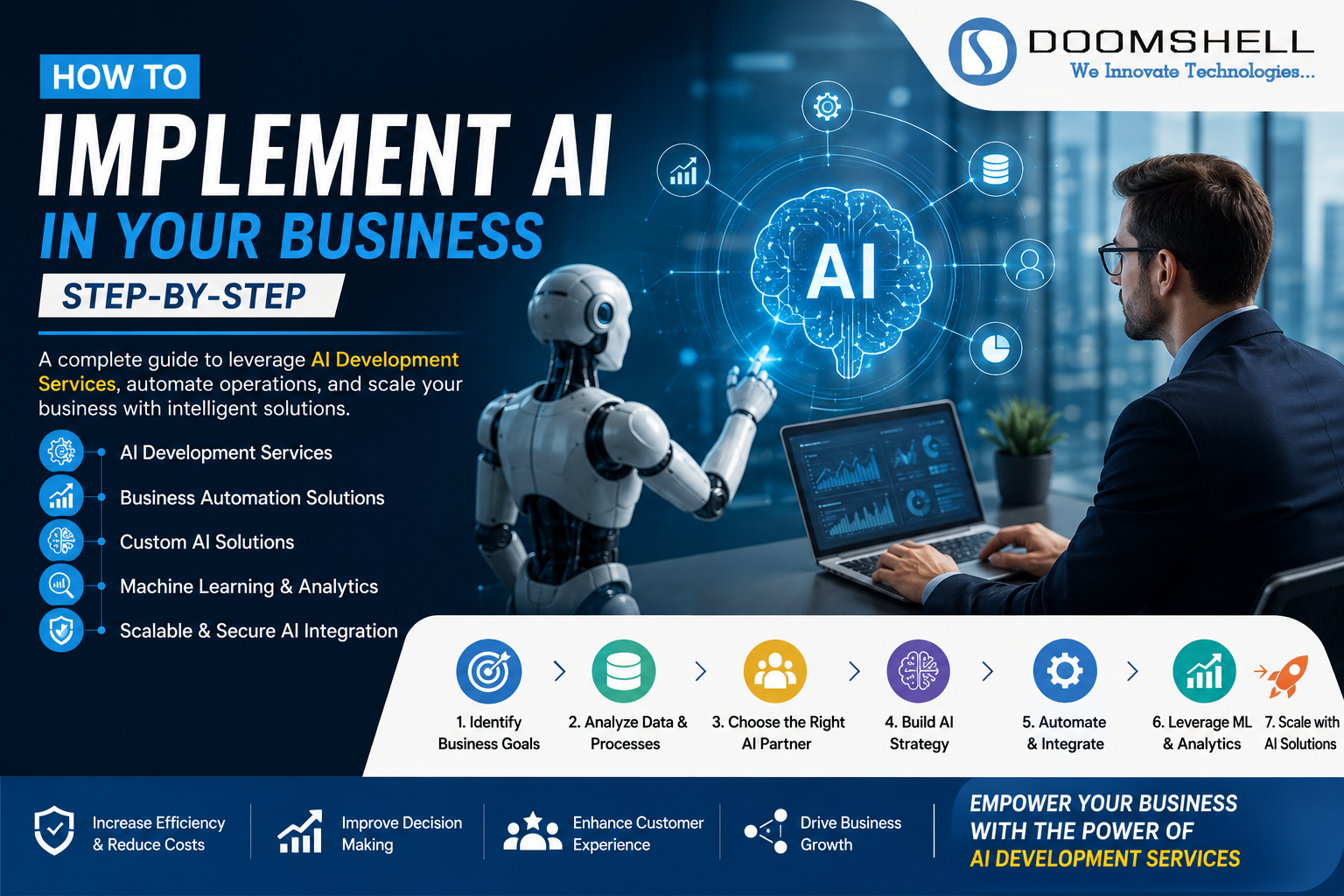
Artificial intelligence is no longer limited to large technology companies. Today, startups, small businesses, and global enterprises use AI to automate workflows, improve customer experiences, and make faster decisions. From retail and healthcare to finance and manufacturing, organizations are integrating intelligent technologies into their daily operations to stay competitive.
According to industry reports, businesses that adopt AI-powered automation often experience faster task completion, improved productivity, and better data-driven decision-making. However, successful implementation requires careful planning rather than simply adopting new technology. Choosing the right strategy helps companies maximize long-term value while minimizing operational risks.
Why AI Development Services Are Essential for Modern Businesses
Implementing artificial intelligence involves much more than installing software. Businesses need solutions that align with their goals, integrate with existing systems, and scale as operations grow. This is where AI Development Services help organizations build practical and secure AI-powered applications.
Instead of replacing employees, AI supports teams by handling repetitive work, analyzing large volumes of data, and generating valuable insights. Businesses can then focus on innovation, customer relationships, and strategic growth.
Companies commonly use AI to:
- Automate repetitive administrative tasks
- Improve customer support with intelligent chatbots
- Analyze business data in real time
- Forecast sales and customer demand
- Detect fraud and unusual business activities
- Enhance operational efficiency across departments
Businesses that introduce AI gradually often achieve better adoption and measurable results than those attempting a complete transformation at once.
Define Business Objectives Before Selecting AI Solutions for Business
Every successful AI project begins with a clear understanding of business objectives. Rather than implementing AI because competitors are doing so, organizations should identify specific challenges that intelligent technology can solve.
For example, an eCommerce company may want to reduce customer response times, while a manufacturing business may focus on predictive maintenance to reduce equipment downtime. Clear objectives help measure success and ensure resources are invested wisely.
Consider questions such as:
- Which manual tasks consume the most time?
- Where do employees face recurring challenges?
- Which customer processes need improvement?
- What business decisions require faster insights?
Real-world companies like Amazon use AI to recommend products based on customer behavior, while Netflix applies AI to personalize content suggestions. These examples demonstrate how focused AI implementation creates measurable business value.
Evaluate Existing Workflows with Business Automation Solutions
Before introducing artificial intelligence, businesses should review their current workflows and identify opportunities for automation. Understanding existing processes prevents unnecessary complexity and helps prioritize projects with the highest return on investment.
Routine activities often suitable for automation include:
- Invoice processing
- Employee onboarding
- Customer support requests
- Inventory monitoring
- Appointment scheduling
- Report generation
Instead of automating every department immediately, organizations usually begin with one process and expand after evaluating performance. This phased approach reduces implementation risks while allowing employees to adapt gradually.
Businesses adopting structured automation strategies generally improve consistency, reduce manual errors, and increase operational efficiency over time.
Prepare High-Quality Data for Better AI Performance
Artificial intelligence depends on accurate, relevant, and well-organized data. Even advanced AI systems cannot produce reliable results if the underlying information is incomplete or inconsistent.
Before implementation, businesses should review their data sources, remove duplicate records, standardize formats, and ensure compliance with privacy regulations. Good data quality improves prediction accuracy and enables better decision-making.
Organizations should also establish clear policies for:
- Data collection
- Data security
- Customer privacy
- Regular database updates
- Access management
For example, hospitals using AI-assisted diagnostics rely on accurate patient records to support medical professionals. Similarly, retailers improve demand forecasting by analyzing reliable sales history and seasonal purchasing patterns.
Choose an Experienced AI Software Development Company
Selecting the right technology partner plays a major role in long-term AI success. An experienced AI Software Development Company understands business challenges, industry requirements, and technical best practices.
Instead of delivering generic software, experienced providers analyze operational goals before recommending suitable AI solutions. They also ensure secure deployment, system scalability, and continuous support after implementation.
When comparing technology partners, evaluate factors such as:
- Industry experience
- Technical expertise
- Previous AI projects
- Security standards
- Integration capabilities
- Ongoing maintenance and support
A reliable implementation partner reduces development risks while helping organizations achieve faster project delivery and measurable business outcomes.
Build a Roadmap Using Custom AI Solutions
Every organization operates differently, making a standardized AI implementation approach less effective. Developing Custom AI Solutions allows businesses to address unique operational requirements instead of adapting their workflows to generic software.
A structured roadmap should include:
- Clear milestones
- Measurable objectives
- Implementation phases
- Employee training
- Performance evaluation
Breaking large projects into manageable stages makes deployment more efficient and reduces disruptions.
Integrate AI with Existing Business Systems
Successful AI implementation depends on seamless integration rather than replacing every existing platform.
Modern businesses often integrate AI with:
- CRM Software
- ERP Systems
- HR Management Platforms
- Accounting Software
- Business Intelligence Dashboards
- Customer Support Applications
Proper integration enables employees to access AI-powered insights within familiar tools, reducing the learning curve and encouraging faster adoption across departments.
Improve Business Decisions with Machine Learning Development Services
After AI is integrated into business operations, the next step is using data to make smarter decisions. Machine Learning Development Services enable systems to learn from historical data, identify patterns, and improve predictions without constant manual programming.
Businesses commonly use machine learning for:
- Customer behavior analysis
- Sales forecasting
- Fraud detection
- Predictive maintenance
- Inventory optimization
- Demand planning
Organizations that invest in intelligent analytics often make faster and more informed decisions.
Scale Operations with Enterprise AI Solutions
As businesses expand, their operational requirements become more complex. Enterprise AI Solutions help organizations manage increasing workloads while maintaining efficiency and consistency across departments.
Businesses planning long-term growth should focus on:
- Scalable infrastructure
- Secure cloud deployment
- Centralized data management
- Performance monitoring
- Continuous optimization
A scalable AI strategy ensures technology continues supporting business objectives as operations grow.
Drive Innovation Through Digital Transformation Solutions
Artificial intelligence becomes even more powerful when combined with Digital Transformation Solutions.
Benefits include:
- Faster decision-making
- Better customer engagement
- Improved operational visibility
- Reduced operational costs
- Increased business agility
Organizations embracing digital transformation remain competitive while improving customer experiences.
How Doomshell Softwares Pvt Ltd Supports AI Adoption
Doomshell Softwares Pvt Ltd helps organizations implement AI through customized development, seamless integration, and ongoing technical support.
Its AI services include:
- AI Consulting
- Intelligent Workflow Automation
- Predictive Analytics
- CRM & ERP Integration
- Business Intelligence Solutions
- AI Application Development
The company focuses on delivering practical AI solutions tailored to each business rather than generic software.
Future Trends Shaping Business AI
Artificial intelligence continues evolving rapidly. Emerging technologies include:
- Generative AI
- Intelligent Virtual Assistants
- Predictive Analytics
- Autonomous Business Processes
- Responsible AI
- Explainable AI
- AI Governance
Organizations investing in responsible AI and employee training will be better positioned for future growth.
Conclusion
Artificial intelligence has become a practical business tool rather than a future concept. Companies that implement AI strategically can improve efficiency, automate repetitive work, strengthen customer experiences, and make faster decisions based on reliable data.
A successful AI journey begins with clear objectives, quality data, and phased implementation. Businesses should evaluate existing processes, integrate AI with current systems, and scale gradually as measurable results are achieved.
Partnering with an experienced AI software development company like Doomshell Softwares Pvt Ltd helps organizations reduce implementation risks, accelerate deployment, and maximize long-term ROI. As AI continues to reshape industries, businesses that invest in intelligent technologies today will be better positioned to innovate, compete, and grow in the future.
Frequently Asked Questions
1. What are AI Development Services?
AI Development Services help businesses design, build, and implement intelligent software that automates processes, analyzes data, and improves operational efficiency.
2. Why are AI Solutions for Business important?
AI solutions automate repetitive tasks, improve customer experiences, enhance decision-making, and increase business productivity.
3. How does an AI Software Development Company help businesses?
It provides AI consulting, custom development, integration, deployment, maintenance, and ongoing support for successful AI implementation.
4. Can small businesses benefit from AI?
Yes. Small businesses can use AI for chatbots, marketing automation, customer analytics, workflow automation, and predictive reporting without significant infrastructure costs.
5. How long does AI implementation take?
Depending on project complexity, implementation may take anywhere from a few weeks for small automation projects to several months for enterprise-scale AI solutions.