 sales@doomshell.com
 +91 8005523567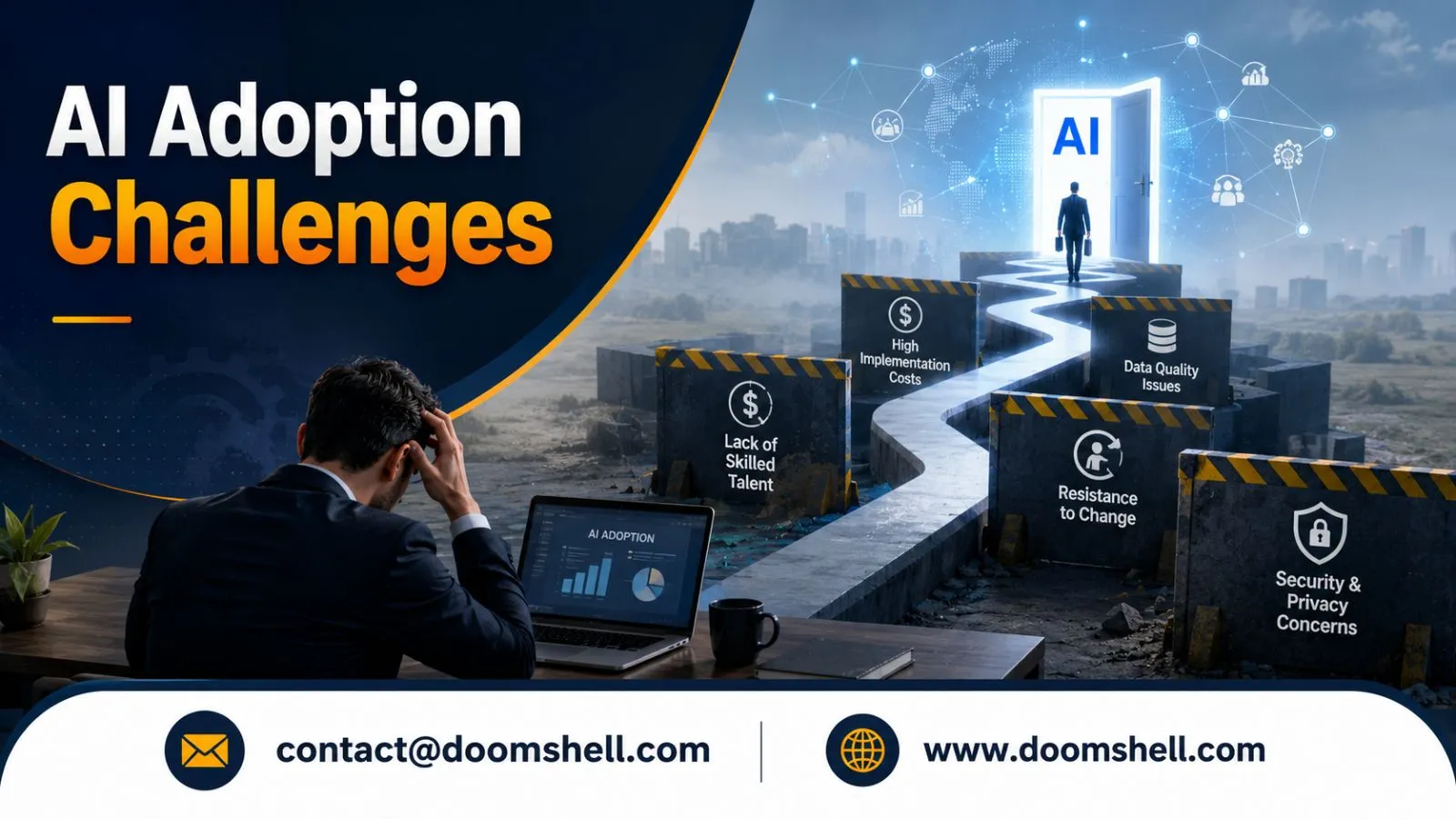
Artificial intelligence has become one of the most influential technologies driving digital transformation across industries. From customer support chatbots and predictive analytics to supply chain optimization and fraud detection, AI is helping organizations improve efficiency and deliver better customer experiences. Despite growing investments, however, many companies continue to face significant AI adoption challenges that prevent them from moving beyond pilot projects.
Industry reports indicate that while most enterprises are experimenting with AI solutions, only a smaller percentage have successfully integrated AI into daily operations. The gap between experimentation and enterprise-wide adoption highlights the importance of having the right strategy, infrastructure, skilled workforce, and governance model. Businesses that fail to address these areas often struggle to generate measurable returns from their AI investments.
AI Adoption Trends and Market Overview in 2026
The global AI market continues to expand as organizations invest heavily in automation, machine learning, and intelligent decision-making systems. Businesses across healthcare, finance, manufacturing, retail, logistics, and education are implementing AI to improve productivity and remain competitive.
Current market trends include:
-
Increased enterprise AI investment
-
Growing demand for generative AI solutions
-
Expansion of AI-powered customer support
-
Cloud-based AI platforms
-
Greater focus on AI governance
-
Responsible AI and regulatory compliance
Although adoption rates continue to rise, many organizations still face implementation barriers that slow enterprise-wide deployment. These challenges often result in delayed projects, increased costs, and limited business impact.
What Does Operationalizing AI Mean?
Operationalizing AI refers to integrating artificial intelligence into everyday business processes so that it consistently delivers measurable value. Instead of limiting AI to research or proof-of-concept projects, organizations embed intelligent systems into operational workflows such as customer service, fraud prevention, inventory management, predictive maintenance, and sales forecasting.
Successful operationalization requires several essential components:
-
Reliable data infrastructure
-
Clear AI governance
-
Scalable cloud platforms
-
Continuous model monitoring
-
Skilled AI professionals
-
Business process integration
Without these foundations, organizations often struggle to move AI initiatives beyond isolated experiments.
Major AI Adoption Challenges Businesses Face
1. Poor Data Quality and Legacy Infrastructure
Data is the foundation of every successful AI initiative. Unfortunately, many organizations continue to rely on fragmented databases, inconsistent records, and outdated legacy systems that limit AI performance.
Common data-related challenges include:
-
Duplicate information
-
Incomplete datasets
-
Poor data governance
-
Limited real-time access
-
Legacy software integration issues
Modernizing infrastructure and establishing centralized data management significantly improves AI accuracy while reducing deployment risks.
2. Shortage of AI Skills and Technical Expertise
Finding experienced AI professionals remains one of the biggest challenges for organizations worldwide. Data scientists, machine learning engineers, AI architects, and MLOps specialists are in high demand, making recruitment increasingly competitive.
Businesses also struggle with:
-
Limited internal AI expertise
-
Insufficient employee training
-
Slow knowledge transfer
-
Difficulty managing complex AI projects
Many organizations now invest in employee upskilling, university partnerships, and external AI consulting to overcome talent shortages and accelerate implementation.
3. Integration with Existing Business Systems
Many companies operate on legacy ERP, CRM, and enterprise software that was never designed for modern AI capabilities. Integrating AI into these environments often requires significant technical effort.
Organizations frequently encounter:
-
Compatibility issues
-
Complex API integration
-
Security concerns
-
Data synchronization challenges
-
Increased implementation timelines
A phased modernization strategy helps businesses integrate AI without disrupting existing operations while improving long-term scalability.
4. Weak AI Strategy and Governance
Technology alone does not guarantee AI success. Organizations without a clear business strategy often invest in AI projects that fail to deliver measurable value.
A successful AI roadmap should include:
-
Defined business objectives
-
Executive leadership support
-
Governance policies
-
Ethical AI practices
-
ROI measurement
-
Risk management
Aligning AI initiatives with organizational goals ensures investments produce sustainable business outcomes rather than isolated technical achievements.
Best Practices for Successful AI Implementation
Organizations that achieve measurable AI outcomes usually follow a structured implementation strategy rather than deploying AI tools without a clear roadmap. Successful adoption requires collaboration between business leaders, technology teams, and data specialists to ensure every AI initiative supports real business objectives.
1. Build a Strong Data Foundation
AI systems perform only as well as the data they receive. Businesses should invest in high-quality data management, centralized storage, and governance frameworks before deploying AI solutions.
Key priorities include:
-
Clean and accurate datasets
-
Real-time data integration
-
Data security and privacy
-
Consistent governance policies
-
Automated data validation
A reliable data foundation improves model accuracy, minimizes errors, and enables organizations to scale AI across multiple departments.
2. Create a Clear AI Strategy
An AI strategy should define measurable business goals instead of focusing only on technology. Organizations need to identify high-impact use cases, expected ROI, implementation timelines, and performance indicators before launching AI projects.
An effective strategy includes:
-
Business-focused objectives
-
Executive sponsorship
-
Department collaboration
-
Governance standards
-
Continuous performance monitoring
When AI initiatives align with business priorities, companies are more likely to achieve long-term success and maximize their investment.
3. Invest in AI Talent and Workforce Development
Technology alone cannot drive AI transformation. Skilled professionals are essential for developing, deploying, monitoring, and improving AI systems over time.
Businesses can strengthen their AI capabilities by:
-
Hiring experienced AI specialists
-
Upskilling existing employees
-
Partnering with AI consultants
-
Encouraging continuous learning
-
Supporting cross-functional collaboration
Developing internal expertise reduces dependence on external resources while creating a sustainable AI culture.
4. Choose Scalable AI Infrastructure
Cloud-based platforms provide the flexibility required for enterprise AI implementation. Scalable infrastructure allows businesses to process large datasets, deploy models efficiently, and support future growth without major hardware investments.
Modern AI infrastructure should offer:
-
Cloud scalability
-
High-performance computing
-
Secure data storage
-
Automated model deployment
-
Continuous monitoring
-
Easy integration with business systems
This approach improves operational efficiency while reducing maintenance complexity.
The Future of AI Transformation in Business
Artificial intelligence is rapidly evolving from a productivity tool into a strategic business capability. Organizations are no longer using AI only for automation—they are leveraging it to improve customer experiences, optimize decision-making, and accelerate innovation.
Several trends are expected to shape AI adoption in the coming years:
-
Generative AI for content creation and software development
-
AI-powered business intelligence
-
Predictive analytics for strategic planning
-
Intelligent process automation
-
Responsible AI governance
-
Industry-specific AI solutions
-
Human-AI collaboration across business functions
Companies that invest in these technologies while maintaining strong governance and ethical standards will be better positioned to compete in an increasingly digital marketplace.
Conclusion
Artificial intelligence is transforming the way businesses operate, but achieving enterprise-wide success requires more than investing in advanced technology. Organizations must overcome challenges related to data quality, infrastructure, talent shortages, governance, and system integration before AI can deliver meaningful business value.
By building a strong data foundation, developing a clear implementation strategy, investing in skilled professionals, and adopting scalable cloud infrastructure, businesses can move beyond pilot projects and successfully integrate AI into everyday operations. Those that address these challenges early will improve efficiency, accelerate innovation, and strengthen their competitive advantage in 2026 and beyond.
Frequently Asked Questions
1. What are the biggest AI adoption challenges in 2026?
The most common challenges include poor data quality, outdated infrastructure, shortage of AI professionals, integration with legacy systems, governance issues, and unclear business strategies.
2. Why do many companies fail to scale AI?
Many organizations struggle because they launch AI pilot projects without preparing the necessary data infrastructure, governance framework, skilled workforce, and long-term implementation strategy.
3. What does operationalizing AI mean?
Operationalizing AI means integrating AI models into everyday business processes so they continuously support decision-making, automation, and measurable business outcomes.
4. How can businesses improve AI implementation success?
Businesses should focus on building high-quality data systems, defining clear business objectives, investing in AI talent, implementing governance policies, and using scalable cloud infrastructure.
5. Which industries benefit the most from AI adoption?
Healthcare, finance, manufacturing, retail, logistics, education, telecommunications, and eCommerce are among the industries gaining significant value from AI through automation, predictive analytics, customer service, and operational optimization.