







 sales@doomshell.com
 +91 8005523567
Key Takeaways
- Difficulties with AI adoption will remain one of the main barriers to digital transformation in 2026.
- Many companies struggle to scale and embed AI into everyday activities beyond pilot projects.
- Lack of skills, adequate infrastructure and governance are some of the reasons impeding the implementation of AI at the organizational level.
- Based on various factors, AI adoption is a challenge that prevents companies from spreading AI use to several departments.
- To be aligned with AI transformation, businesses require leadership at the highest level, a well thought out plan, and excellent preparedness in terms of data.
- A major reason for companies failing to scale AI is the misalignment between technology and business goals.
Market Overview: AI Adoption in 2026
Artificial intelligence adoption is spreading at a fast pace worldwide.
In 2026, more than 80% of enterprises will be trialling AI, however only 30, 35% would have successfully scaled operational AI.
Even with a deep plunge in AI platforms investments, companies still experience AI deployment difficulties which block them from real, world implementation.
On the one hand, enterprises are setting aside billions of dollars for rollout of AI in business but, on the other hand, quite a few structural and organizational factors continue to pose a challenge to AI adoption.
Many organizations launch with proof of concept projects but they hardly ever proceed to full, fledged AI integration in the operational processes.
Such a disparity between testing and substantial impact points out the very thing that the authors stress, that is to focus on AI strategy execution and enabling enhanced frameworks for AI implementation in the organizations.
Also check our services.
Node.js & React.js Development Company in India
WordPress & WooCommerce Development Company in India
AI Agent Development Company in India
YouTube & Instagram Marketing Company in India
YouTube & Instagram Marketing Company in India
CakePHP Development Company in India
Shopify Website Development Company in India
Flutter App Development Company in India
React Native Development Company in USA
Digital Marketing company in India
What Does Operationalizing AI Mean?
Operationalizing AI means putting it into everyday business operations such as customer service, fraud detection, and supply chain to give consistent value.
You cannot overlook the importance of a good infrastructure, governance, and executing your AI strategy. The lack of these puts companies in the situation where they have to deal with the challenges of AI deployment as well as AI adoption and these are the main reasons why companies fail to scale their AI. The resolution of these issues is a must for the AI transformation of business and the scaling of AI in 2026.
Major AI Adoption Challenges in 2026
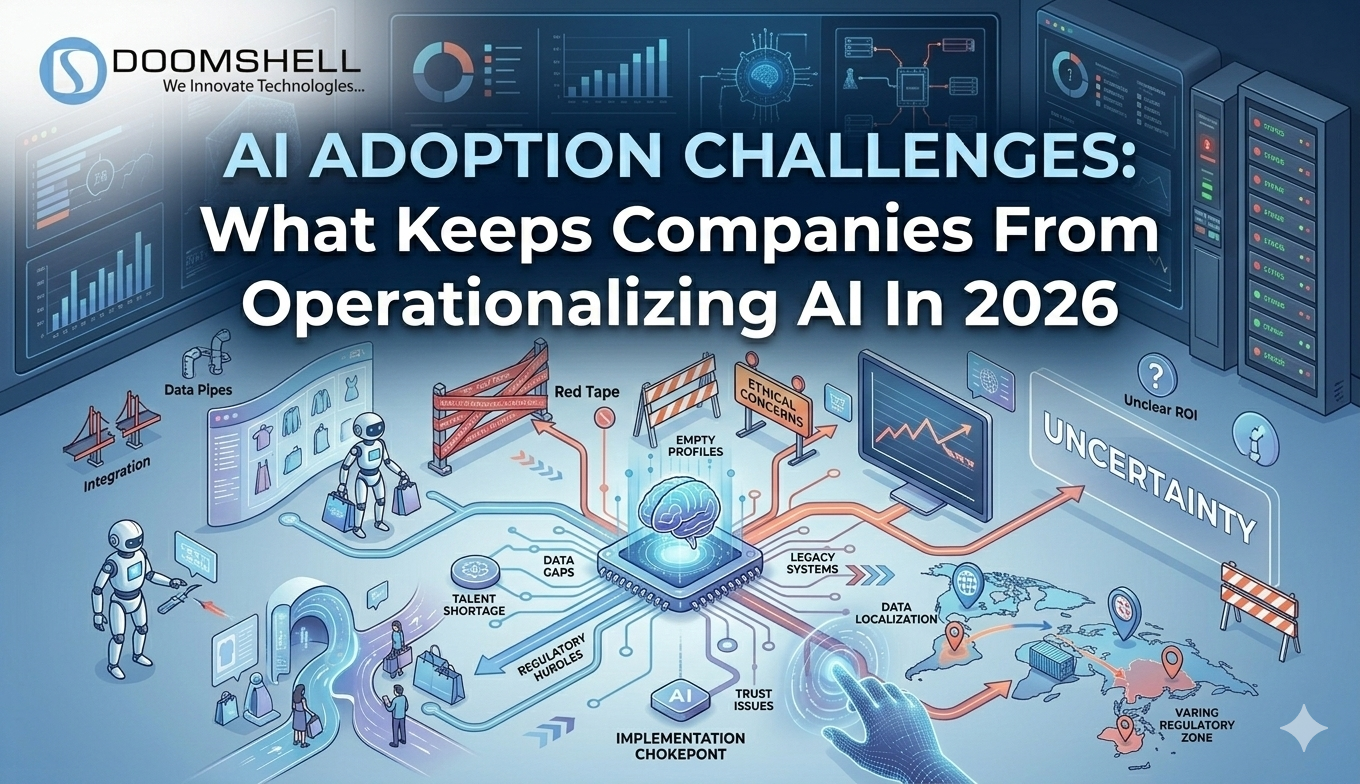
Problems with Data and Infrastructure: Lower quality data and the use of old systems are two key points where AI adoption can falter. In fact, if a company tries to use AI without having a dependable data setup, they are very likely to face issues when trying to deploy the technology and will be setting themselves up with a very big hurdle for AI adoption. What companies really need are top notch, easily reachable data and up, to- date systems if they want to expand their use of AI in a successful way.
Lack of AI Specialists: Having no or a few AI experts is like putting the brakes on AI introduction in companies. Actually, companies without these skilled people are not only stuck in turning their AI plans into reality, but they are also holding up any further AI change and even struggling to get AI to a larger scale. At the same time, this lack of talent turns out to be one of the top reasons why companies fail to get their AI operations to a big scale.
Not tying AI well with current Systems: Old systems usually stand as the main reason for technical problems during AI rollouts. A lot of businesses say that its hard for them to get AI and their existing systems to work together. So, changing to new systems turns out to be very helpful if a company wants not only to use AI at an enterprise level but also to see success with AI scaling by 2026.
Low, Level Strategy and Excessive Spending: Ineffectual AI strategies, very high investment costs, and weak governance remain as major factors that can even lead to the operationalizing of AI getting at the receiving end of the slow, down. Indeed these are the major things that continue to challenge the adoption of AI and to the extent why companies fail to scale AI.
Best Practices for Successful AI Implementation
1. Build a Robust Data Base:
Creating a robust data system is crucial to help ease the difficulties associated with AI adoption and to enable a seamless rollout of AI across the enterprise. By allocating resources to data lakes, governance frameworks, and real time analytics, not only AI deployment challenges get minimized but the biggest obstacles to AI adoption are also dismantled during the course of AI implementation in the organizations.
2. Formulate a Distinct AI Strategy:
An accurately articulated line of action enhances AI strategy implementation and assists businesses in concentrating on genuine use cases. Explicit aims, return on investment (ROI) targets, and governance standards make the deployment of AI simpler and facilitate the AI revolution in the firms.
3. Allocate Resources for AI Workforce & Development:
Qualified staff are a must to successfully implement AI in organizations. Bringing on board and educating individuals who are proficient in data science, machine learning, and AI governance can make a difference in getting rid of AI adoption hindrances and is one of the reasons why some companies fail to scale AI.
4. Choose Flexible AI Infrastructure:
Platforms based on cloud technology allow a rapid enterprise AI implementation and at the same time cutting down the challenges faced during AI deployment. Using scalable systems, accommodating regular model updates and evaluation, is quite essential in making AI operational and scaling AI in 2026.

The Future of AI Transformation in Business
Despite the difficulties, AI integration in businesses still grows at a fast pace.
Those companies which manage well the difficulties in adopting AI, can achieve major competitive advantages.
By giving priority to solid data foundations, well executed AI strategies, and scalable AI infrastructure, businesses can raise themselves over the hurdles of AI deployment and at the same time harness the power of AI transformation in business.
The prospect of AI implementation in companies depends on the level of success to which the enterprises can go beyond experiments and fully operationalize AI systems.
Those enterprises that realize the solutions to these issues at the earliest will be the pioneers leading the trough of extensive AI with the most latest wave of AI implementation and innovation.
Conclusion on AI Adoption Challenges in 2026
Artificial intelligence has stopped being an experimental technology and is on its way to becoming a great force of digital transformation by 2026. Nevertheless, some problems like difficulties in adoption, lack of infrastructure, and shortage of skilled workers have been the main reasons that have prevented organizations from becoming fully AI enabled.
In order to successfully integrate AI within their operations, enterprises need to pinpoint the major barriers, enhance the implementation of their AI strategies, and build up their infrastructures so that they can carry out AI on an enterprise level. Those who take on and succeed in overcoming these challenges of AI implementation will not only find out the reasons why companies fail to scale AI, through them will also lead the fastest AI transformation in business, which will enable them to achieve sustainable growth in 2026. Consult with Ai Development Company In Dubai.
FAQs About AI Adoption Challenges in 2026
1. What are the biggest AI adoption challenges in 2026?
The major barriers to adopting AI are bad data quality, shortage of AI skilled professionals, expensive implementation, and infrastructure constraints.
2. Why do companies fail to scale AI?
A lot of companies fail because they have weak strategies when it comes to AI, they don’t know how to manage their data properly, and they also face issues when trying to integrate AI with old systems.
3. What does operationalizing AI mean?
Operationalizing AI is a process of running AI models within actual business processes that results in continuous generation of quantifiable value.
Check Our Blog
Agentic Commerce: How Buying Behavior Is Being Radically Rewritten