 sales@doomshell.com
 +91 8005523567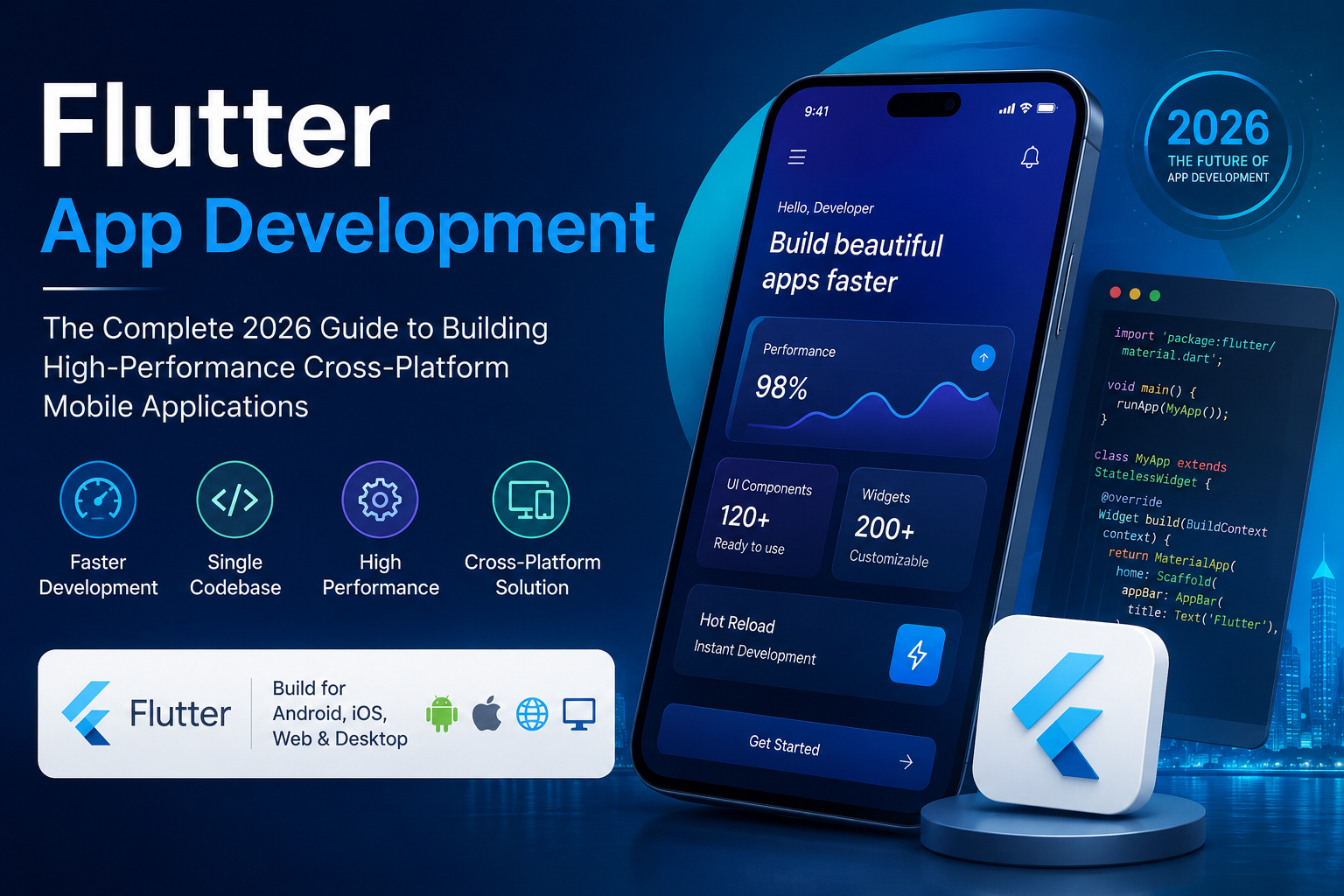
The demand for cross-platform applications continues to rise as businesses seek faster and more cost-effective ways to launch digital products. flutter app development has become one of the most popular approaches because it allows developers to create applications for multiple platforms using a single codebase. Companies ranging from startups to enterprises are adopting this framework to reduce development complexity while maintaining quality.
In 2026, organizations prioritize scalability, user experience, and speed. Flutter addresses these requirements by offering a modern framework that supports Android, iOS, web, and desktop applications. As a result, businesses can reach larger audiences without managing separate development teams for each platform.
Introduction to Flutter and Dart
Many businesses still ask what is flutter app development when exploring modern mobile technologies. Flutter is an open-source UI framework developed by Google, while Dart is the programming language used to build applications within the framework.
The combination of Flutter and Dart helps developers create visually appealing applications with smooth performance. Unlike traditional cross-platform frameworks that rely heavily on platform-specific components, Flutter renders its own interface elements. This approach delivers greater design consistency and flexibility.
Key characteristics include:
- Single codebase development
- Strong community support
- Fast compilation process
- Extensive customization capabilities
- Consistent design across platforms
How Flutter Enables Cross-Platform Development
Traditional app development often requires separate Android and iOS teams. This increases both development time and costs. Flutter eliminates this challenge by allowing developers to write code once and deploy it across multiple operating systems.
Organizations using flutter mobile app development can maintain consistent branding and functionality while simplifying project management. Teams spend less time fixing platform-specific issues and more time improving application features.
This approach is particularly valuable for businesses launching products quickly in competitive markets where speed can determine success.
Why Businesses Prefer Flutter in 2026
Businesses prefer Flutter because it aligns with modern digital transformation goals. Companies want applications that perform well, scale efficiently, and provide a seamless user experience.
Several factors contribute to its popularity:
- Reduced maintenance costs
- Faster release cycles
- Strong developer ecosystem
- Better UI flexibility
- Support for emerging technologies
Large organizations and startups alike recognize that Flutter offers a practical balance between development efficiency and application quality.
Key Benefits of Flutter App Development for Businesses
Organizations evaluating mobile technologies often focus on return on investment. The benefits of flutter app development extend beyond technical advantages and directly impact business performance.
Companies adopting Flutter frequently experience shorter development cycles, lower operational costs, and improved customer satisfaction. These advantages make Flutter a strategic choice for organizations looking to maximize technology investments.
Faster Time-to-Market with Single Codebase
Launching applications quickly has become a competitive necessity. Businesses that reach customers first often gain a significant advantage.
Using a unified codebase enables teams to develop and test features more efficiently. Developers can implement updates simultaneously across multiple platforms instead of maintaining separate versions.
Benefits include:
- Faster product launches
- Quicker feature releases
- Simplified testing processes
- Reduced project complexity
This efficiency allows businesses to respond rapidly to changing customer expectations.
Cost Savings Compared to Native Development
Cost management remains a major concern for organizations investing in digital products. Native development typically requires specialized teams for different platforms, increasing overall expenses.
With mobile app development using flutter, businesses can streamline resource allocation and reduce development costs. A single team can manage multiple platforms, minimizing duplication of effort.
Real-world comparisons often show that Flutter projects require fewer development hours than equivalent native projects, particularly for applications with shared functionality across platforms.
Improved User Experience Across Devices
User experience directly influences customer retention and engagement. Applications that perform smoothly and provide consistent interfaces generally achieve better results.
Flutter supports attractive designs and responsive interactions across devices. Organizations using flutter in mobile app development can deliver a consistent experience whether users access the application on Android or iOS devices.
This consistency strengthens brand perception and improves overall customer satisfaction.
Essential Features That Make Flutter a Powerful Framework
Flutter continues to gain popularity because of its extensive feature set. Developers appreciate its productivity tools, while businesses value the resulting efficiency and performance.
The framework provides capabilities that simplify development without compromising application quality. These features help teams build sophisticated applications that meet modern user expectations.
Hot Reload for Faster Development
One of Flutter’s most recognized features is Hot Reload. This capability allows developers to view changes instantly without restarting the application.
Advantages include:
- Faster debugging
- Improved productivity
- Reduced testing time
- Easier UI experimentation
Development teams can quickly refine application designs and functionality, resulting in more efficient project execution.
Hot Reload is particularly useful during iterative development processes where frequent modifications are necessary.
Rich Widget Library and Custom UI
Creating engaging user interfaces is essential for application success. Flutter includes a comprehensive widget library that enables developers to build highly customized experiences.
Organizations selecting flutter for app development benefit from extensive design flexibility. Developers can create interfaces that align closely with brand requirements while maintaining performance standards.
Popular UI capabilities include:
- Custom animations
- Responsive layouts
- Interactive components
- Platform-adaptive designs
- Modern visual elements
These features contribute to applications that feel polished and professional.
High Performance and Native-Like Experience
Performance remains a critical factor in user satisfaction. Applications that load quickly and respond smoothly are more likely to retain users.
Flutter delivers near-native performance through direct compilation and optimized rendering. This allows businesses to provide responsive experiences without sacrificing cross-platform efficiency.
The framework supports complex animations, real-time updates, and advanced user interactions while maintaining stable performance across devices.
Industries Successfully Using Flutter Mobile App Development
Flutter has expanded beyond simple startup projects and is now widely adopted across multiple industries. Organizations appreciate its ability to support both customer-facing applications and internal business tools.
The flexibility of Flutter makes it suitable for a broad range of use cases, from ecommerce platforms to healthcare solutions.
Ecommerce and Retail Applications
Retail businesses require applications that combine performance, usability, and scalability. Flutter supports these requirements effectively.
Common ecommerce features include:
- Product catalogs
- Secure payments
- Personalized recommendations
- Real-time inventory updates
- Customer loyalty programs
Many retailers use flutter mobile app development to create consistent shopping experiences across devices while maintaining efficient development workflows.
Healthcare and Fintech Solutions
Healthcare and fintech applications demand reliability, security, and excellent user experiences. Flutter helps organizations meet these expectations through scalable architecture and responsive interfaces.
Healthcare providers use Flutter for:
- Appointment scheduling
- Telemedicine services
- Patient management systems
Financial organizations leverage Flutter for:
- Digital banking
- Payment applications
- Investment platforms
- Budget tracking tools
These industries benefit from rapid development without compromising usability.
Education and On-Demand Service Apps
Educational institutions and service providers increasingly rely on mobile technology to engage users and streamline operations.
Applications in these sectors commonly include:
- Online learning platforms
- Video-based training systems
- Food delivery services
- Transportation booking apps
- Home service marketplaces
Businesses implementing mobile app development using flutter can efficiently deliver feature-rich applications that support growing user bases.
Future of Flutter App Development in 2026 and Beyond
Technology continues evolving, and Flutter remains positioned as a leading framework for cross-platform development. Emerging innovations are expanding its capabilities and creating new opportunities for businesses.
The future outlook remains positive as organizations seek efficient solutions for delivering digital experiences across multiple platforms.
AI-Powered Mobile Applications
Artificial intelligence is becoming a standard component of modern applications. Businesses increasingly integrate AI-driven features to enhance user engagement and operational efficiency.
Examples include:
- Intelligent chatbots
- Predictive recommendations
- Personalized content delivery
- Voice-based interactions
- Automated customer support
These capabilities are expected to become more common as AI adoption accelerates.
Flutter for Web and Desktop Development
Flutter is no longer limited to smartphones. The framework now supports web and desktop environments, allowing organizations to expand digital ecosystems using shared technology foundations.
Companies adopting flutter for app development can create unified experiences across multiple platforms while reducing maintenance complexity.
This flexibility supports long-term scalability and future growth initiatives.
Emerging Trends for Business Applications
Several trends are shaping the future of Flutter adoption. Businesses planning digital strategies should monitor these developments closely.
Important trends include:
- AI integration across applications
- Progressive web experiences
- Advanced personalization features
- Cross-device synchronization
- Increased enterprise adoption
As these trends continue evolving, flutter app development is expected to remain a preferred solution for organizations seeking efficient and scalable application development.
FAQs
1. What is Flutter and why is it popular in 2026?
Flutter is Google’s open-source UI framework that enables developers to build applications for multiple platforms using a single codebase. Its speed, flexibility, and cost efficiency contribute to its popularity.
2. How does Flutter reduce development costs?
Flutter minimizes costs by allowing one development team to build and maintain applications across Android, iOS, web, and desktop platforms from a shared codebase.
3. Is Flutter suitable for enterprise applications?
Yes. Many enterprises use Flutter because it offers scalability, strong performance, and efficient maintenance while supporting modern business requirements.
4. Can Flutter support AI-powered applications?
Yes. Flutter can integrate with AI technologies such as recommendation engines, chatbots, predictive analytics, and voice-based features.
5. Which industries benefit most from Flutter?
Ecommerce, healthcare, fintech, education, logistics, and on-demand service businesses commonly use Flutter because of its flexibility and cross-platform capabilities.