 sales@doomshell.com
 +91 8005523567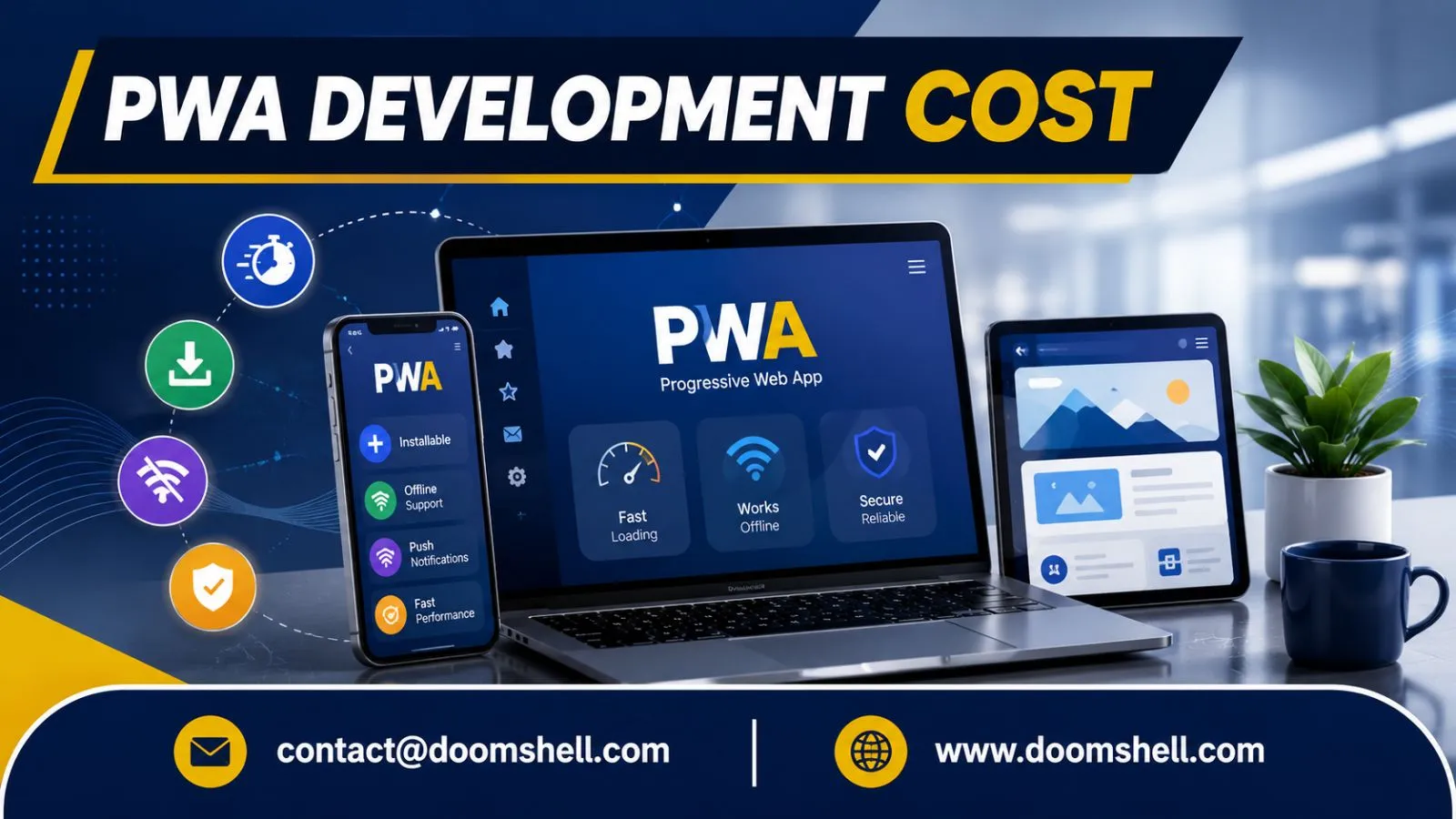
Progressive Web Apps (PWAs) are becoming a major trend in digital product development as businesses focus on performance, cost efficiency, and cross-platform compatibility.
In 2026, more than 60% of enterprises are expected to adopt PWAs to reduce dependency on expensive native app ecosystems. Companies report up to 35% savings in development costs when switching from native apps to PWAs.
Key market trends include:
-
Rising demand for cross-platform applications
-
Increased focus on performance optimization
-
Lower long-term maintenance costs compared to native apps
-
Strong adoption in eCommerce, SaaS, and service-based industries
-
Shift toward mobile-first and offline-capable web apps
PWAs are increasingly seen as a strategic alternative to traditional mobile app development due to their efficiency and ROI benefits.
What Is a Progressive Web App (PWA)?
A Progressive Web App is a web-based application that behaves like a native mobile app. It combines the best of web and mobile technologies to deliver fast, reliable, and engaging user experiences.
Key features include:
-
Offline functionality
-
App-like interface
-
Fast loading speed
-
Push notifications
-
Cross-device compatibility
Because PWAs use a single codebase, they significantly reduce development effort and overall cost compared to native apps.
PWA Development Cost in 2026: Estimated Pricing Range
The cost of developing a Progressive Web App in 2026 varies based on complexity and features:
-
Basic PWA: ₹4–8 lakhs ($5,000–$10,000)
-
Mid-Level PWA: ₹10–25 lakhs ($12,000–$30,000)
-
Enterprise PWA: ₹30 lakhs+ ($35,000+)
These are estimated costs and may vary depending on UI complexity, integrations, and development team location.
PWA Development Cost Breakdown
Understanding the cost structure helps businesses plan their budget effectively.
1. UI/UX Design
Design plays a crucial role in user engagement and directly impacts development cost.
-
Custom design requirements
-
Interactive UI elements
-
Branding and user experience optimization
More advanced designs increase overall PWA development cost.
2. Frontend & Backend Development
This is the largest component of the PWA budget.
-
Frontend frameworks (React, Angular, etc.)
-
Backend APIs and architecture
-
Third-party integrations
Complex functionality and real-time features increase development effort and cost.
3. Testing & Quality Assurance
Testing ensures smooth performance across devices and browsers.
-
Functional testing
-
Performance testing
-
Security testing
-
Cross-device compatibility
Higher quality assurance requirements increase project cost but improve reliability.
4. Deployment & Optimization
Deployment involves launching and optimizing the application for performance.
-
Server setup and hosting
-
Performance tuning
-
Scalability improvements
-
Monitoring tools integration
Ongoing optimization also contributes to maintenance costs.
PWA Development Cost for Startups vs Enterprises
| Aspect | Startups | Enterprises |
|---|---|---|
| Goal | MVP and quick launch | Scalable digital transformation |
| Cost | Lower budget focus | Higher investment |
| Features | Basic functionality | Advanced features & automation |
| Customization | Limited | Highly customized |
| Timeline | Short development cycle | Longer, structured development |
| Integrations | Minimal | CRM, ERP, analytics |
| Maintenance | Lower cost | Higher ongoing maintenance |
Startups focus on speed and affordability, while enterprises prioritize scalability and long-term performance.
Progressive Web App vs Native App Cost Comparison
| Aspect | PWA | Native App |
|---|---|---|
| Development Cost | Lower due to single codebase | Higher (separate apps for iOS & Android) |
| Time to Build | Faster | Slower |
| Maintenance | Low cost | High cost |
| Updates | Instant updates | App store approvals required |
| Performance | Near-native | Fully native |
| ROI | Higher | Moderate to lower |
PWAs clearly offer a more cost-efficient alternative for most modern businesses.
Factors Affecting PWA Development Cost in 2026
1. App Complexity
More complex applications with advanced features like AI, real-time chat, or dashboards increase development cost.
2. Feature Set
Features such as offline mode, push notifications, and payment integrations add to overall cost.
3. Technology Stack
Modern frameworks and backend technologies may require specialized developers.
4. Third-Party Integrations
APIs, CRM systems, and payment gateways increase development effort.
5. Maintenance Requirements
Continuous updates, bug fixes, and performance optimization affect long-term cost.
Conclusion
PWA development in 2026 is one of the most cost-effective strategies for building modern digital applications. Compared to native apps, Progressive Web Apps offer significant advantages in terms of cost, speed, and scalability.
Businesses can reduce development expenses while achieving near-native performance and better user engagement. Whether for startups building MVPs or enterprises planning large-scale platforms, PWAs provide a flexible and future-ready solution.
By understanding the PWA development cost breakdown, pricing range, and influencing factors, businesses can make smarter investment decisions and maximize ROI in 2026.
FAQs on PWA Development Cost in 2026
1. Is PWA cheaper than native app development?
Yes, PWAs are significantly cheaper because they use a single codebase for all platforms, reducing development and maintenance costs.
2. What is the average cost of PWA development in 2026?
It typically ranges from ₹4 lakhs to ₹30+ lakhs, depending on complexity and features.
3. What factors affect PWA development cost?
Key factors include app complexity, features, integrations, design, and technology stack.
4. Are PWAs suitable for enterprises?
Yes, enterprises use PWAs for scalable, high-performance, and cost-efficient digital solutions.
5. How do PWAs reduce long-term costs?
PWAs reduce costs through lower maintenance, single-code deployment, and no app store dependency.