 sales@doomshell.com
 +91 8005523567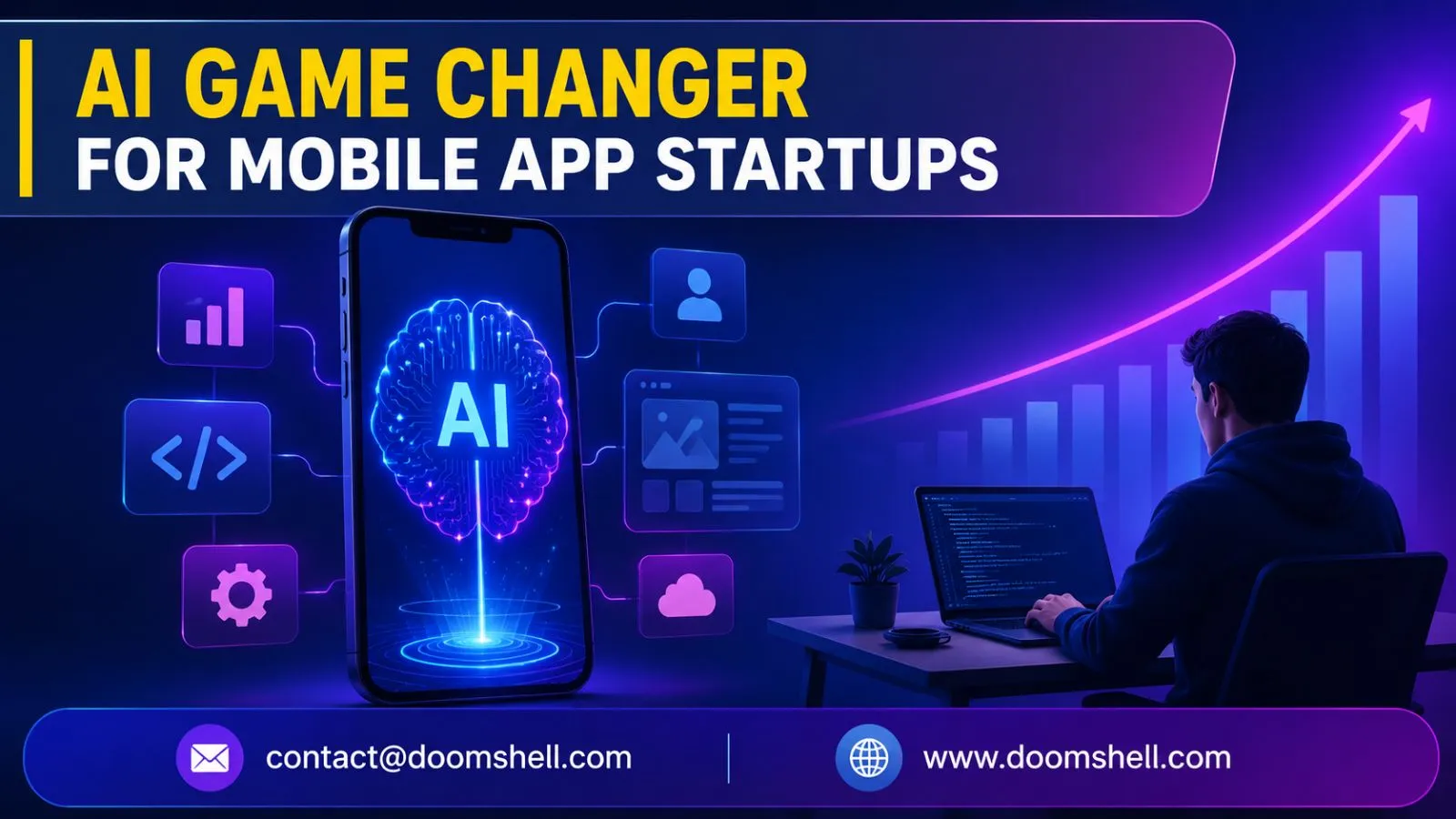
Artificial Intelligence (AI) has become one of the most powerful technologies driving innovation in mobile app development. In 2026, startups are increasingly using AI to build smarter, faster, and more personalized mobile applications with fewer resources.
AI allows small teams to achieve what once required large engineering departments—automating tasks, analyzing user behavior, and delivering highly personalized experiences at scale.
What is AI in Mobile App Startups?
AI in mobile apps refers to the use of machine learning, data analytics, and automation technologies to enhance app functionality and decision-making.
In simple terms, AI helps mobile apps:
- Learn user behavior
- Predict user needs
- Automate repetitive tasks
- Improve app performance over time
This makes apps more intelligent, adaptive, and user-focused.
Why AI is Important for Mobile App Startups
AI is not just a trend—it is a competitive necessity for startups in 2026.
1. Enhanced User Experience
AI enables apps to deliver personalized experiences by analyzing user behavior and preferences.
Examples include:
- Personalized content feeds
- Smart product recommendations
- Adaptive UI/UX based on usage patterns
This increases engagement and user retention significantly.
2. Task Automation
Startups often have limited resources. AI helps automate repetitive tasks such as:
- Customer support via chatbots
- Data entry and processing
- Push notification scheduling
- Email responses
This allows teams to focus on innovation instead of manual work.
3. Better Analytics and Insights
AI can process large volumes of user data and generate meaningful insights such as:
- User engagement patterns
- Drop-off points in the app
- Feature performance
- Predictive user behavior
These insights help startups make data-driven decisions.
4. Cost-Effective Development
AI reduces development time and cost by:
- Automating coding assistance
- Reducing manual testing efforts
- Providing pre-trained models and APIs
- Improving efficiency in app workflows
This is especially useful for early-stage startups.
5. Competitive Advantage
Apps powered by AI stand out in crowded markets.
AI enables:
- Smarter features
- Faster performance
- Personalized user journeys
- Real-time decision-making
This gives startups a strong market advantage.
How AI is Used in Mobile Apps
AI can be integrated into mobile applications in multiple ways.
Chatbots & Virtual Assistants
AI chatbots provide 24/7 customer support by answering user queries instantly.
Use cases:
- Customer service automation
- In-app support
- Onboarding assistance
Recommendation Systems
AI analyzes user behavior to suggest relevant content or products.
Examples:
- E-commerce product suggestions
- Content recommendations in media apps
- Personalized learning paths in education apps
Predictive Analytics
AI predicts future user actions based on historical data.
This helps with:
- User retention strategies
- Demand forecasting
- Feature planning
Voice & Image Recognition
AI enables apps to understand voice commands and images.
Use cases:
- Voice assistants
- Face recognition login
- Image-based search
Marketing Automation
AI improves marketing efficiency through:
- Smart push notifications
- Personalized email campaigns
- Behavioral targeting
- Automated ad optimization
Key Takeaways
- AI helps startups build smarter and more scalable mobile apps
- It improves user experience through personalization
- Automation reduces operational costs and manual effort
- AI-driven analytics support better decision-making
- Startups using AI gain a strong competitive advantage
FAQs
1. What is AI in mobile app development?
AI in mobile apps refers to using machine learning and intelligent systems to automate tasks, personalize experiences, and improve app performance.
2. Why is AI important for startups?
AI helps startups reduce costs, automate workflows, improve user engagement, and compete with larger companies using smarter features.
3. What are examples of AI features in apps?
Examples include chatbots, recommendation systems, voice recognition, predictive analytics, and automated notifications.
4. Is AI expensive to implement in mobile apps?
Not necessarily. Many AI APIs and cloud services make it affordable for startups to integrate AI without building models from scratch.
5. Which technologies are used for AI mobile apps?
Common technologies include TensorFlow, PyTorch, OpenAI APIs, AWS AI services, Google Cloud AI, and Azure AI tools.
Conclusion
AI has become a game-changer for mobile app startups in 2026. It enables businesses to build intelligent applications that improve user experience, reduce costs, and scale efficiently. By integrating AI features such as chatbots, recommendation engines, and predictive analytics, startups can create powerful, future-ready mobile applications that stand out in a competitive market.