Artificial Intelligence has evolved far beyond simple chatbots. Today, businesses are adopting AI Agents that can think, plan, learn, and execute tasks with minimal human intervention. Unlike traditional automation tools, AI Agents analyze data, understand context, make decisions, and perform multi-step actions across different business systems.
Whether it’s customer support, sales automation, HR management, or IT operations, AI Agents are transforming how organizations operate by reducing manual work and improving productivity.
Market Analysis of AI Agents
Artificial Intelligence adoption continues to accelerate across industries. Organizations are increasingly replacing rule-based automation with intelligent systems capable of making real-time decisions.
Recent market trends highlight this shift:
-
More than 68% of businesses are moving from traditional chatbots to AI-powered intelligent automation.
-
Around 72% of enterprise CIOs are investing in AI-powered agents to improve workflow efficiency.
-
Autonomous AI agent adoption is growing by over 50% annually due to increased demand for business automation.
-
Nearly 70% of large enterprises now use intelligent virtual agents in customer service, HR, and internal operations.
-
Conversational AI is expanding beyond customer support into sales, finance, and operations.
These trends clearly indicate that AI Agents are becoming a critical component of digital transformation strategies.
What is an AI Agent?
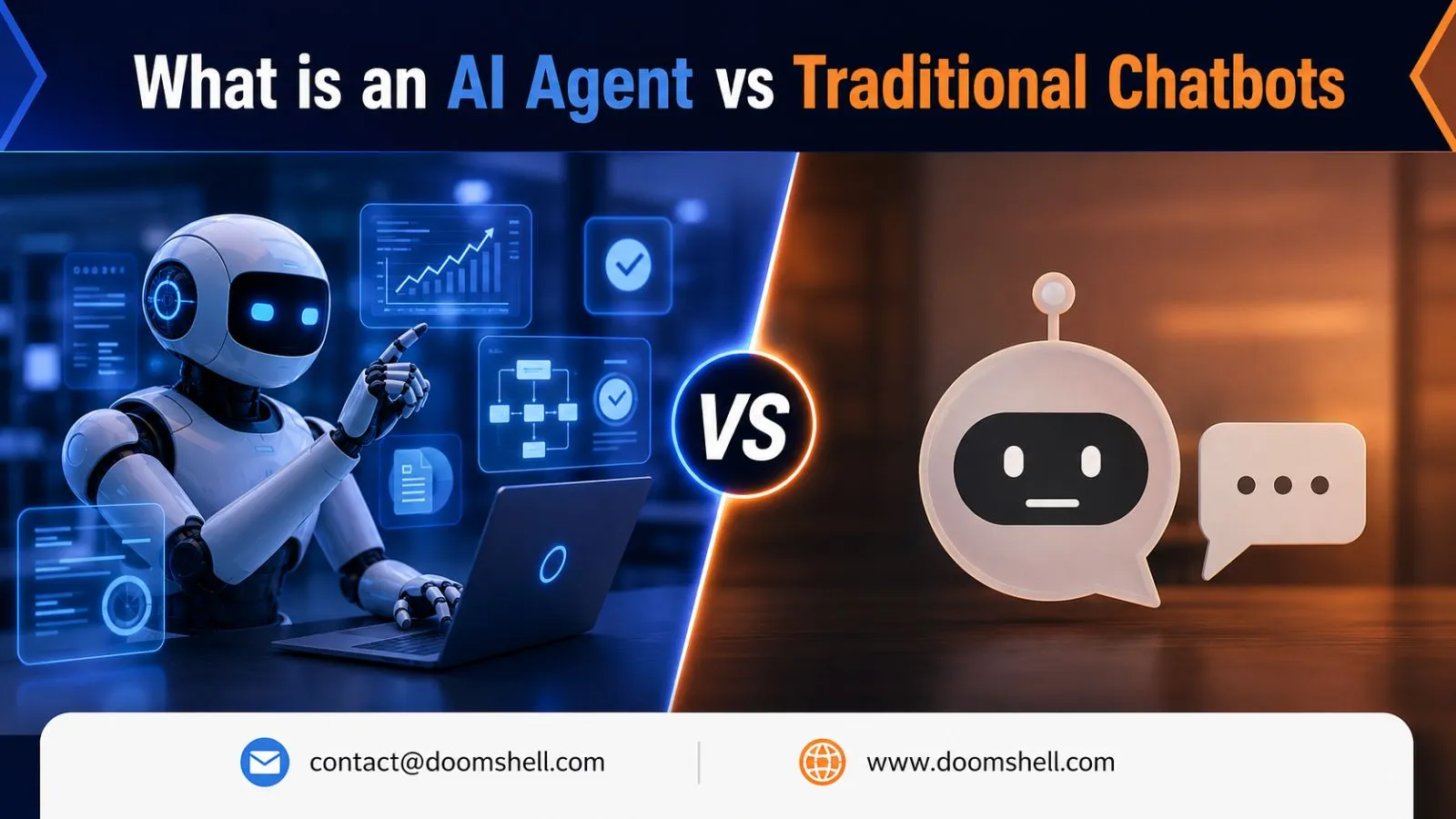
An AI Agent is an intelligent software system capable of observing information, understanding context, making decisions, and completing tasks without continuous human supervision. Unlike traditional chatbots that simply respond to predefined questions, AI Agents can analyze situations, learn from interactions, and execute complete workflows.
For example, if a customer asks about an order delay, an AI Agent can:
-
Check order status
-
Contact the shipping system
-
Generate an updated delivery estimate
-
Notify the customer automatically
-
Escalate the issue if necessary
Instead of only answering questions, the AI Agent actually completes the required task.
How an AI Agent Works Compared to a Traditional Chatbot
Although both technologies communicate with users, their capabilities differ significantly.
Decision-Making Capability
One of the biggest differences between AI Agent vs Chatbot is intelligence.
Traditional chatbots rely on predefined rules and scripted responses. AI Agents analyze user intent, historical interactions, and business context before making decisions.
For instance, an airline chatbot may simply provide flight information, while an AI Agent can rebook canceled flights, send updated tickets, and notify passengers automatically.
Autonomy and Multi-Step Task Execution
Modern Autonomous AI agents perform complete workflows instead of isolated actions.
They can:
-
Retrieve customer information
-
Update databases
-
Generate reports
-
Schedule appointments
-
Send notifications
-
Complete approval workflows
This makes them valuable for enterprise automation where multiple systems work together.
Learning and Continuous Improvement
Unlike traditional chatbots that require manual updates whenever business rules change, AI Agents continuously improve through machine learning and data analysis. Every interaction helps the system better understand user behavior, making future responses more accurate and personalized.
For example, an eCommerce AI Agent can identify purchasing patterns, recommend relevant products, and optimize future conversations based on previous customer interactions. This learning capability enables businesses to deliver better customer experiences over time without constantly redesigning workflows.
Enterprise System Integration
One of the greatest strengths of AI Agents is their ability to integrate with multiple business applications.
These integrations may include:
-
CRM platforms
-
ERP software
-
HR management systems
-
Payment gateways
-
Inventory management software
-
Customer support platforms
Because AI Agents connect with existing business tools, they become a central automation layer rather than a standalone chatbot.
AI Agent vs Traditional Chatbot
| Feature | AI Agent | Traditional Chatbot |
|---|---|---|
| Decision Making | Intelligent reasoning and planning | Rule-based responses |
| Learning | Continuously improves using AI | Requires manual updates |
| Automation | Multi-step workflow execution | Basic conversations only |
| Integration | CRM, ERP, APIs, databases | Limited integrations |
| Scalability | Enterprise-ready | Suitable for basic support |
| Business Value | Process automation | Customer query handling |
Enterprise Use Cases of AI Agents
Customer Support Automation
AI-powered agents provide instant support by resolving customer queries, checking order status, processing refunds, scheduling appointments, and escalating complex cases automatically.
Companies using AI Agents significantly reduce response times while improving customer satisfaction.
Human Resources
HR departments use Intelligent Virtual Agents to automate repetitive administrative work.
Common HR applications include:
-
Resume screening
-
Interview scheduling
-
Employee onboarding
-
Leave management
-
Internal HR support
This allows HR teams to focus on strategic initiatives instead of manual administration.
Sales and Lead Management
Modern sales teams leverage AI Agents to identify high-quality leads and improve conversion rates.
An AI Agent can:
-
Qualify incoming leads
-
Schedule product demonstrations
-
Recommend suitable products
-
Send personalized follow-ups
-
Update CRM records automatically
This shortens the sales cycle and improves productivity.
IT Operations
IT departments increasingly rely on Autonomous AI Agents to monitor infrastructure and resolve technical issues before they affect business operations.
Typical use cases include:
-
System monitoring
-
Incident detection
-
Password resets
-
Software deployment
-
Security alerts
These capabilities reduce downtime while improving operational efficiency.
Finance and Business Operations
Finance teams automate routine processes using AI-powered agents.
Examples include:
-
Invoice processing
-
Expense verification
-
Compliance monitoring
-
Financial reporting
-
Budget forecasting
Automation reduces errors while accelerating business processes.
Marketing and Customer Personalization
AI Agents analyze customer behavior to deliver highly personalized marketing campaigns.
Businesses can use them to:
-
Segment audiences
-
Recommend products
-
Automate email campaigns
-
Predict customer preferences
-
Improve campaign performance
This data-driven personalization increases engagement and customer retention.
Conclusion
AI Agents represent the next generation of business automation. Unlike traditional chatbots that simply answer questions, AI Agents understand context, make intelligent decisions, integrate with enterprise systems, and complete complex workflows independently.
As organizations continue investing in digital transformation, AI-powered agents are becoming essential for improving productivity, reducing operational costs, and delivering exceptional customer experiences. Businesses adopting AI Agents today will be better positioned to compete in an increasingly automated future.
FAQs
1. How is an AI Agent different from a traditional chatbot?
AI Agents use artificial intelligence to reason, learn, make decisions, and execute complete workflows, while traditional chatbots mainly provide predefined responses.
2. Where are AI Agents commonly used?
They are widely used in customer support, HR, sales, IT service management, finance, healthcare, and marketing automation.
3. Can AI Agents integrate with existing business software?
Yes. AI Agents integrate with CRM systems, ERP platforms, APIs, databases, payment gateways, and various enterprise applications.
4. Are AI Agents suitable for small businesses?
Yes. Small businesses can automate customer service, lead management, appointment scheduling, and repetitive tasks using AI Agents, improving efficiency without significantly increasing costs.
5. Why are AI Agents becoming important for digital transformation?
AI Agents improve productivity, automate repetitive work, enhance customer experiences, reduce operational costs, and enable businesses to scale efficiently through intelligent automation.