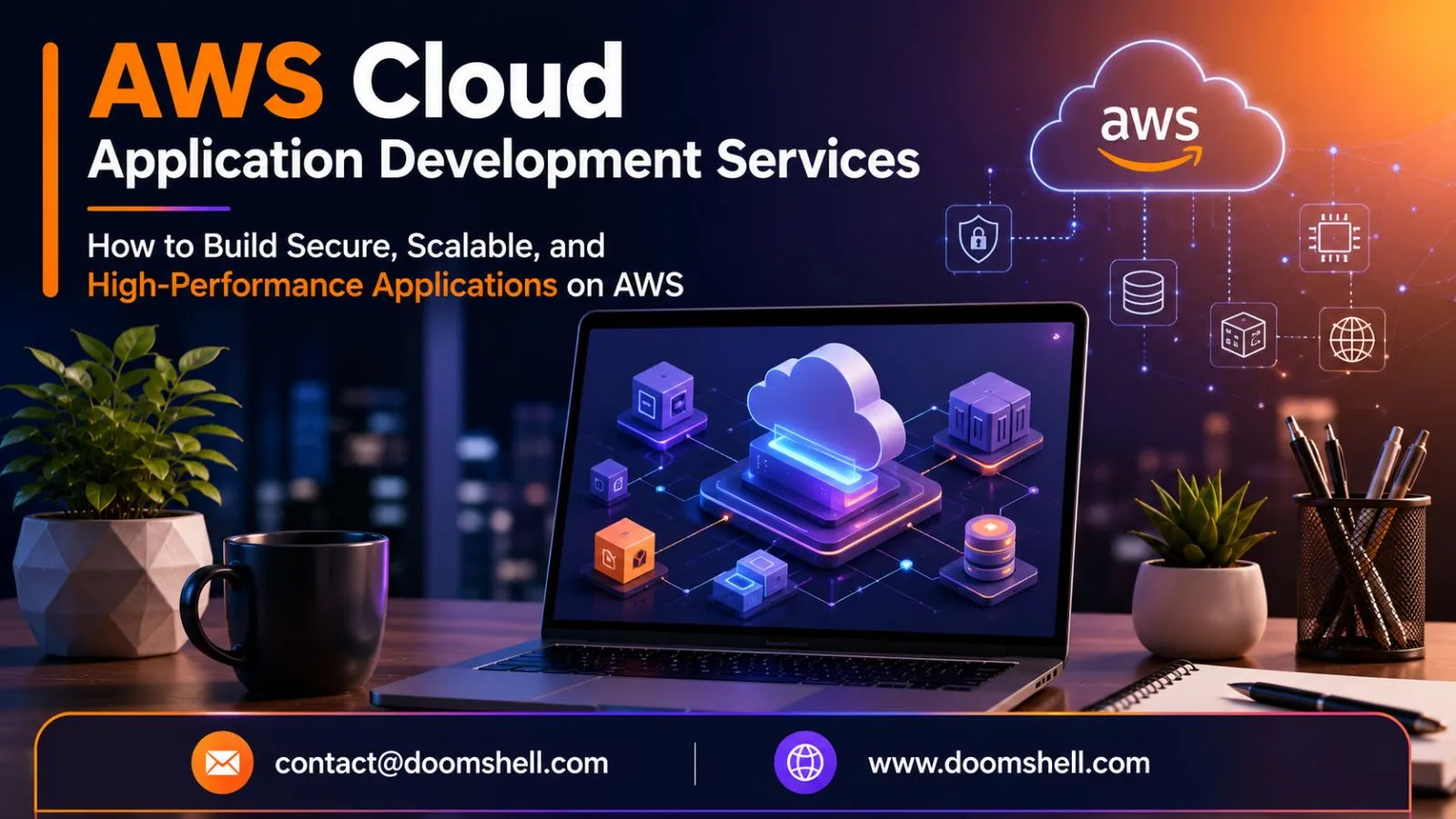
Businesses increasingly rely on cloud applications to deliver digital services, manage data, automate operations, and serve customers across multiple channels. As user expectations rise, applications must remain secure, responsive, scalable, and available. AWS provides a broad ecosystem of cloud services that helps organizations build, deploy, and manage modern applications without maintaining all their infrastructure themselves.
However, successful AWS Cloud Application Development involves more than choosing cloud services. Businesses must plan their architecture, protect sensitive data, optimize performance, manage costs, and establish reliable deployment processes.
With the right strategy, AWS can support everything from startup products and SaaS platforms to enterprise applications handling complex workloads. This guide explores essential AWS services, development practices, security considerations, and strategies for building applications that deliver long-term business value.
Why AWS Is a Strong Platform for Cloud Application Development
Understanding the AWS Cloud Ecosystem
Amazon Web Services offers a broad range of infrastructure, database, storage, networking, security, analytics, and application integration services. These components can be combined according to the needs of each application.
For example, an eCommerce application might use Amazon EC2 for computing, Amazon RDS for relational data, Amazon S3 for product images, and Amazon CloudFront for content delivery. A serverless application could use AWS Lambda and API Gateway to process requests without managing traditional servers.
This flexibility makes AWS suitable for applications with different performance requirements, budgets, and levels of complexity.
Key Benefits for Modern Businesses
AWS offers several advantages for organizations developing digital products:
-
Scalability: Adjust computing capacity as traffic and workloads change.
-
Managed services: Reduce the operational burden of maintaining databases and other infrastructure.
-
Global infrastructure: Support users across regions with appropriate architecture and deployment planning.
-
Automation: Improve consistency through automated provisioning, testing, and releases.
-
Security capabilities: Use identity management, encryption, logging, and network controls to protect applications.
-
Flexible pricing: Select pricing models that match workloads and business requirements.
Nevertheless, these benefits depend on implementation. Poor architecture, excessive permissions, and unused resources can create security risks and unnecessary expenses.
Common Applications Built on AWS
Organizations use AWS to develop SaaS products, mobile application backends, eCommerce platforms, business dashboards, financial applications, healthcare systems, IoT solutions, and data processing platforms.
Each application requires a different combination of services. A content-heavy platform may prioritize caching and content delivery, while a financial application may place greater emphasis on data integrity, access controls, auditability, and regulatory requirements.
Therefore, architecture decisions should begin with business needs rather than a predefined list of cloud products.
Essential AWS Services and Application Architecture
Choosing the Right Compute Services
AWS provides several ways to run application workloads.
Amazon EC2 offers virtual servers with considerable control over operating systems, runtime environments, and configurations. It can suit applications that require specific infrastructure settings or predictable server-level control.
AWS Lambda runs code in response to events without requiring teams to manage traditional servers. It can support APIs, scheduled tasks, file processing, and event-driven workflows.
Amazon ECS helps teams deploy and manage containerized applications. It can be useful when applications are packaged into services that need consistent environments across development and production.
The right choice depends on workload duration, scaling behavior, operational requirements, and cost. Some applications benefit from a combination of virtual servers, containers, and serverless functions.
Selecting Databases, Storage, and APIs
Data architecture has a direct effect on application performance, reliability, and operating costs.
Amazon RDS provides managed relational databases for supported engines such as PostgreSQL, MySQL, and SQL Server. It is suitable for structured data and workloads that depend on relational queries and transactions.
Amazon DynamoDB is a managed NoSQL database designed for applications that need flexible data models and scalable request handling.
Amazon S3 provides object storage for documents, images, videos, backups, and other files. Amazon API Gateway helps developers create and manage APIs, while CloudFront distributes content through a global content delivery network.
For example, a learning platform could store student and course records in a relational database while keeping videos and downloadable resources in S3. CloudFront could then help deliver content efficiently to geographically distributed users.
Designing for Reliability and Scalability
A scalable application needs more than additional computing resources. Teams must consider database capacity, network performance, caching, failure recovery, and the behavior of connected services.
AWS architecture can incorporate load balancing, multiple Availability Zones, managed databases, queues, and automatic scaling where appropriate. These components can help an application handle demand fluctuations and recover from certain infrastructure failures.
However, resilience is not automatic. Teams should identify potential failure points, define recovery objectives, test backup restoration, and verify how the application behaves when a dependency becomes unavailable.
The AWS Cloud Application Development Process and Security Best Practices
Planning and Developing the Application
A structured development process begins with defining business objectives, target users, functional requirements, expected traffic, data needs, security controls, and availability expectations.
Architects can then select the appropriate AWS services and design the application around those requirements. Development typically includes frontend implementation, backend services, database design, API development, authentication, and third-party integrations.
Infrastructure as code can help teams create consistent environments through version-controlled configurations. Separate development, staging, and production environments also allow changes to be tested before reaching customers.
For custom applications, integration planning is particularly important. The system may need to connect with CRM platforms, ERP software, payment gateways, analytics tools, or external partner APIs. These connections should be designed with clear authentication, error handling, and data validation.
Building Security Into Every Development Stage
Security should be part of the architecture from the beginning, not a final checklist before launch.
Important practices include:
-
Apply least-privilege access permissions.
-
Require multi-factor authentication for appropriate users and administrators.
-
Encrypt sensitive data in transit and at rest.
-
Store credentials securely rather than embedding them in source code.
-
Protect public endpoints and restrict unnecessary network access.
-
Keep dependencies and runtime environments updated.
-
Maintain audit logs and monitor suspicious activity.
-
Back up critical data and test recovery procedures.
AWS Identity and Access Management (IAM) supports permissions management, while services such as AWS CloudTrail and Amazon CloudWatch help teams monitor activity and operational behavior. Additional security services can be introduced according to the application's risk profile.
Organizations handling personal, financial, or healthcare information should also evaluate applicable privacy laws, industry standards, and contractual requirements. Cloud infrastructure alone does not guarantee regulatory compliance.
Testing, Deployment, and Performance Monitoring
Before release, applications should undergo functional, integration, security, load, and performance testing. Teams should evaluate how the application responds to high traffic, slow dependencies, invalid requests, and unexpected failures.
Continuous integration and continuous delivery pipelines can automate testing and deployment, reducing manual effort and improving release consistency.
After deployment, monitoring remains essential. Teams can use CloudWatch metrics, logs, alarms, and dashboards to investigate latency, errors, resource utilization, and operational events.
Performance optimization should be guided by evidence. Database indexing, caching, efficient API design, optimized assets, and appropriate scaling policies can improve response times. Regular load testing helps determine whether these changes address actual bottlenecks.
Cost Optimization, Business ROI, and Long-Term Growth
Managing AWS Costs Effectively
AWS offers usage-based pricing for many services, allowing organizations to align spending with their infrastructure requirements. However, cloud costs can rise unexpectedly when resources are oversized, idle environments remain active, or data transfer and storage usage are not monitored.
Businesses can improve cost control by reviewing resource utilization, removing unused resources, setting budgets and billing alerts, and choosing appropriate storage classes and pricing options.
Reserved capacity or commitment-based pricing may suit predictable workloads, while more flexible options may be preferable when demand changes significantly. Each decision should be based on usage patterns and the application's availability requirements.
Cost optimization should not compromise security, resilience, or performance. The objective is to achieve the right balance between operational quality and total cost.
Using Automation to Improve Efficiency
Automation can reduce repetitive operational work and make infrastructure management more consistent.
Infrastructure-as-code tools help teams define cloud resources through version-controlled configurations. Deployment pipelines automate software releases, while monitoring alerts can notify teams when application behavior requires attention.
Automation can support environment creation, testing, backup procedures, scaling, and routine maintenance. When combined with clear approval processes and access controls, it can reduce configuration errors and help teams deliver updates more reliably.
Building Applications That Support Future Growth
As a business expands, its applications may need to support more users, higher transaction volumes, additional integrations, and new markets. AWS provides options for evolving the architecture as these requirements change.
Organizations should regularly review application performance, infrastructure spending, security permissions, database capacity, and recovery readiness. They should also avoid introducing unnecessary complexity before it is justified by actual demand.
Working with a cloud application development company can help businesses plan architecture, build application features, integrate enterprise systems, and establish monitoring and optimization practices.
The most effective development approach begins with a clearly defined business problem, validates the solution with measurable outcomes, and expands the architecture as the product grows.
Final Thoughts
AWS provides a flexible foundation for building secure, scalable, and high-performance applications. Its services support computing, databases, storage, APIs, security, deployment automation, and monitoring, allowing organizations to design architectures around their operational needs.
However, successful AWS Cloud Application Development depends on thoughtful planning and continuous improvement. Businesses need to choose suitable services, secure application data, test performance, monitor infrastructure, and control costs throughout the application's lifecycle.
The best architecture is not necessarily the one that uses the most cloud services. It is the one that meets business requirements with the right balance of security, reliability, performance, scalability, and cost efficiency.
By combining sound engineering practices with a well-planned AWS strategy, organizations can build digital products that adapt to changing customer expectations and support sustainable business growth.