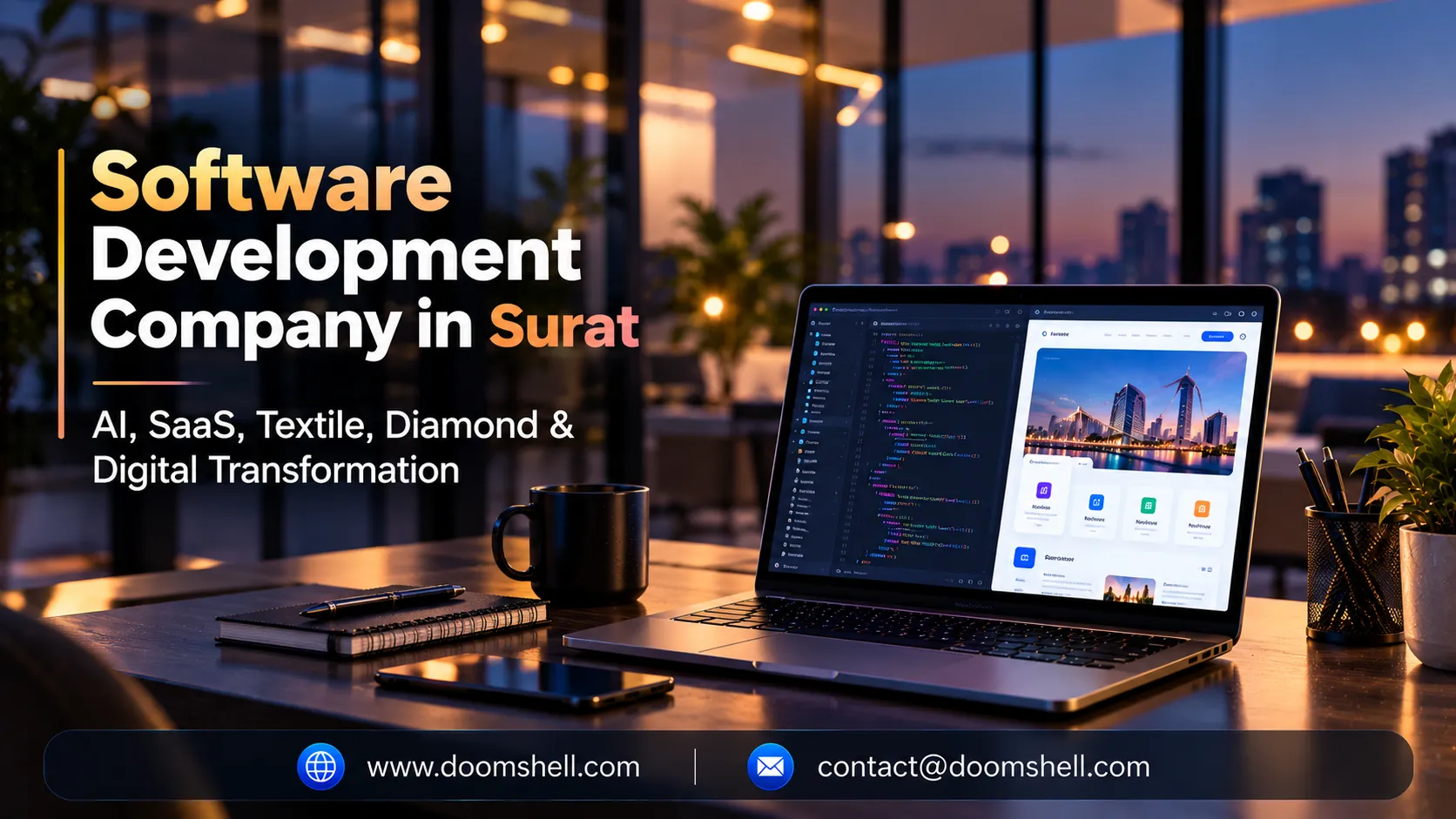
Surat has long been recognised for its diamond and textile industries, but its business ecosystem increasingly creates opportunities for technology-led transformation across manufacturing, healthcare, logistics, finance, retail, and professional services. A software development company in Surat can help these businesses build custom applications, SaaS platforms, AI-powered workflows, mobile apps, ERP integrations, analytics systems, and secure digital infrastructure.
The Surat district administration describes the city as a major diamond and textile centre, with more than 5,000 diamond manufacturing units and a large jewellery-production ecosystem. This concentration of industrial and commercial activity creates a strong use case for software that connects production, inventory, quality, procurement, sales, finance, and customer operations.
At the same time, Surat is developing a more formal technology ecosystem. STPI began full-fledged operations in Surat in August 2016 to promote IT growth, attract investment, and increase IT/ITeS exports from the region, while its Surat facility now includes dedicated plug-and-play incubation infrastructure.
Why Choose a Software Development Company in Surat?
Surat presents a different software opportunity from a city whose economy is dominated by technology services alone. Here, software can be closely connected with physical industries such as textiles, diamonds, engineering, chemicals, logistics, healthcare, and trading.
A software development company in Surat can therefore create solutions that address highly specific operational requirements. Examples include production-management systems for textile businesses, inventory and workflow platforms for jewellery companies, B2B commerce applications, factory dashboards, logistics systems, and AI-assisted business analytics.
Gujarat's current IT/ITeS Policy 2022–27 is designed to grow the state's IT/ITeS ecosystem, develop IT infrastructure, increase high-skilled resources, and encourage emerging technologies. The state's Directorate of ICT & e-Governance also lists a Gujarat GCC Policy for 2025–30 focused on research and development, emerging sectors, innovation, and industrial transformation.
This policy environment adds another layer to Surat's technology potential, particularly for businesses that want to combine industrial expertise with software products and digital services.
Industries Driving Software Development in Surat
1. Textile and Apparel
Textiles remain one of Surat's defining industries, covering yarn production, weaving, processing, embroidery, garments, synthetic fabrics, and related activities. Government industrial information identifies Surat as a major textile centre, while Gujarat's textile ecosystem is expanding through initiatives such as the PM MITRA Park near the Surat textile cluster.
Software can improve visibility across the textile value chain. Manufacturers can use production-management platforms to monitor orders, raw materials, machines, batches, quality checks, processing stages, dispatches, and customer requirements.
A modern textile ERP can connect production with procurement, inventory, accounting, sales, and logistics. Managers can then view information through dashboards instead of relying on disconnected spreadsheets and manual updates.
AI and analytics can further support demand forecasting, anomaly detection, quality inspection, production planning, and inventory optimisation. The objective is not simply to digitise paperwork but to turn operational information into faster and more reliable decisions.
2. Diamond and Jewellery
Surat's diamond industry creates specialised opportunities for software development. The district administration identifies the city as a major diamond manufacturing centre with thousands of diamond manufacturing units, while 2026 government science-and-technology information also highlights the GI recognition of Surat Cut Diamond.
Diamond businesses can benefit from software for inventory management, stone tracking, purchase management, grading information, production workflows, sales, customer relationship management, and accounting.
A secure digital platform can create traceability across multiple stages of processing. Businesses can define permissions so that production teams, sales staff, managers, finance departments, and external partners access only the information relevant to their responsibilities.
AI and computer vision can also support specific inspection and classification workflows where suitable datasets and controlled testing are available. Human expertise remains important, particularly for high-value decisions, but software can reduce repetitive work and improve information availability.
3. Manufacturing and Engineering
Surat and the surrounding industrial belt support engineering, chemicals, plastics, machinery, processing, and other manufacturing activities. Government industrial assessments identify these sectors alongside Surat's established diamond and textile industries.
Manufacturers can use custom software to connect production, procurement, maintenance, quality, inventory, and dispatch.
Industry 4.0 applications can combine machine data with enterprise software. Sensors and connected equipment can feed information into dashboards that help teams identify downtime, production deviations, equipment conditions, and resource usage.
Predictive-maintenance systems can analyse historical machine information and generate alerts when patterns indicate potential problems. Such systems work best when businesses begin with reliable data collection and clearly defined operational objectives.
4. Healthcare
Surat has a broad healthcare and medical-education ecosystem, creating demand for hospital management, appointment, diagnostics, pharmacy, billing, patient communication, and administrative software.
A healthcare platform can connect patient registration, appointments, electronic records, laboratory workflows, billing, pharmacy inventory, notifications, and reporting.
A software development agency in Surat can also build patient-facing mobile applications that allow users to book appointments, receive reports, communicate with providers, and manage selected services through a single interface.
Security should remain central to healthcare software. Encryption, authentication, role-based access, audit trails, secure backups, controlled integrations, and appropriate data-retention practices should be considered during architecture.
5. Logistics and Trading
Surat's industrial and commercial activity generates significant movement of raw materials, finished products, shipments, samples, and business documents.
Logistics software can manage orders, vehicles, warehouses, routes, deliveries, documentation, and customer communication. APIs can connect logistics applications with ERP, accounting, e-commerce, GPS, and payment systems.
Real-time dashboards can help businesses track orders from dispatch to delivery. Automated alerts can notify teams about delays, exceptions, stock levels, or pending approvals.
For businesses operating across multiple locations, cloud-based systems can provide a unified view of operations while still maintaining role-based access for different teams.
How a Software Development Agency in Surat Supports Businesses
A software development agency in Surat can help companies move from manual workflows to connected digital operations. The first step should be understanding how the organisation actually works, including people, processes, systems, data, approvals, and bottlenecks.
For an established business, the requirement may not be a completely new platform. Integration between existing ERP, accounting, CRM, inventory, production, and customer-facing systems may create more value than replacing everything.
For a startup, the priority may instead be a focused MVP. The development team can define a minimum feature set, validate the product with real users, and then expand the architecture as demand becomes clearer.
A mature development process should also include testing, deployment, monitoring, documentation, security, maintenance, and scalability planning.
Custom Software Development Service in Surat
A complete software development service in Surat can cover the entire product lifecycle, from business analysis and UI/UX design through development, testing, cloud deployment, integration, and ongoing maintenance.
Common solutions include:
-
Textile ERP and production software
-
Diamond and jewellery management systems
-
Manufacturing applications
-
SaaS products
-
CRM and ERP integrations
-
Healthcare platforms
-
Logistics software
-
B2B marketplaces
-
E-commerce applications
-
Mobile applications
-
AI-powered business tools
-
Data analytics dashboards
-
IoT platforms
-
Workflow automation
-
Cloud-native applications
-
Legacy application modernisation
The technology stack should follow the project's requirements rather than the other way around. A small internal workflow application may require a very different architecture from a multi-tenant SaaS platform serving thousands of users.
AI and Data Analytics for Surat Businesses
AI is increasingly becoming part of mainstream software development, and Surat's industrial base provides many practical use cases.
Textile businesses can explore AI-assisted demand forecasting, quality analysis, production optimisation, and inventory planning. Diamond and jewellery businesses can investigate computer vision, classification, search, workflow automation, and document processing where appropriate.
Manufacturers can use analytics for machine performance, maintenance, quality, energy consumption, and production efficiency.
Customer-facing businesses can use generative AI for knowledge search, customer support, document summarisation, internal assistants, and content workflows.
However, AI projects should start with a measurable problem rather than simply adding an AI feature. Data availability, privacy, accuracy, model costs, integration requirements, response time, and human review should all be considered before deployment.
SaaS Product Development in Surat
Surat's industry diversity can provide founders with opportunities to develop specialised B2B SaaS products. Instead of creating another general-purpose application, entrepreneurs can build software around specific operational problems in textiles, manufacturing, jewellery, logistics, healthcare, trading, or professional services.
A vertical SaaS platform can include workflows that generic products do not understand. For example, textile software may need production-stage tracking, batch information, processing workflows, quality controls, and industry-specific reporting.
A SaaS product should be designed around multi-tenancy, authentication, authorisation, billing, subscriptions, analytics, APIs, monitoring, backups, and automated deployments.
Starting with a narrow problem can make product validation easier. Once customers demonstrate consistent demand, the platform can expand into adjacent workflows and integrations.
Surat's Emerging Technology Ecosystem
STPI's Surat centre was established specifically to promote IT industry growth and attract investment into the regional technology sector. Its current incubation facility provides 19,392 square feet with 106 seats and plug-and-play arrangements for startups and SMEs.
STPI's wider startup ecosystem also supports areas such as artificial intelligence, IoT, blockchain, FinTech, data science, cybersecurity, health informatics, gaming, machine learning, and ESDM. Its startup programme provides incubation, mentoring, industry connections, lab access, and seed or risk-funding opportunities for eligible startups.
This creates opportunities for Surat entrepreneurs to develop technology products around problems they already understand through industry experience.
The connection between industrial knowledge and software expertise can be particularly valuable. A founder familiar with textile production, diamond operations, logistics, or manufacturing may identify workflow problems that a generic technology team would not immediately recognise.
Cloud Modernisation and Enterprise Software
Many established companies have accumulated software over years of growth. Some may use desktop applications, spreadsheets, older databases, third-party SaaS tools, and disconnected systems simultaneously.
Cloud modernisation can bring these systems into a more manageable architecture. Businesses can migrate selected workloads, expose APIs, centralise data, introduce role-based access, and create dashboards without necessarily replacing every legacy application at once.
A phased approach can reduce operational disruption. Teams can first modernise high-impact processes, measure the results, and then move toward additional systems.
A software development agency in Surat can support this process through architecture assessment, API development, cloud migration, database modernisation, application redevelopment, testing, and post-deployment monitoring.
Cybersecurity for Surat Businesses
Digital transformation also increases the importance of cybersecurity. Manufacturing systems, customer portals, payment applications, employee platforms, APIs, cloud infrastructure, and mobile applications can all become part of an organisation's technology footprint.
Secure software should include strong authentication, appropriate authorisation, encrypted communication, secure secrets management, logging, monitoring, vulnerability testing, dependency updates, backups, and controlled deployment processes.
Industrial organisations should also consider the relationship between IT systems and connected operational technology. If machines, sensors, production systems, and enterprise software exchange information, access controls and network segmentation become particularly important.
Security is most effective when it is included throughout the development lifecycle rather than added shortly before launch.
Mobile Application Development in Surat
Mobile applications can extend business services to customers, employees, distributors, sales teams, delivery personnel, and field workers.
Surat businesses can use mobile apps for order management, inventory, field sales, customer support, logistics, healthcare appointments, education, retail, payments, and internal operations.
A field-service application, for example, can allow employees to receive assignments, capture photographs and documents, update job status, collect signatures, and synchronise information with a central platform.
Offline functionality can be valuable when employees operate in locations with inconsistent connectivity. Data can be stored securely on the device and synchronised once a reliable connection becomes available.
Automation for Textile and Industrial Operations
Automation is one of the most practical software opportunities for Surat's established industries. Repetitive tasks such as data entry, report preparation, approval routing, stock updates, invoice generation, notifications, and reconciliation can often be connected through workflow software.
A software development service in Surat can integrate these processes with existing ERP, CRM, accounting, inventory, and production systems.
For example, an automated order workflow can capture a new order, validate inventory, notify production, generate internal tasks, update the customer portal, and trigger dispatch documentation.
The objective is not to automate every process immediately. Businesses can start with repetitive, high-volume workflows where automation can produce measurable improvements.
What to Look for in a Software Development Partner
Choosing a technology partner should involve more than comparing development quotations. Businesses should evaluate whether the team understands their industry, can explain architectural decisions clearly, and has processes for quality, security, deployment, and long-term support.
Important questions include:
-
How will business requirements be documented?
-
Can the team integrate existing ERP and accounting systems?
-
What approach will be used for data security?
-
How will the application be tested?
-
What happens when user numbers increase?
-
How will APIs and third-party integrations be maintained?
-
Who owns the source code and technical documentation?
-
How will backups and disaster recovery be handled?
-
What monitoring will be available after launch?
-
How can AI or automation be introduced later without rebuilding the entire system?
These questions help organisations assess the development process rather than focusing only on the initial price.
Current Software Development Trends in Surat
Several technology trends are particularly relevant to Surat's business environment.
AI-powered business applications: AI is moving into forecasting, document processing, search, customer support, quality workflows, and analytics.
Industrial automation: Software is increasingly connecting production data with enterprise systems for better operational visibility.
Vertical SaaS: Industry-specific SaaS products can address specialised workflows in textiles, jewellery, manufacturing, healthcare, and logistics.
Cloud modernisation: Businesses are moving selected applications and data workloads toward scalable cloud infrastructure and API-driven architectures.
IoT and Industry 4.0: Connected machines and sensors can provide data for maintenance, quality, production, and energy management.
Cybersecurity: More connected systems increase the need for secure identities, APIs, applications, infrastructure, and data.
GCC development: Gujarat's 2025–30 GCC Policy identifies research and development and emerging sectors as areas of focus, creating a broader state-level environment for technology-led enterprise operations.
Emerging IT infrastructure: STPI's continued presence and incubation facility give Surat a dedicated platform for IT/ITeS startups and SMEs.
AEO, GEO and LLM SEO for Surat Software Businesses
A software business targeting Surat should create content that explains both technology and local industry context. Search engines and AI systems need meaningful information about what the company builds, which industries it serves, what technologies it uses, and which business problems it solves.
For AEO, businesses can answer practical questions such as how to build textile ERP software, how diamond businesses can digitise inventory, how manufacturing companies can introduce Industry 4.0, how SaaS platforms are developed, and how AI can automate repetitive business workflows.
For GEO and LLM SEO, content should connect Surat with its strongest commercial and technology themes. Textile manufacturing, diamonds, jewellery, engineering, chemicals, healthcare, logistics, SaaS, AI, cloud computing, automation, and IT/ITeS provide useful contextual relationships.
Detailed service pages, industry-specific landing pages, technical guides, FAQs, case studies, implementation articles, and software comparisons can help create a more complete digital knowledge base.
Choosing the Right Software Development Service in Surat
The right software development service in Surat should align with the company's actual operational goals. A business may need a new product, an internal application, ERP integration, a mobile platform, cloud migration, AI automation, or simply better reporting.
A practical development roadmap usually begins with discovery and requirements before moving into architecture, UX/UI, development, testing, deployment, and continuous improvement.
For complex industrial applications, phased delivery can be especially useful. Businesses can first digitise one workflow, measure its impact, and then expand into related processes.
Post-launch maintenance should also be part of the plan. Software requires security patches, infrastructure updates, bug fixes, dependency upgrades, performance monitoring, backups, and new features as business requirements evolve.
The Future of Software Development in Surat
Surat's established industrial strengths provide a distinctive foundation for software innovation. The city's diamond and textile industries create large-scale operational use cases, while engineering, healthcare, logistics, trading, and manufacturing add further opportunities for specialised digital products.
At the same time, STPI's presence since 2016, its dedicated startup incubation facility, and Gujarat's broader IT/ITeS and GCC initiatives are helping expand the technology side of the regional economy.
For organisations searching for a software development company in Surat, the opportunity is therefore not limited to conventional websites or basic business applications. AI, SaaS, automation, Industry 4.0, cloud platforms, analytics, cybersecurity, healthcare technology, textile software, and specialised diamond-industry solutions can all become part of Surat's next digital growth phase.
The most useful software projects will begin with clearly defined business problems and measurable outcomes. By combining domain expertise with secure architecture, modern development practices, scalable infrastructure, and continuous optimisation, businesses can turn software into a long-term operational capability rather than a one-time technology project.
Doomshell is a Jaipur-based technology company that works on software development, digital products, automation, and modern business applications. Its focus is on translating complex business requirements into scalable and user-focused digital solutions.
For Surat businesses exploring digital transformation, specialised software can connect established industry expertise with modern technology. Doomshell, based in Jaipur, can support organisations looking to build secure, scalable, and growth-ready software products.