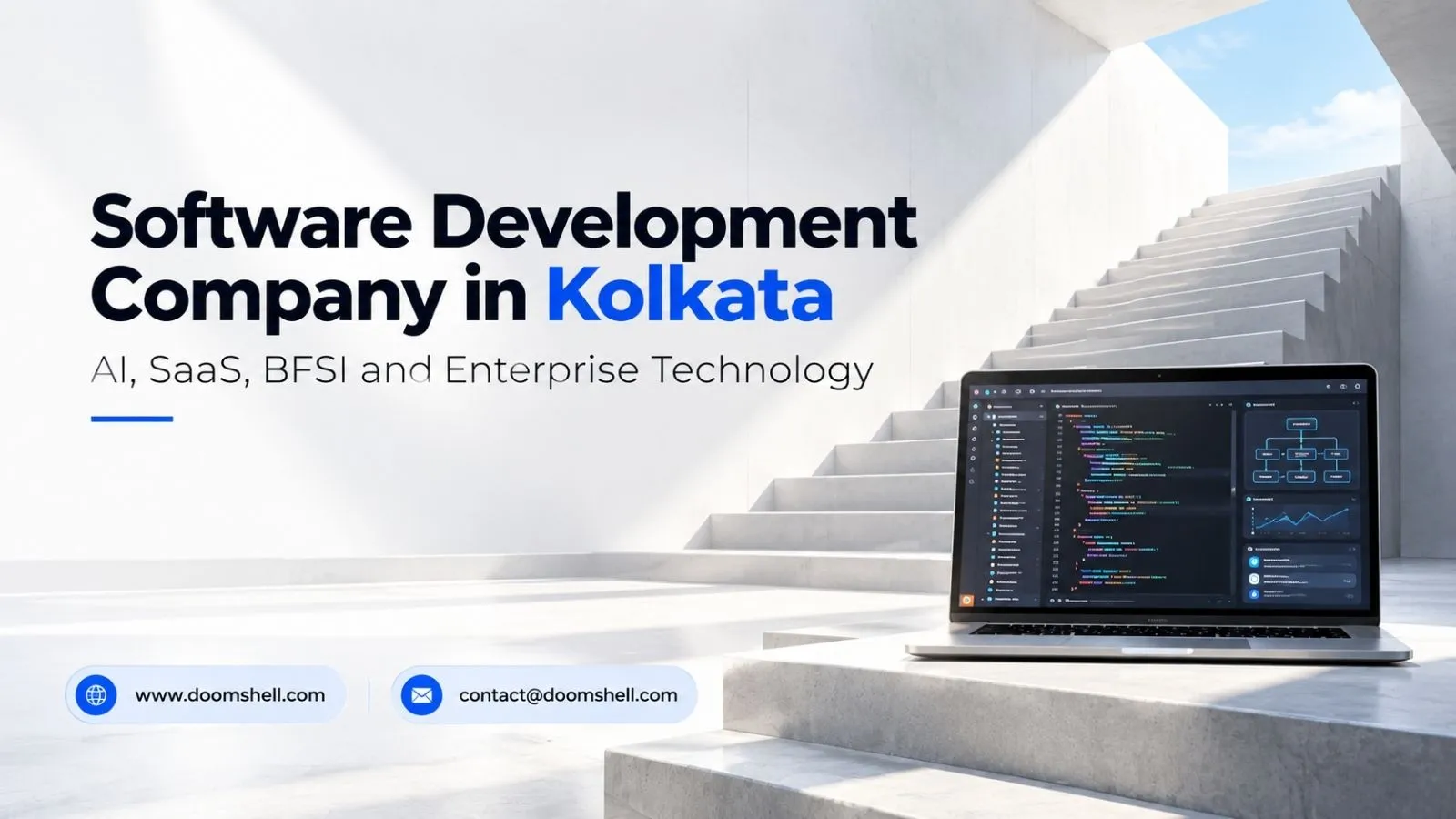
Kolkata has a diverse business ecosystem spanning financial services, healthcare, education, logistics, manufacturing, retail, media, professional services, and technology. A software development company in Kolkata can help organisations in these sectors build custom applications, SaaS products, AI platforms, enterprise systems, mobile applications, analytics dashboards, automation tools, and cloud-native infrastructure.
West Bengal's Department of Information Technology & Electronics identifies IT infrastructure, IT promotion, new-age technology, cybersecurity, and digital governance among its focus areas. The department currently lists IT parks, a state data centre, and a State AI Data Centre offering GPU access, showing that the state's technology infrastructure is expanding beyond traditional software services.
Kolkata also has dedicated technology infrastructure through STPI. Its Salt Lake facility provides incubation infrastructure, high-speed connectivity, security, server co-location, and mentoring support for IT/ITeS businesses and startups.
Why Choose a Software Development Company in Kolkata?
Kolkata's software requirements are closely connected to the city's varied economy. Financial institutions need secure transaction and workflow platforms, hospitals need healthcare systems, educational organisations need digital learning and administration tools, while logistics and manufacturing companies require supply-chain and operational software.
A software development company in Kolkata can therefore build technology around specific business processes instead of forcing every organisation into generic software. Custom development can connect existing ERP, CRM, accounting, inventory, payment, logistics, and customer-facing systems through APIs and shared data workflows.
West Bengal's IT and electronics department describes its role as supporting the continuous development of the electronics and IT industry while promoting innovation in emerging technologies and cybersecurity.
This creates an environment where software development can support both traditional enterprises and newer digital businesses.
Industries Driving Software Development in Kolkata
1. Banking, Financial Services and Insurance
BFSI is one of the most important areas for enterprise software because financial organisations manage large volumes of transactions, customer information, documents, compliance processes, and internal workflows.
Banks, NBFCs, insurance companies, fintech businesses, and financial service providers can use custom software for customer onboarding, loan workflows, document verification, payments, reconciliation, reporting, risk operations, customer support, and internal knowledge management.
A secure financial platform needs strong authentication, authorisation, encryption, audit trails, monitoring, and carefully controlled integrations. API-based architecture can also allow financial applications to connect with payment gateways, accounting platforms, identity services, CRM systems, and other business applications.
AI can assist with document classification, customer-service workflows, anomaly detection, information retrieval, and operational analytics. Human review remains important wherever automated outputs affect significant financial decisions.
2. Healthcare and MedTech
Kolkata's healthcare ecosystem creates demand for hospital-management platforms, diagnostic software, appointment systems, pharmacy applications, patient portals, billing solutions, and healthcare analytics.
A connected healthcare platform can bring appointments, patient registration, laboratory workflows, pharmacy inventory, billing, communication, and reporting into a coordinated system.
A software development agency in Kolkata can also build patient-facing mobile applications that allow users to book appointments, access selected reports, receive reminders, and communicate with healthcare providers.
Healthcare applications should be designed around privacy and security from the beginning. Role-based access, encrypted communication, audit logging, secure APIs, backups, and controlled integrations are important components of a responsible architecture.
AI can support administrative healthcare use cases such as document processing, search, scheduling, reporting, and workflow automation. Clinical applications require additional validation and appropriate human oversight.
3. Logistics and Supply Chain
Kolkata's position as a major commercial centre creates software opportunities across transportation, warehousing, distribution, procurement, and supply-chain operations.
Logistics businesses can use software for fleet management, shipment tracking, warehouse operations, route planning, delivery management, inventory visibility, and customer communication.
A central dashboard can combine information from vehicles, warehouses, orders, GPS systems, ERP platforms, and customer applications.
Mobile applications are particularly useful for drivers and field teams. They can receive assignments, capture delivery information, upload documents, collect signatures, and synchronise data with the central system.
AI and analytics can further support demand forecasting, route optimisation, anomaly detection, and operational reporting when reliable historical data is available.
4. Education and EdTech
Kolkata's extensive education ecosystem provides opportunities for student-management systems, learning-management platforms, admission portals, examination applications, fee-management software, and digital libraries.
A modern education platform can connect admissions, attendance, fees, examinations, learning content, communication, and student records.
AI can support intelligent search, personalised learning recommendations, content assistance, document processing, and administrative workflows.
For institutions operating across multiple campuses, cloud-based software can provide centralised administration while preserving separate access controls for departments, campuses, faculty, students, and administrators.
5. Manufacturing and Engineering
Manufacturing and engineering businesses can use software to connect production planning, inventory, procurement, quality, maintenance, finance, and dispatch.
A production dashboard can provide information about machine status, output, downtime, pending orders, quality indicators, and inventory.
Industrial IoT can extend this capability by connecting machines and sensors to software platforms. Data from equipment can then be analysed for predictive maintenance, energy monitoring, production efficiency, and operational alerts.
For companies with older systems, modernisation does not always require immediate replacement. APIs, integration layers, modern databases, and selected application redevelopment can gradually connect legacy systems with newer digital platforms.
How a Software Development Agency in Kolkata Supports Businesses
A software development agency in Kolkata can help organisations transform manual and disconnected processes into integrated digital workflows. The process should start with understanding users, business objectives, existing technology, data sources, bottlenecks, integrations, and security requirements.
For an established company, the solution could involve modernising a legacy application or connecting several existing systems. For a startup, it may involve designing an MVP that validates a focused product idea before larger investments are made.
A structured development lifecycle should cover discovery, architecture, UI/UX, development, testing, deployment, monitoring, documentation, security, and maintenance.
The objective should be a maintainable system that can evolve with the organisation rather than a product that becomes difficult to modify after launch.
Custom Software Development Service in Kolkata
A complete software development service in Kolkata can cover product discovery, business analysis, UI/UX design, application development, API integration, testing, cloud deployment, data engineering, cybersecurity, maintenance, and performance optimisation.
Common solutions include:
-
BFSI and fintech applications
-
Healthcare platforms
-
Education-management systems
-
Logistics and supply-chain software
-
Manufacturing applications
-
CRM and ERP solutions
-
SaaS products
-
E-commerce platforms
-
Mobile applications
-
AI-powered business tools
-
Data analytics dashboards
-
Workflow automation
-
IoT platforms
-
Cloud-native applications
-
Legacy system modernisation
The technology stack should be selected according to the application's requirements. A small internal workflow application may need a simpler architecture than a high-volume financial platform or multi-tenant SaaS product.
AI and Data Analytics in Kolkata
AI is becoming increasingly relevant to software projects in Kolkata. West Bengal's IT and Electronics Department currently lists a State AI Data Centre with GPU access alongside broader initiatives for promoting new-age technology.
Businesses can apply AI to customer support, enterprise search, document processing, forecasting, data classification, reporting, quality analysis, and workflow automation.
Financial organisations can explore AI for document workflows, internal knowledge search, customer-service assistance, and anomaly analysis. Healthcare organisations can use AI for administrative processes, information retrieval, and operational analytics where appropriate.
Generative AI can also be integrated into internal enterprise systems. Employees could search policies, product information, technical documentation, project records, or other approved business knowledge through a controlled assistant.
AI projects should start with a measurable problem. Data quality, privacy, model accuracy, infrastructure costs, integration requirements, response times, and human oversight should be considered before the technology is introduced into important business processes.
SaaS Product Development in Kolkata
Kolkata's broad business base creates opportunities for specialised SaaS products. Founders can develop vertical software for financial operations, healthcare, education, logistics, manufacturing, retail, professional services, and other sectors.
A vertical SaaS platform can address industry-specific workflows more effectively than a generic application. For example, a logistics platform might include fleet tracking, delivery workflows, route management, warehouse integration, and proof-of-delivery features.
A scalable SaaS architecture should consider multi-tenancy, authentication, authorisation, subscriptions, billing, APIs, monitoring, backups, analytics, and automated deployments.
Starting with one well-defined business problem can make product validation easier. Once recurring customer demand is established, additional workflows and integrations can be introduced.
Kolkata's IT Infrastructure and Startup Ecosystem
Kolkata has dedicated IT infrastructure through STPI, particularly around Salt Lake. STPI Kolkata provides plug-and-play incubation facilities, high-speed leased-line connectivity, security, server co-location, and mentoring support for IT/ITeS businesses and startups.
STPI's broader ecosystem supports emerging technologies including AI, machine learning, computer vision, IoT, robotics, RPA, data science, FinTech, MedTech, cybersecurity, Industry 4.0, and other technology domains. Its incubation and startup programmes provide infrastructure, mentoring, industry connections, lab access, and funding-related support for eligible startups.
The city therefore offers more than a conventional IT-services market. Startups and established companies can develop products around domain-specific problems while using Kolkata's existing technology and business ecosystem.
The West Bengal government also maintains IT infrastructure initiatives covering IT parks, hardware parks, data centres, and new-age technology.
Cloud Modernisation and Enterprise Software
Many established organisations operate a combination of legacy applications, spreadsheets, databases, SaaS products, ERP systems, and departmental tools.
Cloud modernisation can gradually connect these systems through APIs, centralised data services, modern applications, and managed infrastructure.
A phased approach can reduce disruption. Organisations can begin with a high-value workflow, introduce integration or modernisation, measure the results, and then expand into additional systems.
A software development agency in Kolkata can support this process through architecture assessment, API development, database migration, cloud deployment, application redevelopment, testing, monitoring, and technical documentation.
Cybersecurity for Kolkata Businesses
As businesses adopt cloud applications, mobile platforms, APIs, digital payments, and connected enterprise systems, cybersecurity becomes an essential part of software development.
West Bengal has a dedicated Cyber Security Strategy 2023 and Data Privacy Guideline 2023 listed in the state's official document repository.
Secure applications should incorporate strong authentication, appropriate access controls, encryption, secure secrets management, vulnerability testing, logging, monitoring, backups, dependency updates, and controlled deployment processes.
Financial and healthcare systems require particular attention because they may process sensitive personal or financial information. Industrial companies should additionally consider the separation between enterprise IT systems and operational technology.
Security testing should happen throughout the development lifecycle rather than only before launch.
Mobile Application Development in Kolkata
Mobile applications allow businesses to take digital services directly to customers, employees, field teams, students, patients, suppliers, and distributors.
A logistics application can provide drivers with assignments and delivery workflows. A healthcare application can support appointments and communication, while a financial application can provide customer-facing services through secure authentication.
Enterprise mobile applications can also support field sales, inspections, inventory, service calls, expense reporting, and workforce management.
Offline functionality can be valuable for field teams operating in areas with unreliable connectivity. Secure local storage and controlled synchronisation can allow employees to continue essential workflows before reconnecting.
Automation for Business Operations
Automation can reduce repetitive manual work in finance, HR, procurement, customer support, operations, and administration.
A software development service in Kolkata can connect business systems so that an event in one platform triggers a controlled workflow in another.
For example, an approved purchase request could automatically create procurement tasks, update inventory information, notify finance, and communicate with the relevant supplier system.
Document-processing automation can also extract information from invoices, forms, purchase orders, reports, and other structured or semi-structured documents, with human validation where necessary.
The strongest automation opportunities are usually repetitive, rules-based processes with high transaction volumes or measurable manual effort.
What to Look for in a Software Development Partner
Choosing a technology partner should involve more than comparing project quotations. Organisations should evaluate the team's technical capability, industry understanding, development methodology, security practices, communication, testing process, and post-launch support.
Important questions include:
-
How will business requirements and workflows be documented?
-
Can the team integrate existing ERP, CRM, accounting, payment, or logistics systems?
-
How will sensitive information be protected?
-
What testing and quality-assurance process will be followed?
-
How will the application scale as users and transactions increase?
-
How will APIs and third-party integrations be monitored?
-
Who owns the source code and technical documentation?
-
What backup and disaster-recovery approach will be used?
-
What monitoring will be available after deployment?
-
Can the architecture accommodate future AI, analytics, and automation requirements?
These questions help businesses evaluate the long-term development approach rather than focusing exclusively on the initial project cost.
Current Software Development Trends in Kolkata
Several trends are shaping software development opportunities in Kolkata.
AI-powered enterprise applications: AI is increasingly being used for search, document processing, customer support, forecasting, analytics, and workflow automation.
SaaS and vertical software: Businesses can develop specialised platforms around BFSI, healthcare, education, logistics, manufacturing, and professional services.
Cloud-native applications: APIs, managed databases, containerised deployments, automated CI/CD, and cloud monitoring are becoming important components of modern software architecture.
Cybersecurity: Increased digital connectivity is driving demand for stronger identity, application, API, infrastructure, and data security.
Industrial IoT: Connected machines and sensors can generate information for maintenance, production analytics, quality monitoring, and operational visibility.
Data-driven decision-making: Businesses are using dashboards, analytics platforms, predictive models, and automated reporting to reduce dependence on fragmented spreadsheets.
AI infrastructure: The West Bengal IT and Electronics Department currently provides an application route for GPU access through the State AI Data Centre, indicating growing attention to AI infrastructure.
Startup and incubation support: STPI continues to provide incubation, mentoring, technology infrastructure, industry connections, and startup-support programmes across its ecosystem.
AEO, GEO and LLM SEO for Kolkata Software Businesses
A software business targeting Kolkata should publish content that explains its technology capabilities alongside the industries and problems it serves. Search engines and AI systems need context about what the company builds, who it serves, which technologies it uses, and how its solutions address business requirements.
For AEO, businesses can answer specific questions such as how to build fintech software, how hospitals can digitise workflows, how manufacturers can implement Industry 4.0, how to develop a SaaS platform, and how AI can automate enterprise processes.
For GEO and LLM SEO, content should connect Kolkata with its major commercial and technology themes. BFSI, healthcare, education, logistics, manufacturing, retail, SaaS, AI, cloud computing, cybersecurity, and enterprise software create useful contextual relationships.
Industry-specific service pages, detailed FAQs, case studies, technical guides, implementation articles, comparison content, and software-development explainers can build a stronger searchable information footprint.
Choosing the Right Software Development Service in Kolkata
The right software development service in Kolkata should match the organisation's business objectives, users, data requirements, integrations, security expectations, budget, and growth plans.
A practical roadmap usually starts with discovery and requirements before moving into UX/UI design, architecture, development, testing, deployment, monitoring, and continuous improvement.
For large organisations, phased development can make transformation easier to manage. One workflow or department can be modernised first, followed by additional integrations after the results have been measured.
Post-launch support should be considered from the beginning. Software needs security updates, dependency upgrades, performance monitoring, infrastructure maintenance, backups, bug fixes, and feature enhancements as business needs evolve.
The Future of Software Development in Kolkata
Kolkata's combination of financial services, healthcare, education, logistics, manufacturing, retail, professional services, and IT creates a broad base for software innovation. The city's established STPI infrastructure and the West Bengal government's current focus on IT infrastructure, new-age technology, cybersecurity, and AI infrastructure further support the technology ecosystem.
For organisations searching for a software development company in Kolkata, the opportunity extends well beyond basic business applications. AI, SaaS, fintech, healthcare technology, cloud modernisation, cybersecurity, enterprise automation, data analytics, IoT, and industry-specific platforms can all contribute to the city's next stage of digital development.
The most effective software projects will begin with clearly defined business problems and measurable outcomes. Combining domain expertise with secure architecture, scalable infrastructure, modern engineering practices, and continuous optimisation can turn software into a long-term business capability rather than a one-time technology investment.
Doomshell is a Jaipur-based technology company working across software development, automation, digital products, and modern business applications. Its approach focuses on converting complex business requirements into scalable, secure, and user-focused digital solutions.
For Kolkata businesses exploring digital transformation, specialised software can connect established industry knowledge with modern technology. Doomshell, based in Jaipur, can support organisations looking to build reliable, scalable, and growth-ready software products.