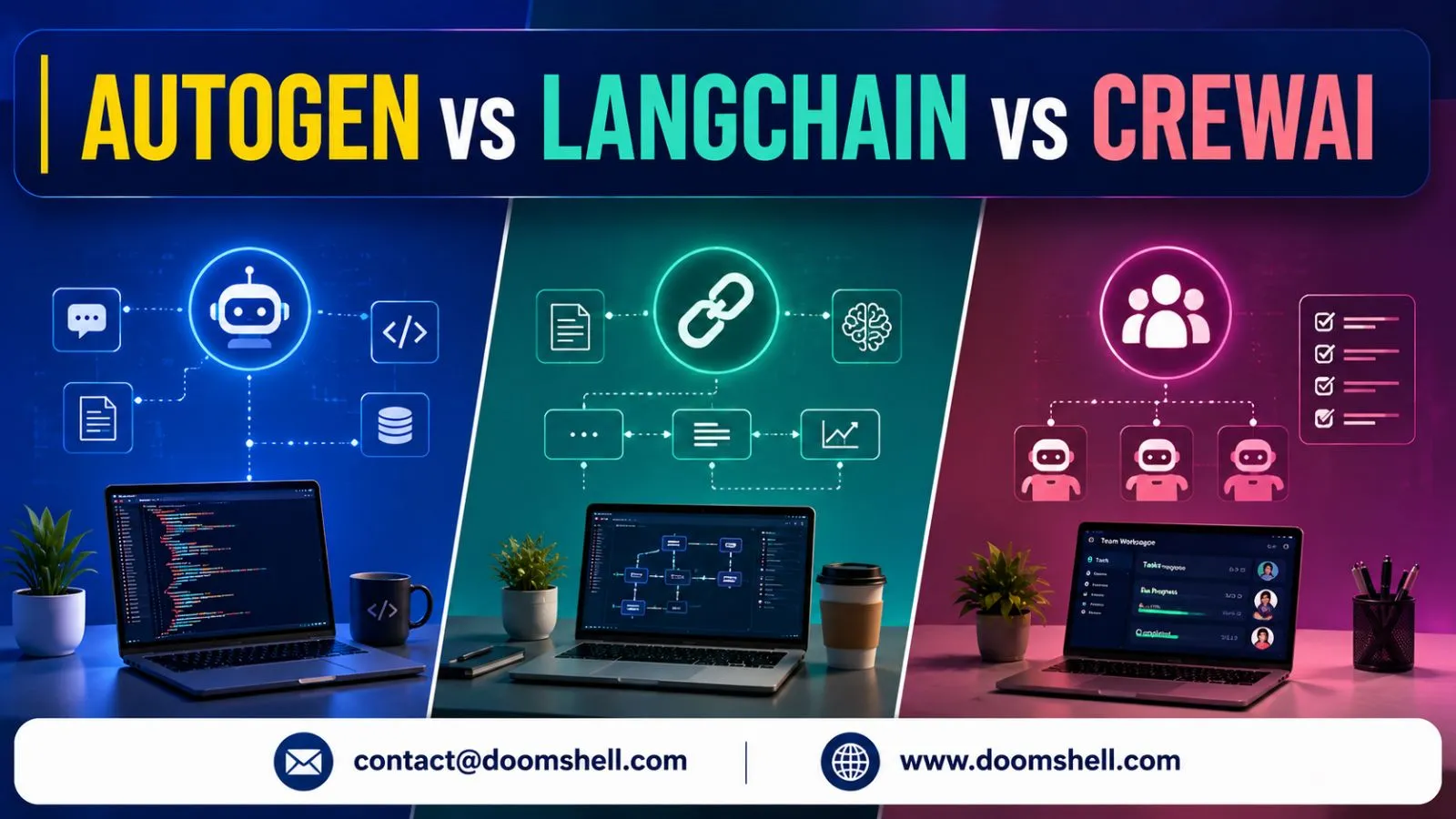
AI agents are transforming how businesses automate workflows, analyze data, and make decisions. Instead of relying on a single large language model (LLM), organizations are building AI systems that use tools, retrieve information, and coordinate specialized tasks. Choosing between AutoGen vs LangChain vs CrewAI depends on the project's complexity, integration requirements, control needs, and long-term maintenance strategy.
Each framework takes a different approach to building AI-powered applications. LangChain provides flexible components for LLM applications and agent development, CrewAI focuses on collaborative agents and structured workflows, while AutoGen established a flexible approach to multi-agent collaboration. However, Microsoft's AutoGen project is now in maintenance mode, and Microsoft recommends its Agent Framework for new projects.
This guide compares their capabilities, practical use cases, limitations, and selection criteria to help businesses choose an appropriate framework for 2026.
AutoGen vs LangChain vs CrewAI: Understanding the Differences
What Is AutoGen?
AutoGen is an open-source framework developed by Microsoft for creating applications in which multiple AI agents communicate, collaborate, and work alongside humans. Its AgentChat API supports conversational agents and team-based interaction patterns, while its Core layer provides more flexible event-driven programming.
AutoGen has been used for research automation, coding assistants, multi-agent simulations, and tasks that benefit from collaborative problem-solving.
However, its maintenance-mode status is an important consideration in 2026. Existing projects can continue using it, but teams starting new Microsoft-aligned agent projects should evaluate Microsoft Agent Framework and its migration options before committing to AutoGen.
What Is LangChain?
LangChain is a framework for building applications powered by large language models. It connects models with tools, prompts, retrievers, data sources, and external services.
Developers can use it to create AI assistants, document search applications, RAG systems, and agents that call APIs or perform tasks using available tools. Its broader ecosystem also includes LangGraph for stateful, long-running agent workflows and LangSmith for debugging, testing, and monitoring.
LangChain is particularly useful when a project requires flexible integrations and control over how an LLM application is assembled. Teams can begin with a simple assistant and extend it as requirements grow.
What Is CrewAI?
CrewAI is designed around collaborative AI agents and workflow orchestration. Developers can assign agents specific roles, goals, and tools, then organize their work into coordinated tasks.
Its architecture includes Crews, which support collaborative agent work, and Flows, which provide structured execution, state management, conditional logic, and event-driven control. These components allow developers to combine flexible AI reasoning with more predictable business processes.
CrewAI is a strong candidate for research teams, reporting pipelines, marketing operations, and business workflows that benefit from specialized agent roles.
Comparing Features, Use Cases, and Production Readiness
Feature Comparison: AutoGen vs LangChain vs CrewAI
| Feature | AutoGen | LangChain | CrewAI |
|---|---|---|---|
| Primary focus | Multi-agent collaboration | LLM applications and agents | Collaborative agents and workflows |
| Agent coordination | Conversational and team patterns | Flexible; LangGraph adds orchestration | Role-based Crews and structured Flows |
| Integrations | Extensions and custom components | Broad model, data, and tool ecosystem | Tools and workflow integrations |
| Workflow control | Depends on chosen patterns | LangGraph supports stateful orchestration | Flows support explicit control |
| Learning approach | Requires understanding agent patterns | Flexible, but the ecosystem can take time to learn | Role-based concepts are approachable |
| Best fit | Existing AutoGen systems and experimentation | Custom LLM applications and integrations | Structured multi-agent business automation |
| New-project consideration | Maintenance mode; assess successor | Evaluate LangChain and LangGraph together | Evaluate Crews and Flows together |
These are general architectural distinctions rather than universal performance rankings. Actual results depend on model choice, prompt quality, tools, data, workflow design, testing, and operational requirements.
When Should You Choose LangChain?
Choose LangChain when your application needs extensive integration with external data, APIs, retrieval systems, or multiple model providers.
Typical use cases include:
-
Enterprise knowledge assistants
-
Retrieval-Augmented Generation (RAG)
-
Customer support applications
-
AI-powered search and document analysis
-
Applications that call business APIs
-
Custom AI products with evolving requirements
For complex workflows involving persistent state, retries, checkpoints, or human approval, evaluate LangGraph alongside LangChain. This distinction matters because connecting tools to an LLM is different from reliably managing a long-running business process.
When Should You Choose CrewAI?
CrewAI is worth considering when the workflow naturally divides into specialized responsibilities.
For example, a market research workflow might include a research agent that gathers evidence, an analysis agent that compares findings, and a reporting agent that prepares a structured summary. A Flow can control the overall process, while a Crew handles tasks requiring collaborative reasoning.
Common applications include marketing research, report generation, sales support, project coordination, and internal process automation.
Use explicit workflow steps for tasks that must follow strict rules. Reserve greater agent autonomy for activities where exploration and judgment provide genuine value.
When Should You Continue with AutoGen?
AutoGen remains relevant when a team already has a working implementation, depends on its existing patterns, or needs to maintain an established application.
Before expanding an existing deployment, assess dependencies, support expectations, security updates, and migration effort. For a new project, compare the Microsoft Agent Framework against the actual requirements rather than assuming AutoGen remains Microsoft's preferred starting point.
This approach avoids unnecessary rewrites while helping teams make informed long-term architecture decisions.
Choosing the Right AI Agent Framework for Your Business
Evaluate Requirements Before Selecting a Framework
The best framework is the one that solves the business problem reliably—not necessarily the one with the most features.
Start by defining the workflow, expected inputs and outputs, required integrations, acceptable response times, and consequences of incorrect actions. Then build a small proof of concept around representative tasks.
Measure completion rate, factual accuracy, tool-call reliability, latency, operating cost, and recovery from errors. These metrics provide a more useful comparison than a feature checklist alone.
Security, Governance, and Scalability
Production AI systems need safeguards beyond agent coordination.
Implement authentication, role-based permissions, secret management, audit logs, input validation, and monitoring. Require human approval for sensitive actions such as financial transactions, access changes, or consequential customer decisions.
Also consider how the system handles failed tool calls, repeated actions, changing data, and incomplete responses. Use deterministic code for steps that must be predictable, and introduce autonomous agents where flexible reasoning adds measurable value.
An experienced AI agent development company can help businesses evaluate these trade-offs, design integrations, test workflows, and deploy AI applications aligned with operational and security requirements.
Can These Frameworks Work Together?
Yes, provided each component has a clear responsibility and the integration is justified.
A business might use LangChain components for model interactions or retrieval, a separate orchestration layer for workflow control, and specialized agents for particular tasks. CrewAI or other agent frameworks may also fit into a larger architecture through well-defined interfaces.
However, combining frameworks adds dependencies, debugging complexity, and operational overhead. Avoid using multiple frameworks simply because each offers an appealing feature. Start with the smallest architecture that meets the requirements, then add components when testing demonstrates a clear benefit.
The Future of Multi-Agent AI in 2026
AI development is increasingly focused on reliable execution, observable workflows, secure tool access, and systems that can recover from errors. Businesses are also paying greater attention to evaluations, human oversight, and the cost of running multi-step agent processes.
Frameworks will continue to evolve, so architecture decisions should account for active maintenance, migration paths, model-provider flexibility, and the availability of monitoring tools.
For new Microsoft-focused projects, Microsoft's Agent Framework deserves consideration as AutoGen's successor. For flexible LLM applications, LangChain and LangGraph offer complementary options. For role-based collaboration with structured process control, CrewAI provides a distinct approach.
The right decision should follow a tested business use case, not framework popularity alone.
Conclusion
Choosing between AutoGen vs LangChain vs CrewAI depends on the application you want to build, the degree of control you need, and the framework's long-term support outlook.
-
LangChain: A strong choice for flexible LLM applications, retrieval, and integrations.
-
CrewAI: A strong choice for role-based agent collaboration and structured workflows.
-
AutoGen: Relevant for existing implementations, but its maintenance-mode status makes successor evaluation important for new projects.
Before committing, test the leading option against real tasks, security requirements, integration needs, and operating costs. A well-designed system with clear workflow boundaries, appropriate human oversight, and reliable evaluation will generally provide more business value than an unnecessarily complex multi-agent architecture.
The goal is not to deploy the most agents. It is to build an AI solution that completes useful work accurately, securely, and consistently.