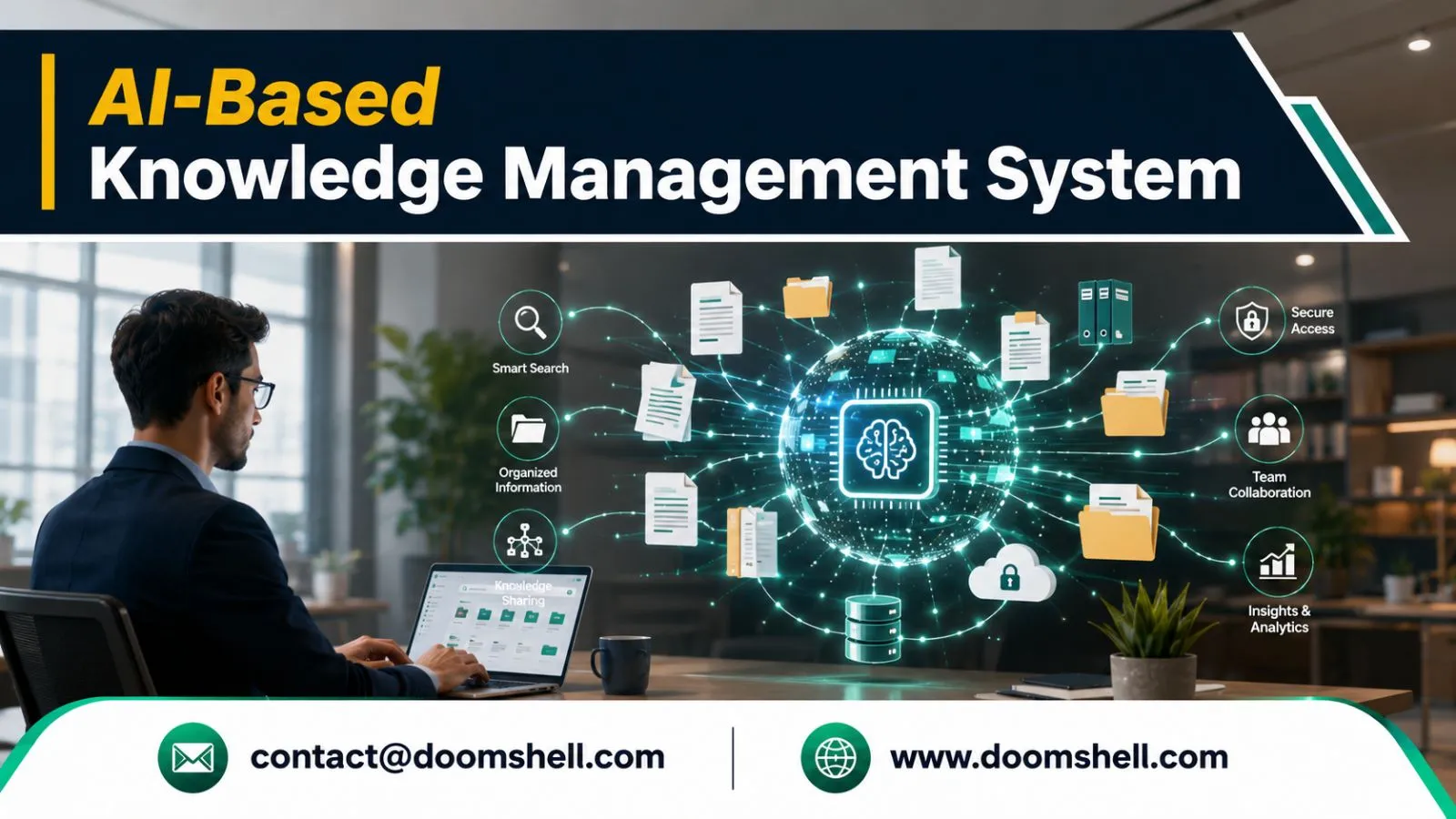
An AI-powered Knowledge Management System addresses these challenges by combining artificial intelligence, machine learning, natural language processing, semantic search, and intelligent automation to organize enterprise information and make it easier to discover.
Instead of simply storing information, modern knowledge platforms can understand context, classify content, connect related information, answer questions, and deliver relevant knowledge based on an employee's role or business requirement. This shift is transforming knowledge management from a passive repository into an intelligent enterprise capability.
AI-Powered Knowledge Management System: From Storage to Intelligence
What Is an AI-Powered Knowledge Management System?
An AI-powered Knowledge Management System is an intelligent platform designed to capture, organize, search, analyze, and distribute organizational knowledge using artificial intelligence.
Traditional repositories generally depend on folders, tags, manually created categories, and exact keyword matches. AI-driven systems can analyze the meaning and context of content, making information easier to discover even when users do not know the exact terminology used in the original document.
A modern system may work with:
-
Documents and reports
-
Emails and internal communications
-
Policies and procedures
-
Product documentation
-
Customer information
-
Training materials
-
Project knowledge
-
Databases and business applications
The objective is to create a connected enterprise knowledge base where employees can find reliable information without repeatedly asking colleagues or searching through disconnected systems.
Why Enterprise Knowledge Management Is Changing
The volume of organizational information continues to grow, while employees increasingly expect fast, conversational access to business knowledge.
Keyword search alone often fails when the user's question is expressed differently from the wording inside a document. AI improves this experience by understanding intent, context, relationships, and semantic meaning.
For example, an employee could ask, "What expenses can I claim when traveling for a client meeting?" Instead of requiring the employee to search for the exact phrase used in a policy document, an intelligent knowledge platform can identify the relevant travel policy and present the applicable information.
This reduces information friction and helps employees spend more time on productive work.
The Role of an IT Company in Knowledge Transformation
Building an enterprise knowledge platform involves more than adding an AI chatbot to an existing repository. Organizations need data integration, search architecture, security controls, access permissions, APIs, cloud infrastructure, and ongoing optimization.
An IT Company can help businesses connect these components into a secure knowledge ecosystem that supports existing workflows and enterprise applications.
The most effective approach is therefore to treat AI knowledge management as a business transformation initiative rather than simply a software implementation.
Technologies Powering Intelligent Knowledge Management
Machine Learning for Knowledge Organization
Machine Learning enables knowledge platforms to analyze large amounts of enterprise content and identify patterns that would be difficult to manage manually.
It can support:
-
Automatic document classification
-
Content tagging
-
Duplicate detection
-
Knowledge gap identification
-
Personalized recommendations
-
Content prioritization
-
Continuous improvement
As employees interact with the platform, usage patterns can also help improve recommendations and search relevance.
However, organizations should not assume that every interaction should automatically change the system. Governance and quality controls are important to prevent incorrect or outdated information from influencing future results.
Natural Language Processing and Semantic Search
Natural Language Processing allows employees to interact with enterprise knowledge using natural language rather than rigid search terms.
Users can ask questions such as:
-
"Where is our customer onboarding process documented?"
-
"What is the latest cybersecurity policy?"
-
"Show me the documentation for this product."
-
"Which procedure should I follow for this issue?"
Semantic search goes beyond exact keyword matching by considering the meaning behind a query. This can make enterprise information significantly easier to discover.
AI-Powered Document Management
Documents are often one of the largest sources of organizational knowledge. Yet manually categorizing, tagging, indexing, and maintaining documents can consume significant employee time.
AI-powered document management can automate many of these activities.
Capabilities may include:
-
Automatic categorization
-
Metadata extraction
-
Content summarization
-
Version identification
-
Duplicate detection
-
Intelligent tagging
-
Document recommendations
-
Lifecycle management
This reduces administrative effort while improving the discoverability of important information.
Retrieval-Augmented Generation
Modern knowledge platforms can also use Retrieval-Augmented Generation to connect AI models with trusted enterprise information.
Instead of relying only on the model's training knowledge, the system retrieves relevant internal content and uses it as context for generating a response.
This approach can make conversational knowledge assistants more useful for enterprise environments because responses can be grounded in company-specific documentation and policies.
The retrieval layer, however, must be designed carefully. Poor indexing, outdated sources, weak permissions, or irrelevant retrieval can still produce unreliable answers.
Benefits, Challenges, and Best Practices
Faster Knowledge Retrieval
One of the biggest benefits of intelligent knowledge management is reducing the time employees spend searching for information.
Instead of browsing multiple folders, opening documents, and checking emails, employees can use conversational or semantic search to find relevant information more quickly.
This is particularly valuable for customer support, HR, operations, sales, and technical teams where employees frequently need access to internal knowledge.
Better Collaboration and Productivity
A centralized knowledge environment reduces information silos between departments.
Employees can access consistent documentation, previous project knowledge, policies, processes, and best practices without depending entirely on individual employees who may hold that knowledge.
This can also improve onboarding because new employees can discover relevant information without repeatedly requesting basic guidance from experienced team members.
Improved Knowledge Discovery
AI can identify relationships between information that may not be obvious through traditional search.
For example, related documents from different departments can be connected based on common subjects, projects, customers, products, or processes.
This helps organizations turn scattered information into usable institutional knowledge.
Data Quality and Integration Challenges
AI knowledge management is not successful simply because an organization has large amounts of data.
Outdated documents, duplicate records, contradictory policies, incomplete metadata, and disconnected systems can reduce the quality of search results.
Organizations should therefore establish content ownership, document lifecycle policies, data-cleaning processes, and clear source priorities before scaling AI capabilities.
Integration is another major challenge. Enterprise information may exist across CRM platforms, ERP systems, cloud storage, email, collaboration tools, databases, and internal applications.
Connecting these systems requires secure APIs, consistent access controls, and an architecture designed around the organization's actual information flow.
Security, Governance, and User Adoption
Enterprise knowledge can contain confidential financial information, employee records, customer data, intellectual property, and internal policies.
AI systems must therefore respect existing permissions and ensure that users only receive information they are authorized to access.
Important controls include:
-
Role-based access
-
Authentication and authorization
-
Encryption
-
Audit trails
-
Data retention policies
-
Source-level permissions
-
Monitoring and logging
-
Human review for sensitive use cases
User adoption also matters. Employees are more likely to use the platform when the interface is intuitive, search results are useful, and the system fits naturally into their existing workflows.
The Future of AI Knowledge Management in Enterprises
Conversational Enterprise Knowledge Assistants
Enterprise knowledge management is moving toward conversational interfaces where employees can ask complex questions and receive contextual answers.
Instead of navigating through a knowledge portal, users can interact with an AI assistant that retrieves relevant information and explains it in a practical format.
This can make knowledge access faster while reducing the learning curve associated with complex internal systems.
Autonomous Knowledge Discovery
Future platforms will increasingly identify important information without waiting for employees to search for it.
AI can analyze newly created documents, detect changes in policies, summarize important updates, identify knowledge gaps, and recommend information to relevant teams.
This creates a more proactive knowledge environment.
Personalized Knowledge Delivery
Different employees need different information.
A sales representative may need customer and product knowledge, while a compliance employee may need policies and regulatory documentation. AI can personalize knowledge delivery based on role, project, department, previous interactions, and current workflow.
Personalization can make large enterprise repositories more useful without requiring employees to manually configure complex filters.
AI Agents and Knowledge Workflows
The next stage goes beyond retrieving information.
AI agents can use enterprise knowledge to support multi-step workflows. For example, an employee could ask an AI agent to prepare a customer onboarding package. The agent could retrieve the relevant procedures, identify required documents, check available information, generate a checklist, and initiate approved workflow steps.
This connects knowledge management with enterprise automation.
Building an AI-Ready Knowledge Architecture
Organizations should prepare their knowledge infrastructure for this evolution by focusing on clean data, structured metadata, reliable retrieval, permission-aware access, API connectivity, and strong governance.
An AI development company can help businesses design and implement these components while connecting AI capabilities with existing enterprise applications.
The goal should not be to replace every existing knowledge platform. Instead, businesses can progressively introduce intelligence where it provides measurable value.
How Businesses Can Implement AI Knowledge Management Successfully
Start With High-Value Knowledge Problems
Organizations should begin by identifying where employees lose the most time searching for information.
Common starting points include customer support documentation, HR policies, technical manuals, product information, compliance documents, and internal process guides.
Starting with a clearly defined use case makes it easier to measure improvements.
Build a Trusted Knowledge Layer
Before introducing advanced AI features, businesses should identify authoritative information sources and remove outdated or duplicate content.
The system should understand which sources are current and which documents should take priority when conflicting information exists.
Connect Existing Business Systems
A useful knowledge platform should not remain isolated.
Integration with CRM, ERP, HRMS, cloud storage, databases, collaboration tools, and other enterprise applications can provide broader context and reduce information silos.
Measure Search Quality and Business Outcomes
Organizations should monitor more than the number of searches or AI conversations.
Useful measurements include:
-
Search relevance
-
Answer accuracy
-
Time saved
-
Employee adoption
-
Support resolution time
-
Onboarding efficiency
-
Knowledge reuse
-
Reduction in repetitive requests
These metrics help determine whether AI knowledge management is delivering actual business value.
How Doomshell Helps Build Intelligent Knowledge Platforms
Doomshell Software Pvt Ltd helps businesses develop AI-powered knowledge solutions that connect enterprise information with intelligent search, automation, and AI capabilities.
Our solutions can support:
-
AI-powered knowledge management
-
Intelligent enterprise search
-
AI document processing
-
Retrieval-Augmented Generation
-
Enterprise AI assistants
-
AI agent integration
-
CRM and ERP connectivity
-
Cloud-based knowledge platforms
-
Secure API integrations
-
Ongoing AI optimization
With experience across AI development, enterprise software, cloud technologies, and digital transformation, businesses can use these capabilities to build scalable knowledge systems aligned with their operational requirements.
Conclusion
An AI-powered Knowledge Management System is changing how organizations capture, organize, discover, and use enterprise knowledge.
Traditional repositories remain useful for storing information, but modern businesses need more intelligent ways to understand and access their growing data. Machine Learning, Natural Language Processing, semantic search, AI-powered document management, and Retrieval-Augmented Generation can transform static repositories into intelligent knowledge environments.
The next evolution will connect these capabilities with AI agents that can not only retrieve information but also support business workflows and take approved actions.
Successful implementation requires more than technology. Organizations need high-quality data, secure integrations, reliable retrieval, governance, user adoption, and continuous performance monitoring.
Businesses that build these foundations today will be better positioned to turn organizational knowledge into a strategic advantage, improve employee productivity, accelerate decision-making, and create more intelligent enterprise operations.