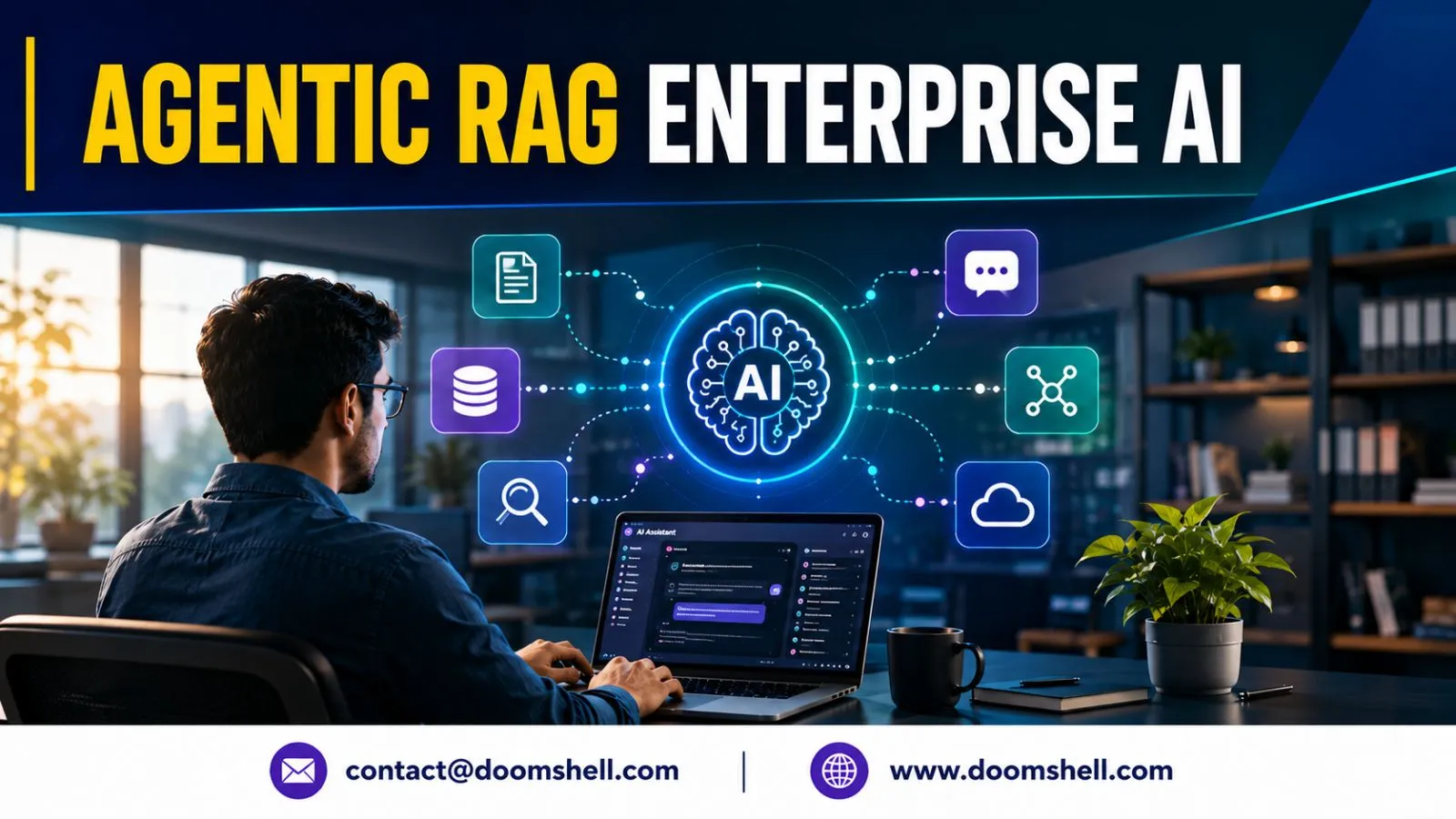
This limitation has led to the rise of Agentic RAG (Retrieval-Augmented Generation)—the next generation of Enterprise AI that combines intelligent retrieval with autonomous AI agents capable of planning, reasoning, and executing multi-step business workflows.
Unlike conventional AI assistants, Agentic RAG enables organizations to build systems that can answer questions, evaluate information, use external tools, automate tasks, and respond to changing business conditions. As enterprises move toward more practical AI adoption in 2026, the focus is shifting from AI experimentation toward measurable business outcomes.
Agentic RAG and the Evolution of Enterprise AI
What Is Agentic RAG?
Agentic RAG is an advanced AI architecture that combines Retrieval-Augmented Generation with autonomous AI agents. Traditional RAG retrieves relevant information from enterprise knowledge sources before generating an answer. Agentic RAG extends this process by allowing an AI agent to decide what information it needs, retrieve it from multiple sources, reason over the results, use tools, and complete a defined objective.
For example, a traditional RAG assistant might answer a question about a customer order. An Agentic RAG system could retrieve the order details, check inventory, review the customer's account, identify the issue, initiate an approved action, update the CRM, and provide a complete response.
This shift from answer generation to task execution is one of the most important developments in enterprise AI.
Why Enterprise AI Is Moving Toward Agents
Enterprise workflows rarely depend on a single document or one database. A typical business process can involve emails, CRM records, ERP data, internal policies, spreadsheets, APIs, and customer information.
AI agents can coordinate these resources while RAG provides the contextual knowledge required to make better decisions.
The result is an AI system that is more closely connected to actual business operations rather than functioning as an isolated chatbot.
The Role of an IT Company in Enterprise AI Transformation
Enterprise AI implementation requires more than selecting a language model. Organizations also need secure integrations, cloud infrastructure, data pipelines, APIs, access controls, monitoring, and workflow orchestration.
An experienced IT Company can help connect these components into a practical architecture that aligns AI capabilities with business objectives.
The strongest implementations therefore treat AI as part of a broader technology ecosystem rather than deploying an agent as a standalone feature.
Why Traditional RAG Falls Short
Limited Decision-Making
Traditional RAG significantly improves the ability of language models to work with company-specific information. However, its typical workflow remains relatively straightforward: retrieve relevant content, provide context to the model, and generate a response.
Business processes are usually more complicated.
An enterprise AI system may need to determine which source to query first, identify missing information, compare results, decide which tool to use, and verify whether the completed action produced the expected result.
Agentic RAG introduces this additional reasoning and orchestration layer.
Lack of Multi-Step Workflow Automation
Traditional RAG is highly effective for knowledge search, documentation assistants, internal question-answering, and customer support.
However, it may stop after producing an answer.
Agentic RAG can continue beyond that point. An agent can break a larger objective into smaller tasks, retrieve information at each stage, execute approved actions, evaluate intermediate results, and continue until the workflow reaches its intended outcome.
This makes the architecture particularly useful for business processes involving multiple applications or departments.
Weak Context and Memory
Enterprise workflows often require context beyond the current conversation.
For example, a sales agent may need information about previous customer interactions, open opportunities, product availability, pricing rules, and previous commitments.
Agentic systems can maintain relevant state and use structured memory to support longer-running workflows. Combined with retrieval, this creates a more context-aware experience without requiring every piece of information to remain inside a model's prompt.
Tool and System Integration
The real value of enterprise AI appears when agents can interact with business systems.
Modern Agentic RAG architectures can connect with:
-
CRM platforms
-
ERP systems
-
HRMS applications
-
Databases
-
Internal knowledge bases
-
Cloud platforms
-
Business intelligence tools
-
APIs and third-party services
This allows AI to move from simply explaining what should happen to participating in the workflow itself.
From Reactive AI to Goal-Oriented AI
Traditional AI is generally reactive: a user asks a question and the system responds.
Agentic RAG introduces a goal-oriented model. The system receives an objective, determines the steps required, gathers the necessary information, performs permitted actions, and evaluates the results.
That difference is critical for organizations looking to automate complete business processes rather than individual interactions.
Enterprise Use Cases and Business Benefits of Agentic RAG
Intelligent Customer Support
Customer support is one of the strongest applications for Agentic RAG.
An AI agent can retrieve customer history, product documentation, policies, order information, and troubleshooting instructions before responding. If an issue requires an operational action, the agent can initiate an approved workflow such as creating a ticket, updating a CRM record, requesting additional information, or escalating the case.
This creates a more connected support experience while reducing repetitive work for human teams.
Sales and Revenue Operations
Sales teams manage large volumes of customer information across different systems.
Agentic RAG can help qualify leads, retrieve account information, analyze previous interactions, prepare personalized proposals, update CRM records, and schedule follow-ups.
Instead of requiring employees to manually collect information from several systems, AI agents can coordinate these steps and present the results in a usable format.
Enterprise Knowledge Management
Large organizations often have valuable information distributed across documents, policies, contracts, manuals, emails, databases, and internal platforms.
A conventional search system may return documents. Agentic RAG can go further by understanding the user's objective, searching across multiple knowledge sources, comparing information, identifying relevant evidence, and producing a contextual response.
This makes enterprise knowledge more accessible while reducing the time employees spend searching for information.
Finance, HR, and Operations
Agentic RAG can also support internal workflows such as invoice analysis, employee onboarding, policy assistance, procurement research, reporting, compliance checks, and operational coordination.
For example, an HR agent could retrieve company policies, verify employee information, generate required documents, and initiate the next approved onboarding steps.
Similarly, an operations agent could monitor business information, identify exceptions, retrieve relevant procedures, and route tasks to the appropriate teams.
Business Benefits
Organizations adopting Agentic RAG can achieve several practical advantages.
Faster decisions: AI agents can gather and analyze relevant information quickly.
Higher productivity: Employees spend less time performing repetitive searches and administrative tasks.
Better knowledge utilization: Important enterprise information becomes easier to access and apply.
Improved customer experiences: AI can provide contextual responses while also supporting backend actions.
Scalable automation: Organizations can automate increasingly complex workflows without creating separate manual processes for every scenario.
The key is to measure Agentic RAG by business outcomes rather than simply the number of AI interactions it handles.
Building a Secure and Scalable Agentic RAG Strategy
Data Quality and Retrieval Architecture
Agentic RAG is only as reliable as the information available to it.
Organizations should establish clear data sources, document ownership, metadata standards, access permissions, retrieval strategies, and freshness requirements.
Retrieval should also respect user permissions. An agent should never expose information simply because it can technically access the underlying database.
Governance, Security, and Human Oversight
Greater autonomy also creates greater responsibility.
AI agents may have permission to access sensitive information or perform actions across business systems. Therefore, organizations need authentication, authorization, audit trails, monitoring, approval checkpoints, and clear escalation rules.
Human oversight remains especially important for high-impact decisions. The goal is not to remove humans from every process but to allow AI to handle appropriate tasks while people retain control over sensitive or consequential actions.
Multi-Agent Enterprise Architecture
As AI deployments mature, organizations may use multiple specialized agents instead of one general-purpose agent.
A customer support agent could work with a knowledge agent, while a finance agent or workflow agent handles specialized operations. An orchestration layer can coordinate these agents and determine how information and tasks move between them.
This approach can make complex enterprise automation more modular and scalable.
Why Businesses Need an Enterprise AI Partner
Implementing Agentic RAG requires expertise across AI models, retrieval systems, data engineering, APIs, cloud infrastructure, security, and workflow automation.
A practical implementation should begin with high-value workflows rather than attempting to automate an entire organization at once. Businesses can identify repetitive processes, connect trusted data sources, introduce appropriate agent capabilities, measure outcomes, and gradually expand the architecture.
An AI agent development company can support this journey by combining AI engineering with enterprise software integration, cloud deployment, workflow automation, and ongoing optimization.
For organizations, the objective should not simply be to deploy the latest AI technology. The objective is to create dependable systems that solve real operational problems.
Agentic RAG represents this shift particularly well because it connects enterprise knowledge with reasoning, tools, and action.
Conclusion
Agentic RAG represents a major evolution of Retrieval-Augmented Generation and Enterprise AI. Traditional RAG made AI more useful by connecting language models with trusted business information. Agentic RAG takes the next step by enabling AI systems to reason about objectives, retrieve information dynamically, interact with tools, coordinate workflows, and complete multi-step tasks.
Its potential extends across customer support, sales, finance, HR, operations, knowledge management, and many other enterprise functions.
However, successful adoption depends on more than autonomous agents. Businesses also need high-quality data, reliable retrieval, secure integrations, governance, monitoring, and appropriate human oversight.
As enterprises move through 2026, the competitive advantage will increasingly come from how effectively organizations connect AI capabilities with real business processes.
The future of Enterprise AI is therefore not simply about asking better questions. It is about building intelligent systems that can understand objectives, find the right information, take appropriate action, and deliver measurable business outcomes.