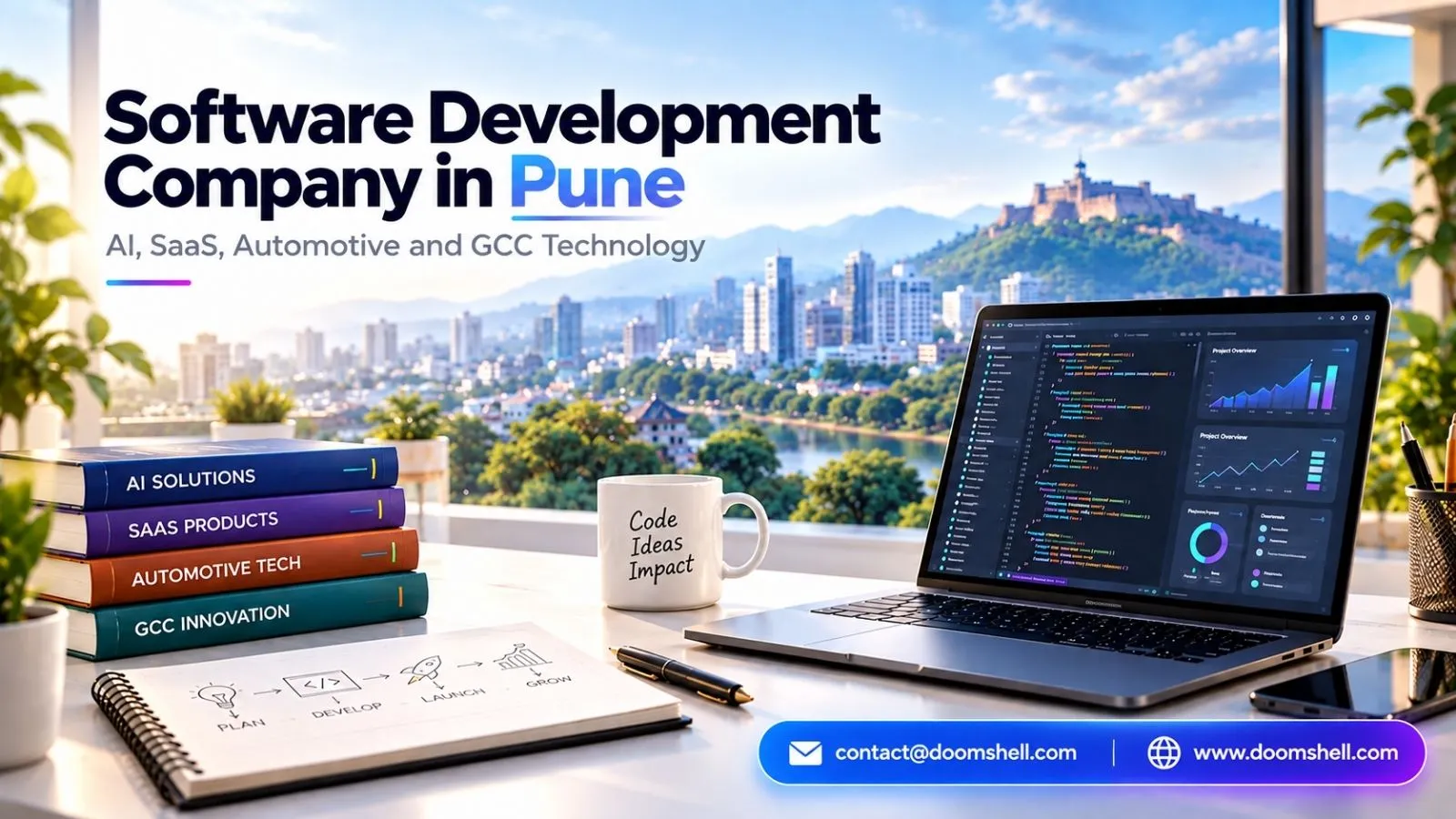
Pune has evolved into a major technology and engineering centre where software intersects with automotive, manufacturing, SaaS, FinTech, healthcare, education, engineering and global business operations. A software development company in Pune can therefore build everything from enterprise applications and SaaS platforms to connected mobility systems, Industrial IoT solutions, AI products, mobile apps and cloud-native infrastructure.
The city's technology ecosystem is supported by the wider Maharashtra digital economy, while the state has introduced dedicated frameworks covering IT/ITeS, Global Capability Centres, AI, cybersecurity, electronics and emerging technologies. Maharashtra's current policy repository includes the 2025 GCC Policy and its 2026 operational guidelines, along with the Maharashtra AI Policy 2026 and other technology-focused policies.
Pune also has an established software-export and startup infrastructure through STPI. STPI Pune operates from Rajiv Gandhi Infotech Park in Hinjawadi, while STPI's wider mandate includes software development, IT/ITeS exports, entrepreneurship and technology infrastructure.
Why Choose a Software Development Company in Pune?
Pune's biggest technology advantage is the proximity of software businesses to engineering and industrial companies. Automotive manufacturers, engineering firms, healthcare organisations, financial businesses, educational institutions and SaaS companies all create different software requirements.
A software development company in Pune can consequently work on projects that require both digital expertise and industry knowledge. These can include ERP systems, CRM platforms, customer portals, supply-chain software, manufacturing dashboards, mobile applications, AI assistants, IoT platforms and cloud-based enterprise systems.
The city's established technology ecosystem also makes it suitable for companies that need ongoing engineering rather than a one-time website or application. Product development, application modernisation, cloud migration, DevOps, cybersecurity, data engineering and managed software support can all become part of a longer technology roadmap.
Industries Driving Software Development in Pune
Automotive and Mobility Technology
Automotive is one of Pune's most important technology-linked industries, making mobility software a significant opportunity for developers.
Modern automotive businesses need applications for vehicle management, dealerships, service operations, fleet management, spare parts, manufacturing, supply chains and customer engagement. Electric vehicles are adding another layer of software requirements around charging, telemetry, battery information, fleet analytics and connected services.
Connected mobility platforms can collect information from vehicles and devices, process it through cloud infrastructure and present useful insights through web or mobile interfaces. This creates demand for APIs, data engineering, real-time processing, mobile development, cybersecurity and cloud architecture.
Software can also support manufacturing quality, production planning and maintenance. Computer vision can be applied to inspection workflows, while predictive analytics can help identify patterns in machine or vehicle data.
Manufacturing and Engineering
Pune's engineering ecosystem creates demand for digital tools that connect production, inventory, procurement, maintenance, quality and workforce operations.
A manufacturing application may integrate ERP systems with shop-floor equipment, warehouse platforms, supplier systems and analytics dashboards. Industrial IoT can provide real-time information about machines, production cycles, energy consumption, downtime and operating conditions.
A software development agency in Pune can help manufacturers move from isolated spreadsheets and legacy applications toward integrated digital workflows.
The objective should not simply be to digitise an existing manual process. Good software architecture should also identify opportunities for automation, data visibility, integration and measurable operational improvement.
SaaS and Product Engineering
Pune has a strong base for B2B technology and SaaS development because the city combines engineering talent with a large business customer base.
SaaS products can serve HR, finance, procurement, manufacturing, logistics, healthcare, education, cybersecurity, customer support and professional services.
A SaaS architecture needs to consider multi-tenancy, authentication, authorisation, billing, subscription management, APIs, monitoring, analytics, backups and automated deployment from the beginning.
Startups can initially build an MVP around the most important customer problem, then expand the architecture as product-market requirements become clearer. Established SaaS businesses may instead need performance optimisation, cloud migration, microservices, data engineering or application modernisation.
FinTech and Financial Technology
Financial technology requires secure, reliable and scalable software for lending, payments, insurance, wealth management, accounting, reconciliation, financial analytics and customer onboarding.
Pune's software ecosystem can support both customer-facing financial applications and internal enterprise systems. Typical requirements include secure APIs, identity management, transaction workflows, dashboards, reporting, notification systems and integration with external financial services.
Security should be designed into the application rather than added at the end. Encryption, access control, audit trails, secrets management, vulnerability testing, monitoring and backup procedures are important considerations for financial software.
AI can also support document processing, customer-service workflows, fraud-analysis assistance, financial reporting and enterprise search when implemented with suitable controls and validation.
Healthcare and HealthTech
Healthcare organisations can use custom applications for appointment management, hospital administration, patient communication, laboratory operations, billing, inventory, pharmacy workflows and telehealth.
Mobile applications can improve access to appointments, reminders, service information and communication. Internal applications can help staff manage workflows, records and operational reporting.
Healthcare software requires careful treatment of sensitive information. Role-based access, encryption, audit logging, secure APIs, backups and controlled data retention should therefore be considered during architecture and development.
AI can support administrative processes such as document classification, information retrieval, scheduling and reporting. Applications that influence clinical decisions require much stronger validation and professional oversight.
Education and EdTech
Pune's large student and education ecosystem also creates opportunities for learning platforms, assessment systems, student portals, administration software and digital content applications.
An EdTech product may require video delivery, assessments, payments, user management, analytics, notifications and content-management capabilities.
AI can support personalised learning workflows, knowledge search, automated administrative tasks and content assistance. Data architecture should be designed carefully so that student information remains appropriately protected.
How a Software Development Agency in Pune Builds Digital Products
A software development agency in Pune should begin with the business problem rather than immediately choosing a programming language or framework.
The discovery stage can document users, workflows, business rules, integrations, data requirements, security needs and expected outcomes. This creates a technical foundation before development begins.
For a startup, the outcome may be an MVP designed to validate a core product assumption. For an established business, discovery may identify opportunities for legacy modernisation, API integration, cloud migration or automation.
A mature development lifecycle normally includes product discovery, UX/UI design, architecture, development, testing, deployment, monitoring and ongoing improvement.
Automated testing and continuous integration can reduce regression risk as applications become larger. Monitoring and observability can also help development teams identify performance issues and production failures more quickly.
Custom Software Development Service in Pune
A complete software development service in Pune can cover business analysis, UI/UX design, web development, mobile development, API engineering, cloud architecture, DevOps, cybersecurity, AI integration, data engineering, testing and maintenance.
Common projects include:
-
SaaS platforms
-
Automotive applications
-
EV and mobility software
-
Manufacturing systems
-
ERP and CRM applications
-
FinTech platforms
-
Healthcare software
-
Logistics applications
-
IoT platforms
-
AI-powered applications
-
Data analytics systems
-
Mobile applications
-
Enterprise portals
-
Workflow automation
-
Legacy application modernisation
The correct architecture depends on the business environment. An automotive telemetry platform may need real-time data processing, while an HR SaaS product may place greater emphasis on multi-tenancy, permissions, integrations and workflow management.
AI Development and Data Analytics in Pune
Artificial intelligence is becoming an increasingly important part of Maharashtra's technology strategy. The state's Electronics, Information Technology and Artificial Intelligence Department was established in 2026 with responsibilities spanning AI, cybersecurity, data governance, digital infrastructure, electronics and emerging technologies.
Maharashtra also published a dedicated AI Policy 2026, indicating a stronger policy focus on AI adoption and development.
For Pune businesses, AI applications can include customer-service assistants, document processing, enterprise search, forecasting, recommendation systems, quality analysis and workflow automation.
Manufacturers can combine computer vision with production data to improve inspection and identify operational patterns. Automotive businesses can use analytics for fleet management, connected vehicles and predictive maintenance.
SaaS businesses can add generative AI features for knowledge search, document summarisation, customer support, report generation and workflow assistance.
The technology should always follow the use case. Data quality, model evaluation, security, inference costs, latency, monitoring and human review can determine whether an AI application performs reliably in production.
Global Capability Centres in Pune
Maharashtra's GCC Policy 2025 identifies Global Capability Centres as important platforms for technology, finance, analytics, engineering, marketing, research and development and digital transformation. The policy aims to establish Maharashtra as a destination for new GCCs while supporting high-skilled employment, sector-specific infrastructure and research-driven innovation.
For Pune, GCC activity can generate demand for software engineering, cloud infrastructure, data platforms, cybersecurity, AI, product development, enterprise applications and engineering technology.
GCC engineering teams often need software that serves global users and integrates with systems across multiple regions. This increases the importance of documentation, architecture standards, automated testing, CI/CD, observability, security and release governance.
The Maharashtra policy also identifies sectors such as automotive, IT/ITeS, logistics, pharmaceuticals and chemicals, renewable energy and aerospace and defence as priority areas for specialised GCC clusters.
Cloud-Native Software Development
Cloud platforms allow Pune businesses to scale applications without building every infrastructure component themselves.
A modern cloud architecture can use managed databases, containers, serverless functions, object storage, queues, APIs and automated infrastructure provisioning.
Cloud migration, however, should begin with application assessment. Some legacy applications may be rehosted, while others may need refactoring or replacement.
A software development service in Pune can support this process through application audits, cloud architecture, database migration, API development, DevOps automation, testing and monitoring.
The objective should be measurable improvement in reliability, scalability, deployment speed, security or operating efficiency rather than moving an application to the cloud without changing its underlying limitations.
Industrial IoT and Smart Manufacturing
Industrial IoT is particularly relevant to Pune because of the city's connection with automotive, engineering and manufacturing businesses.
Sensors can collect information about machine temperature, vibration, energy use, production cycles, machine status and maintenance conditions. Software platforms can then process that information into dashboards, alerts and analytical models.
Industrial IoT applications can support:
-
Predictive maintenance
-
Production monitoring
-
Quality control
-
Energy management
-
Asset tracking
-
Equipment diagnostics
-
Factory dashboards
-
Maintenance scheduling
-
Remote monitoring
-
Operational analytics
An IoT system should not stop at a dashboard. Device identity, secure communications, data ingestion, storage, analytics, alerts, monitoring and controlled firmware updates need to work together.
The strongest use cases often connect machine information to enterprise processes such as inventory, maintenance, procurement, production planning and quality management.
Cybersecurity for Pune Software Systems
As businesses adopt cloud applications, APIs, mobile platforms, IoT devices and third-party services, cybersecurity becomes part of software architecture.
Maharashtra's current EIT&AI Department explicitly includes cyber security and data governance within its mandate, reflecting the growing importance of secure digital infrastructure.
Applications should use strong authentication, least-privilege access, encryption, secure dependency management, secrets protection, vulnerability testing, logging and monitoring.
API security is especially important when systems connect customers, partners, payment providers, enterprise applications and mobile applications.
For industrial organisations, technology teams should also consider the separation and controlled connectivity of IT and operational technology environments.
Security testing should be performed throughout the development lifecycle rather than only immediately before launch.
Automation and Business Process Software
Automation can reduce repetitive tasks across finance, HR, procurement, manufacturing, logistics, healthcare and customer support.
A software development company in Pune can build workflow systems that connect existing applications through APIs and trigger actions automatically.
For example, an approved purchase request could update inventory, create a procurement task, notify finance and update a management dashboard without requiring multiple manual entries.
AI-powered document processing can also extract information from invoices, contracts, forms and reports before applying business rules.
The best automation candidates are usually processes where the organisation can measure time, error rates, processing volume or operating costs before and after implementation.
Mobile Application Development in Pune
Mobile applications can extend enterprise and consumer services to customers, employees, field workers and partners.
Automotive applications can support service appointments, vehicle information and connected features. Manufacturing teams can use mobile tools for inspections, work orders, inventory and field service.
Logistics companies can use mobile applications for delivery assignments, tracking, proof of delivery and driver communication. Healthcare businesses can provide appointment booking, reminders and selected communication features.
Offline-first design can be valuable for field operations where connectivity is inconsistent. Secure local storage and controlled synchronisation can allow essential workflows to continue without continuously depending on a network connection.
EV and Connected Mobility Software
The growth of electric mobility is creating new software requirements beyond traditional automotive applications.
EV platforms may require charging-station discovery, charging-session management, fleet analytics, battery information, customer accounts, payments and mobile interfaces.
Fleet operators can combine vehicle telemetry with route, maintenance and utilisation data. Analytics can then help teams understand operational patterns and plan maintenance or charging requirements.
Connected mobility systems also need secure device communication, reliable APIs, scalable cloud infrastructure and monitoring.
For Pune's automotive ecosystem, this creates opportunities for software that connects vehicles, infrastructure, manufacturers, dealerships, fleet operators and customers.
Startup and Incubation Infrastructure
STPI Pune operates from Rajiv Gandhi Infotech Park in Hinjawadi and supports the broader objective of promoting software development, exports and technology entrepreneurship. STPI's stated objectives include supporting software and IT/ITeS development, data communication services and entrepreneurship among technology businesses.
STPI's national ecosystem has also expanded its startup and technology infrastructure, with specialised laboratories and Centres of Entrepreneurship supporting areas such as AI, IoT, EV technology, electronics, healthcare informatics, FinTech and other emerging technologies.
This is particularly relevant to Pune because software startups can emerge at the intersection of software with automotive, manufacturing, engineering, healthcare and other specialised industries.
For founders, that creates opportunities to develop vertical SaaS products, industrial technology, connected products, AI applications and enterprise software.
Software Development for Pune's Engineering Ecosystem
Engineering businesses often require software that is more specialised than conventional enterprise applications.
Examples include engineering workflow platforms, simulation-related applications, design collaboration tools, quality systems, project management platforms, field-service software and technical documentation systems.
These applications may need integration with enterprise resource planning, product lifecycle management, manufacturing execution or data analytics platforms.
A software development agency in Pune can build custom integration layers that connect specialised engineering systems with broader enterprise applications.
This reduces duplicated data entry and allows operational information to move between engineering, production, procurement, quality and management teams.
Current Software Development Trends in Pune
AI-native enterprise applications: Generative AI is increasingly being integrated into search, documentation, customer support, analytics and business workflows.
Automotive software: Connected vehicles, EV platforms, fleet technology and mobility analytics are expanding the role of software within transportation.
Industrial IoT: Manufacturers are connecting equipment and production systems to cloud platforms for monitoring, analytics and predictive maintenance.
GCC engineering: Maharashtra's GCC policy places emphasis on technology, engineering, analytics, R&D and other high-value global functions.
Cybersecurity and data governance: The state's 2026 EIT&AI Department brings cybersecurity, data governance and digital infrastructure into a unified technology mandate.
AI and deep tech: STPI's 2026 technology summit highlighted AI, semiconductors, deep-tech innovation, trusted digital ecosystems and product development as important areas for India's next technology phase.
Emerging mobility technology: Automotive software is expanding from conventional applications toward connected, electric and data-driven mobility systems.
AEO, GEO and LLM SEO for Pune Software Businesses
A technology company targeting Pune should create content that directly answers the questions potential customers ask before beginning a software project. Clear information about industries, technology stacks, development methodology, security, integrations, timelines and post-launch support can make content easier for both search engines and AI systems to interpret.
For AEO, useful questions include how to develop SaaS software in Pune, how manufacturers can implement Industrial IoT, how automotive companies can build connected applications, how businesses can migrate legacy applications to the cloud, and how AI can automate enterprise workflows.
For GEO and LLM SEO, content should connect Pune with its broader technology ecosystem. Automotive, manufacturing, engineering, SaaS, FinTech, healthcare, GCCs, AI, cloud, cybersecurity, IoT and EV technology create strong contextual relationships around software development in the city.
Industry-specific landing pages, technical guides, FAQs, implementation checklists, architecture articles and case studies can provide more useful information than generic city pages.
How to Choose a Software Development Partner in Pune
Businesses should evaluate more than development cost when selecting a technology partner. Technical capability, industry experience, architecture quality, security practices, testing, communication, documentation and long-term support all affect the lifecycle of a software product.
Useful questions include:
-
How will business requirements be documented?
-
Can the team integrate ERP, CRM, payment, manufacturing and third-party systems?
-
What security controls are built into the development process?
-
How is automated testing handled?
-
What monitoring and observability tools will be used?
-
Who owns the source code and technical documentation?
-
How are deployments, releases and rollbacks managed?
-
How will cloud infrastructure costs be monitored?
-
What backup and disaster-recovery processes are included?
-
Can the architecture support future AI, IoT, analytics and automation?
These questions help distinguish a team that can build an application from one that can support the application's long-term technical lifecycle.
Choosing the Right Software Development Service in Pune
The right software development service in Pune should match the organisation's business model, users, integrations, security requirements, data environment and growth plans.
A practical development roadmap begins with discovery and requirements, followed by UX/UI design, technical architecture, development, testing, deployment and monitoring.
Startups can use phased development to validate an idea before investing heavily in advanced architecture. Enterprises can modernise legacy applications gradually, prioritising systems where improvements can produce measurable operational or customer benefits.
Post-launch engineering is equally important. Applications need security updates, dependency maintenance, infrastructure monitoring, performance optimisation, backups, bug fixes and new feature development throughout their lifecycle.
The Future of Software Development in Pune
Pune's combination of automotive, engineering, manufacturing, SaaS, FinTech, healthcare, education and GCC activity gives its software ecosystem a wide range of use cases. Maharashtra's current technology policies around AI, IT, GCCs, cybersecurity, electronics and emerging technologies add further momentum to the state's digital infrastructure and innovation agenda.
For organisations searching for a software development company in Pune, the opportunity extends far beyond conventional websites and business applications. AI, SaaS, connected mobility, EV technology, Industrial IoT, cloud modernisation, cybersecurity, enterprise automation and GCC engineering can all influence the next generation of digital products.
The strongest software projects start with a clear business problem, measurable objectives and a realistic technical roadmap. Combining domain knowledge with scalable architecture, secure engineering, modern DevOps, strong data practices and continuous optimisation can create technology that remains useful as the business grows.
Doomshell is a Jaipur-based technology company working across software development, digital products, automation and modern business applications. Its approach focuses on turning complex business requirements into scalable, secure and user-focused technology solutions.
For Pune businesses exploring digital transformation, specialised software can connect engineering and industrial operations with AI, cloud, data, IoT and automation. Doomshell, based in Jaipur, can support organisations seeking reliable, scalable and growth-ready digital products.