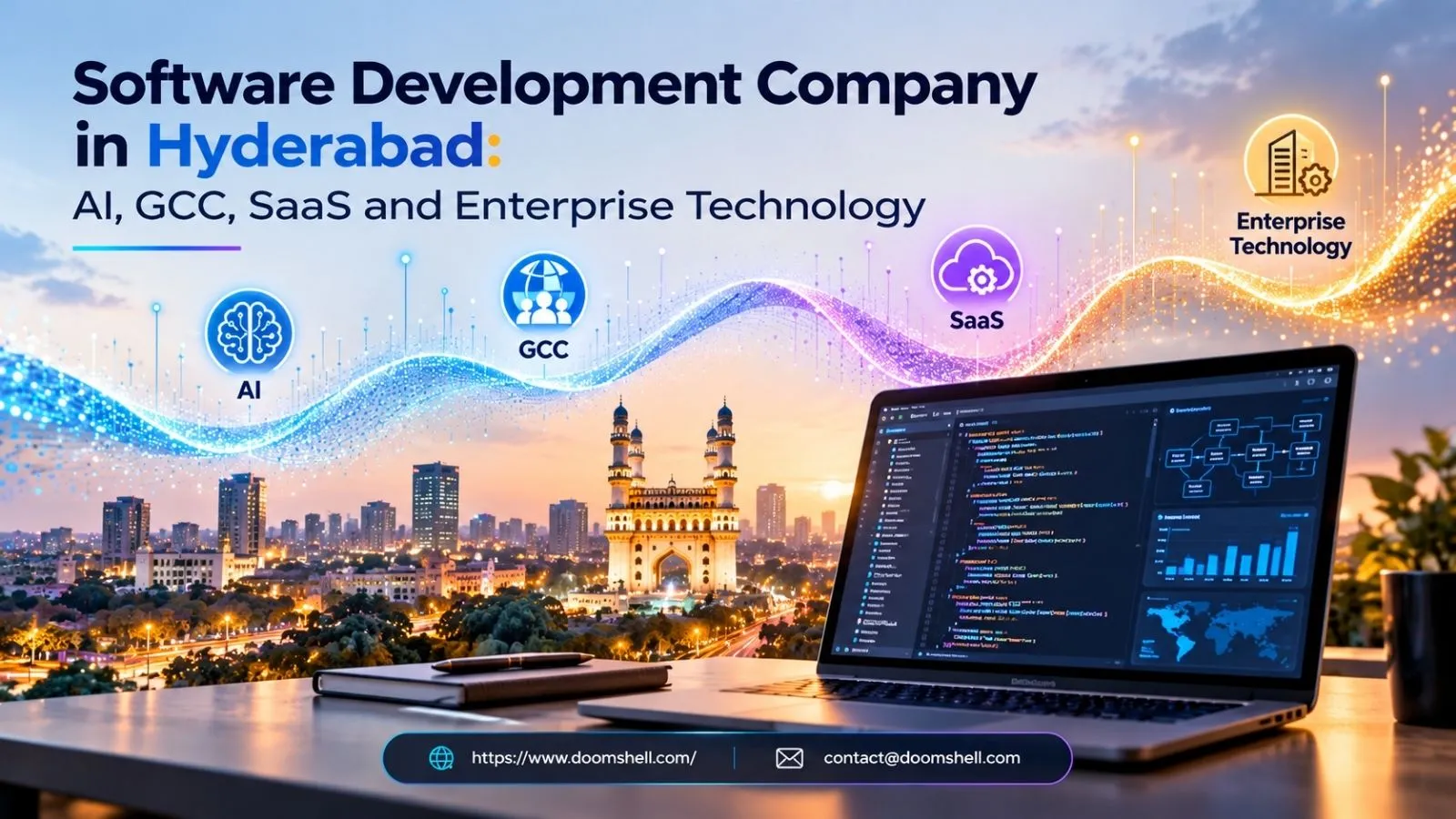
Hyderabad has developed into one of India’s major technology and innovation centres, creating strong demand for a software development company in Hyderabad across enterprise technology, SaaS, fintech, healthcare, life sciences, global capability centres, e-commerce, and emerging AI businesses. Telangana’s technology ecosystem includes dedicated initiatives for AI, IoT, cybersecurity, data analytics, startups, and digital governance, giving Hyderabad a broad base for software-led business growth.
The city’s software requirements are also becoming more sophisticated. Businesses are moving beyond basic websites and applications toward cloud-native platforms, AI-enabled workflows, data products, APIs, cybersecurity systems, automation, customer portals, mobile applications, and software that can connect with physical infrastructure.
Why Choose a Software Development Company in Hyderabad?
Hyderabad combines a mature technology ecosystem with strong enterprise, research, healthcare, pharmaceutical, and startup capabilities. The state’s current technology programmes specifically support areas such as artificial intelligence, IoT, cybersecurity, data analytics, and emerging technologies, while its startup ecosystem provides infrastructure and institutional support for technology entrepreneurs.
This diversity matters when developing software because different industries have very different requirements. A fintech platform may need secure transaction processing and regulatory controls, while a life-sciences company may need research data management, analytics, laboratory workflows, or supply-chain software.
A capable software development company in Hyderabad can bring these requirements together through custom architecture, cloud infrastructure, APIs, analytics, automation, security, and user-focused product design.
Industries Driving Software Development in Hyderabad
1. IT, SaaS and Enterprise Technology
IT and enterprise technology remain central to Hyderabad’s software economy. The city supports a large ecosystem of technology companies, startups, global enterprises, and GCCs that require software for internal operations as well as products serving customers worldwide.
SaaS businesses can use custom development to build subscription platforms, multi-tenant applications, workflow products, analytics dashboards, customer portals, and API ecosystems. Enterprise organisations may require CRM extensions, ERP integrations, employee platforms, procurement systems, knowledge-management applications, and business intelligence tools.
For SaaS companies, architecture needs to account for tenant isolation, scalability, billing, authentication, observability, API management, and continuous deployment. These considerations should be addressed from the beginning rather than added after the product begins acquiring customers.
2. Global Capability Centres and Enterprise Innovation
Hyderabad continues to attract global capability centre activity across technology and other industries. Telangana’s long-term GCC strategy identifies IT, pharmaceuticals, AI, life sciences, and sustainable technology among the areas that can support a more innovation-intensive GCC ecosystem.
Recent developments show how GCC requirements are expanding beyond conventional IT support. L’Oréal announced a Hyderabad beauty-tech GCC that is planned as a global hub for innovation, technology, AI, data, analytics, and supply-chain solutions, with inauguration planned for November 2026.
This creates demand for software platforms that can operate at global scale. GCC technology teams may work on data platforms, enterprise applications, AI systems, automation, cybersecurity, digital commerce, supply-chain software, and internal tools used across multiple countries.
3. Healthcare, Pharmaceuticals and Life Sciences
Hyderabad has a major life-sciences ecosystem, and software is increasingly intertwined with research, healthcare delivery, pharmaceutical operations, and biotechnology. During BioAsia 2026, the Telangana government highlighted new life-sciences investments and GCC expansion in Hyderabad, including AI and data-science activity focused on healthcare and life-sciences analytics.
Software applications in this sector can include hospital management systems, patient portals, appointment platforms, healthcare analytics, laboratory management, clinical workflows, pharmaceutical supply-chain platforms, research databases, and AI-assisted decision-support tools.
Security and data governance are particularly important in healthcare and life sciences. Applications should therefore use appropriate access controls, audit trails, encryption, secure APIs, backup strategies, and carefully designed data-management practices.
How a Software Development Agency in Hyderabad Supports Business Growth
A software development agency in Hyderabad can support organisations at different stages, from early-stage product development to enterprise application modernization. The first step should normally be understanding the business process rather than immediately selecting a programming language or framework.
A structured engagement can include discovery workshops, requirements analysis, UX research, technical architecture, database design, development, testing, deployment, monitoring, and long-term maintenance. For an enterprise, this can also involve integrating legacy applications with newer cloud systems through APIs and middleware.
For startups, the focus may be different. Hyderabad’s startup ecosystem includes T-Hub, T-Works, Telangana Innovation Cell, and other programmes designed to support entrepreneurship, innovation, prototyping, and technology commercialization.
Custom Software Development Service in Hyderabad
A modern software development service in Hyderabad can cover everything from a single business application to an interconnected digital platform. The appropriate scope depends on the organisation’s customers, workflows, technology stack, security requirements, and future growth plans.
Common solutions include:
-
Custom enterprise software
-
SaaS platforms
-
CRM and ERP applications
-
Healthcare and hospital software
-
Pharmaceutical and life-sciences platforms
-
Fintech applications
-
E-commerce systems
-
Logistics and supply-chain software
-
AI-powered business applications
-
Data analytics platforms
-
IoT applications
-
Mobile applications
-
API development and integrations
-
Cloud migration and modernization
-
Workflow automation systems
-
Cybersecurity and identity-management solutions
The objective should not simply be to create more software. A well-designed software development service in Hyderabad should eliminate unnecessary manual work, improve access to information, connect fragmented systems, and create measurable operational value.
Artificial Intelligence Is Reshaping Hyderabad’s Software Ecosystem
AI has become one of the most important technology directions for Hyderabad. Telangana’s AI Framework covers areas including data, skilling, governance, ethics and privacy, research and innovation, adoption, and investment support. It also proposes infrastructure and ecosystem initiatives for AI startups and companies.
For businesses, AI can be integrated into software in several practical ways. Examples include intelligent document processing, customer-support assistants, predictive maintenance, fraud detection, recommendation engines, demand forecasting, enterprise search, workflow automation, and analytics.
The important distinction is between adding an AI feature because it is fashionable and solving a real business problem with AI. Software teams should evaluate data quality, model reliability, security, cost, latency, human oversight, and measurable outcomes before deciding where AI belongs.
Hyderabad’s Emerging AI Data-Centre Infrastructure
One of the most significant technology developments around Hyderabad is the expansion of advanced computing infrastructure. In January 2026, Telangana announced a proposed 100 MW AI data centre at Bharat Future City through a UPC Renewables–Volt Data Centers joint venture, with an announced investment of ₹5,000 crore over five years.
In September 2026, the state also announced a proposed Hypervault AI data-centre campus of 1 GW across more than 250 acres, with an announced investment of about ₹70,000 crore and an estimated 7,000 direct and indirect jobs.
Amazon Web Services also broke ground on a data centre at Bharat Future City in July 2026. The Telangana government described the project as part of a wider digital-infrastructure development strategy for the region.
For software companies, expanding computing infrastructure can have implications beyond data-centre operations. It can support AI workloads, high-performance computing, large-scale analytics, cloud applications, machine learning platforms, and other computationally intensive services.
Cloud-Native Software for Hyderabad Enterprises
Cloud development allows businesses to build applications that can scale with demand and support distributed teams and customers. Hyderabad’s enterprise and SaaS ecosystem makes cloud-native architecture especially relevant for organisations managing large amounts of data or serving users across geographies.
A cloud-native application can use containers, managed databases, serverless components, event-driven services, APIs, automated deployment pipelines, monitoring, and elastic infrastructure. However, architecture should always be selected according to the workload rather than following technology trends blindly.
For established enterprises, cloud modernization may involve gradually moving individual workloads while keeping critical legacy systems operational. API layers, data synchronization, identity management, and integration services can help create a bridge between older infrastructure and newer applications.
Fintech and Financial Technology Software
Hyderabad’s wider technology ecosystem also creates demand for financial applications and enterprise financial technology. Fintech products require strong security, reliable transaction processing, data integrity, authentication, monitoring, and carefully controlled access.
Software development can support digital payments, lending workflows, financial dashboards, expense management, accounting automation, customer onboarding, risk analytics, and business finance platforms. APIs can connect banking, payment, identity, accounting, and reporting systems into unified workflows.
Security should be considered from the architecture stage. Strong authentication, encryption, audit logging, secure API design, monitoring, vulnerability management, and controlled permissions are essential for applications handling financial information.
IoT, Automation and Connected Software
Telangana has maintained dedicated policy support for IoT, including initiatives around IoT devices, software algorithms, hardware-software integration, funding, mentoring, and industry collaboration.
This creates opportunities for Hyderabad businesses to connect physical assets with digital applications. Industrial equipment, healthcare devices, logistics systems, energy infrastructure, and smart facilities can generate data that software platforms collect and analyse.
A connected IoT solution may include edge devices, communication protocols, cloud infrastructure, real-time dashboards, alert systems, analytics, device management, and APIs. The value comes from turning raw sensor data into useful actions rather than simply collecting more information.
Data Analytics and Business Intelligence
Data analytics is another important component of Hyderabad’s software ecosystem. Telangana’s technology policy framework identifies data analytics infrastructure, talent development, private-sector participation, research, innovation, and analytics adoption as priorities.
Businesses can use analytics software to understand sales performance, customer behaviour, supply-chain efficiency, workforce productivity, financial performance, healthcare operations, and product usage.
Modern analytics platforms can combine operational databases, external sources, application events, and IoT information. When properly designed, management dashboards can provide near-real-time visibility instead of relying entirely on manually prepared spreadsheets.
Cybersecurity and Secure Software Architecture
As software becomes more interconnected, security must become part of the development lifecycle. Hyderabad’s technology ecosystem includes a dedicated state cybersecurity policy aimed at strengthening cybersecurity capabilities and supporting product development, testing, and deployment.
For application development, security can involve identity and access management, encryption, secure coding, vulnerability testing, API protection, dependency management, logging, monitoring, backups, and incident-response planning.
Enterprise applications should also use role-based permissions and appropriate segregation of duties. For SaaS products, tenant isolation and secure administrative controls are particularly important because one security issue can potentially affect multiple customers.
Mobile and Customer-Facing Applications
Mobile applications remain an important channel for customers, employees, field teams, and partners. Hyderabad businesses can use mobile software for banking and finance, healthcare, retail, logistics, education, travel, food delivery, field service, and enterprise operations.
A strong mobile application should be designed around the actual user journey rather than simply reproducing a desktop website. Offline functionality, push notifications, secure authentication, device permissions, performance, accessibility, and integration with backend APIs should be considered during architecture planning.
Cross-platform frameworks can be useful when organisations need applications for both Android and iOS while maintaining a common codebase. Native development can still be appropriate where performance, hardware integration, or platform-specific functionality is especially important.
What to Look for in a Software Development Agency
Selecting a software development agency in Hyderabad requires more than comparing hourly rates. Businesses should evaluate technical capability, industry experience, communication practices, architecture quality, security processes, testing standards, and post-launch support.
Important questions include:
-
Does the team understand the business problem?
-
Can it integrate existing systems and third-party APIs?
-
How does it approach security?
-
Can the application scale as users and data increase?
-
How are testing and quality assurance handled?
-
Can the team support cloud deployment and monitoring?
-
Is the source code and technical documentation clearly managed?
-
What support is available after launch?
-
Can AI or analytics capabilities be introduced later?
-
How will performance and reliability be monitored?
These questions are particularly relevant for Hyderabad enterprises and startups because software may eventually become a core part of operations or a product sold to customers.
Current Software Development Trends in Hyderabad
Several technology trends are especially relevant to Hyderabad’s business ecosystem.
AI-native applications: AI is increasingly being embedded directly into business software for search, automation, prediction, recommendation, summarisation, and decision support.
AI infrastructure: New data-centre investments are increasing the region’s relevance for high-performance computing and AI workloads.
GCC engineering platforms: Global capability centres are expanding into AI, analytics, supply chain, product engineering, and global innovation functions. L’Oréal’s planned Hyderabad beauty-tech GCC is one current example.
Life-sciences technology: Healthcare and pharmaceutical organisations are increasingly combining software, analytics, AI, research, and digital operations.
Cloud modernization: Enterprises are replacing fragmented legacy systems with API-connected and cloud-enabled architectures.
Cybersecurity by design: Security is becoming part of application architecture rather than a final-stage compliance exercise.
IoT and edge computing: Connected devices are creating demand for software that can process and respond to operational data closer to where it is generated.
Startup and Innovation Opportunities in Hyderabad
Hyderabad’s startup infrastructure gives technology companies access to incubation, mentoring, prototyping, networking, and innovation programmes. Telangana’s startup policy framework was designed to build an innovation-driven economy using its technology and research talent, while T-Hub and T-Works form important parts of the broader ecosystem.
Government programmes also provide mechanisms for technology startups to participate in public procurement. Telangana’s procurement framework includes provisions designed to encourage innovative startup solutions for government use.
This can create opportunities for startups working on GovTech, HealthTech, AgriTech, cybersecurity, AI, logistics, smart infrastructure, and other technology-driven sectors. For software teams, the opportunity is to build products that are technically scalable while solving specific operational problems.
AEO, GEO and LLM SEO for Hyderabad Software Businesses
Software companies also need to think about how customers discover information through search engines and AI assistants. Traditional keyword optimisation remains useful, but modern digital visibility increasingly depends on clear service descriptions, structured information, technical expertise, FAQs, use cases, and location-specific context.
A Hyderabad software company can create useful content around AI development, SaaS development, GCC engineering, healthcare software, fintech development, cloud migration, IoT development, data analytics, cybersecurity, and enterprise modernization. This gives search engines and AI systems clearer signals about the company’s expertise and the problems it solves.
For AEO and GEO, answers should be direct and factually useful. Pages should explain what the service does, who needs it, what technologies may be involved, typical project stages, security considerations, and how the solution can be adapted to different industries.
Choosing the Right Software Development Service in Hyderabad
The right software development service in Hyderabad should begin with a clearly defined business objective. Technology selection should follow the requirement, not the other way around.
For example, a startup may need a fast MVP and scalable SaaS architecture, while a pharmaceutical company may require secure data workflows and analytics. A GCC may need enterprise integrations and global deployment, while a retailer may prioritise e-commerce, inventory, customer engagement, and mobile experiences.
A practical development roadmap usually includes discovery, requirements, UX/UI design, architecture, development, quality assurance, deployment, monitoring, and continuous improvement. Breaking the project into measurable phases can make complex software initiatives easier to manage and validate.
The Future of Software Development in Hyderabad
Hyderabad’s software ecosystem is moving toward a combination of AI, cloud, data, enterprise engineering, life sciences, GCC innovation, and advanced computing infrastructure. The expansion of AI data-centre capacity and the continued development of Future City indicate that digital infrastructure will remain an important part of the region’s technology story.
For businesses, this means software development is increasingly about creating connected digital systems rather than standalone applications. The strongest solutions can combine business processes, APIs, data platforms, AI, cloud infrastructure, security, mobile experiences, and analytics into one coherent technology strategy.
For organisations searching for a software development company in Hyderabad, the central consideration is therefore not simply whether a team can write software. It is whether the team can understand the industry, design a scalable architecture, integrate existing systems, protect business data, and continuously improve the product as requirements evolve.
Hyderabad’s combination of enterprise technology, startups, GCCs, life sciences, AI initiatives, and digital infrastructure provides a strong environment for building sophisticated software products. Businesses that approach development as a long-term digital capability can use these technologies to improve operational efficiency, customer experiences, data visibility, and product innovation.
Doomshell is a Jaipur-based technology company focused on practical digital solutions for businesses that need scalable software, web platforms, automation, and modern technology products. Its approach can help organisations translate complex business requirements into structured digital experiences.
For businesses evaluating software opportunities in Hyderabad or other technology hubs, local industry context remains an important part of choosing the right development strategy. Doomshell can support organisations looking to turn those requirements into secure, user-focused, and growth-ready technology solutions.