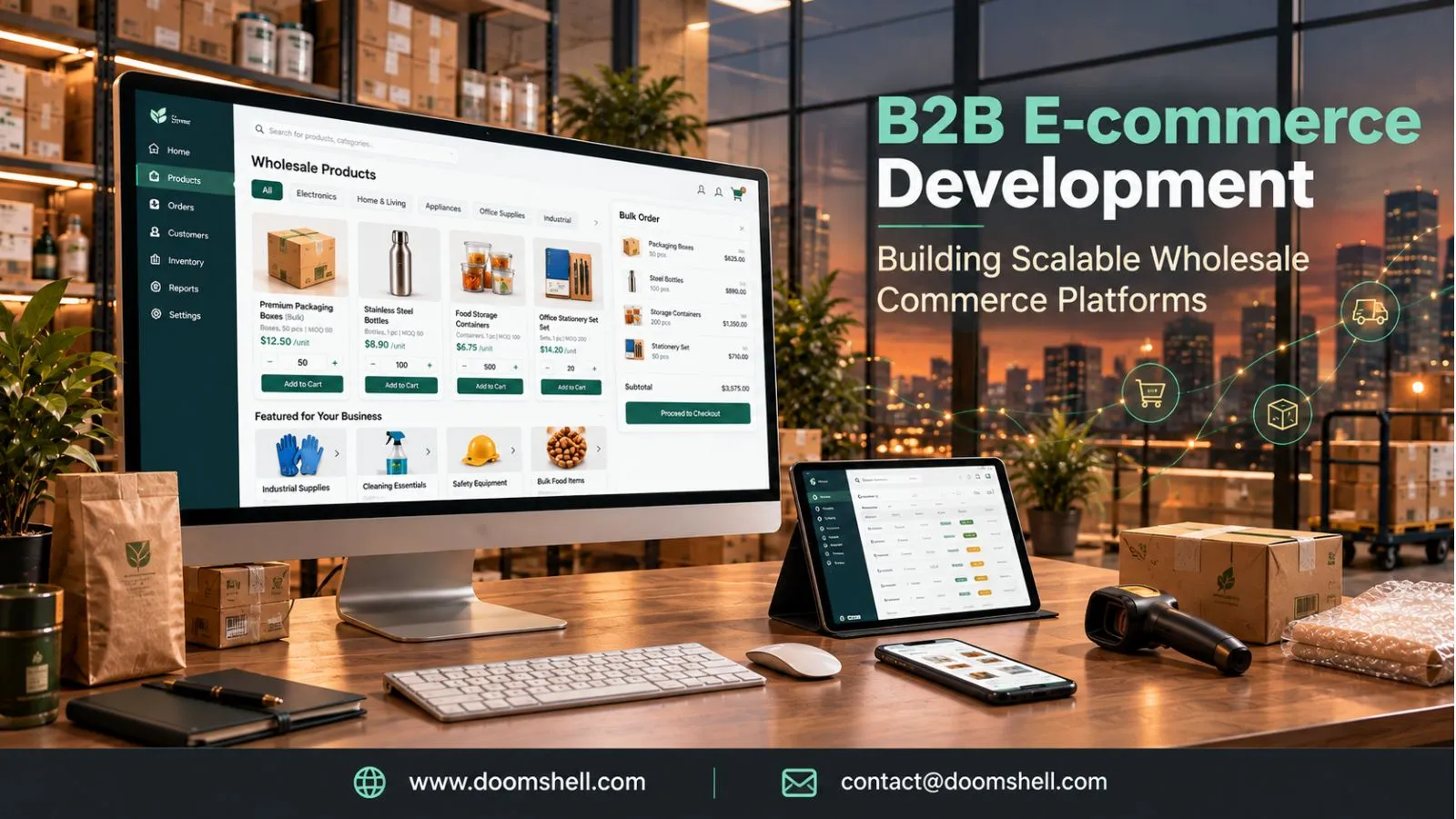
B2B e-commerce development is changing as wholesalers and manufacturers expect the same speed and convenience from digital purchasing that consumers already experience. However, B2B transactions involve company accounts, multiple buyers, negotiated prices, bulk orders, approval rules, and business-specific catalogs. A scalable commerce platform must support these requirements without making the purchasing journey unnecessarily complicated.
Magento can provide a strong foundation for building customized B2B commerce experiences. Its flexibility allows businesses to extend standard commerce functionality around their customers, products, pricing, and operational workflows.
Building B2B Commerce Platforms With Magento
Magento, now part of Adobe Commerce, can support B2B businesses that need a highly customized commerce environment.
Instead of treating every customer as an individual shopper, a B2B platform can organize customers around companies and purchasing relationships. This creates a foundation for account-level pricing, permissions, catalogs, payment terms, and order management.
Custom development becomes particularly useful when standard commerce functionality does not match existing wholesale processes. Businesses can create tailored workflows while keeping the core commerce architecture scalable.
For growing organizations, the platform should also be designed around API-first integrations, reusable components, and clear separation between commerce logic and external business systems.
Creating Company Accounts and Buyer Roles
A B2B customer account can represent an entire organization rather than one person.
Different employees may need different permissions. For example, a purchasing employee may create an order, while a manager approves it and an administrator manages users and company information.
A well-designed platform can support role-based purchasing workflows such as:
-
Buyer access
-
Purchasing approval
-
Account administration
-
Order review
-
Budget control
-
Multi-user company accounts
This reduces the need to manage B2B purchases through email, spreadsheets, or phone calls.
Developing Custom Catalogs for Wholesale Customers
Wholesale customers rarely need access to every product or the same product information.
A distributor may see one catalog, while a manufacturer sees another. Some customers may purchase specific product ranges based on contracts, geography, industry, or purchasing history.
Custom catalogs can therefore create more relevant buying experiences.
Product visibility, descriptions, minimum quantities, packaging information, and availability can be adapted to specific customer groups. This can make large catalogs easier to navigate while reducing confusion during repeat purchases.
Managing Complex B2B Pricing and Orders
B2B pricing rarely follows a simple retail model. Customers may receive contract prices, volume discounts, customer-group pricing, negotiated rates, or special terms.
The commerce platform needs to handle this complexity without creating a difficult purchasing experience.
Implementing Customer-Specific Pricing With Magento
Customer-specific pricing allows a B2B store to display prices based on the buyer's commercial relationship.
For example, two businesses purchasing the same product may have different negotiated prices. A platform can use customer groups, contracts, quantity rules, or custom pricing logic to present the appropriate value.
The key is consistency. Pricing shown on product pages, carts, checkout, quotations, and connected business systems should follow the same rules.
For larger organizations, pricing logic should also be designed carefully so that frequent changes do not require extensive manual development.
Building Bulk Ordering Workflows
Wholesale buyers often order dozens or hundreds of products at once. Searching for every item individually can make the process slow.
Bulk-order functionality can allow buyers to enter SKUs, upload product lists, select quantities, or reorder previous purchases.
A useful bulk ordering workflow should support:
-
Product identification
-
Quantity entry
-
Availability validation
-
Pricing calculation
-
Cart creation
-
Order review
-
Approval or checkout
This is especially valuable for customers who repeatedly purchase the same inventory.
Managing Quote and Approval Processes
Many B2B transactions begin with a quotation rather than immediate checkout.
A customer may request special pricing, negotiate quantities, or require internal approval before placing an order.
A customized workflow can connect quotation requests with customer accounts, sales teams, pricing rules, and approval stages.
Instead of handling these steps manually through separate communication channels, businesses can create a centralized process where buyers can track quotes and convert approved quotations into orders.
Automating Wholesale Operations
Automation is becoming a major part of modern B2B commerce. Businesses can use workflow automation to reduce repetitive tasks and give buyers faster access to frequently used functions.
The objective is not to automate every decision. It is to automate predictable processes while keeping human control where commercial judgment is required.
Automating Reordering With Magento
Repeat purchases are common in wholesale commerce.
A customer may order the same materials every week or replenish stock whenever inventory reaches a certain threshold.
A reordering system can use previous order data to help buyers quickly recreate purchasing lists. Businesses can also develop scheduled or rule-based workflows for recurring orders where appropriate.
Useful features include:
-
Previous order history
-
One-click reorder
-
Saved shopping lists
-
Frequently purchased products
-
Recurring order workflows
-
Quantity suggestions
These features can shorten the purchasing cycle and reduce repetitive data entry.
Creating Custom Inventory Management Workflows
Inventory visibility is critical when customers purchase products in large quantities.
A B2B platform may need to synchronize stock information across warehouses, fulfillment locations, and external inventory systems.
Custom workflows can help manage stock reservations, backorders, minimum order quantities, warehouse availability, and product lead times.
Real-time or near-real-time inventory synchronization can also reduce the risk of customers ordering products that are no longer available.
Developing B2B Order Management Features
B2B order management often requires more flexibility than standard consumer checkout.
Customers may need to modify orders, repeat purchases, split shipments, view invoices, track deliveries, or manage multiple addresses.
A centralized order management layer can connect these activities across commerce and operational systems.
This gives buyers a single place to understand their purchasing activity while giving internal teams better visibility into order status.
Integrating Enterprise Commerce Systems
A B2B commerce platform rarely operates independently. It usually needs to exchange information with ERP, CRM, inventory, accounting, warehouse, payment, and logistics systems.
This is where integration architecture becomes critical.
Connecting Magento With ERP Systems
ERP integration can synchronize essential business information between commerce and back-office operations.
Depending on the business, this may include:
-
Product information
-
Customer records
-
Pricing
-
Inventory
-
Orders
-
Invoices
-
Shipping information
-
Payment status
A well-designed integration should account for data ownership, synchronization frequency, error handling, retries, and duplicate records.
Instead of creating a tightly coupled system, API-based integration can provide greater flexibility as business requirements change.
Integrating CRM and Inventory Platforms
CRM data can provide valuable context about customer relationships, while inventory systems provide operational information about product availability.
Connecting these systems with the commerce platform can help create a more complete view of the B2B customer journey.
For example, sales teams can understand online purchasing activity while buyers can receive accurate product and account information without repeatedly contacting support teams.
Building Custom Magento APIs for Business Integrations
APIs are central to scalable B2B commerce architecture.
Custom Magento APIs can allow external applications to exchange customer, product, order, pricing, and inventory information without relying on manual data transfers.
Modern API development should also consider authentication, authorization, rate limits, logging, validation, versioning, and failure handling.
This becomes particularly important when a business adds new sales channels, mobile applications, partner portals, marketplaces, or internal tools.
A flexible API layer allows these systems to communicate with the commerce platform without rebuilding the entire application each time.
Building B2B Commerce for Long-Term Scale
Modern wholesale commerce is moving toward connected, automated, and highly personalized purchasing experiences. A successful B2B platform must therefore balance customer convenience with complex business rules.
Magento can provide the commerce foundation, while custom development can address company accounts, buyer permissions, pricing, catalogs, bulk ordering, quotations, inventory workflows, and enterprise integrations.
The most scalable approach is to design these capabilities as part of one connected architecture rather than adding isolated features as problems appear. With strong API design, reliable data synchronization, automation, and customer-specific experiences, B2B businesses can build commerce platforms that support today's purchasing requirements while remaining adaptable as operations grow.